
Win Enterprise Accounts with Live Insights: Opportunity & Risk Detection in Executive Sales Meetings
Closing enterprise accounts rarely hinges on a single slide or one perfect demo. It comes down to reading signals, surfacing risks early, and responding with confidence in the moment—especially in executive-level conversations where stakes, timelines, and politics are magnified.
This guide explains how enterprise sales teams and strategic account executives can use live meeting intelligence to detect opportunities and risks in real time. It pairs practical tactics with examples and explains how modern meeting assistants—particularly tools that go beyond recording and summarizing—help sellers perform better during meetings, not just remember them afterward. For a real-world solution built specifically for live support, see https://olva.ai.
Why executive sales meetings demand live intelligence
Executive meetings are fast, high-context, and often pivot on a single insight or objection. Challenges include:
- Multiple decision-makers with different priorities and unspoken objections.
- Rapid exchanges that make it easy to miss buying signals or worrisome comments.
- Technical or contractual questions that require instant, documented answers.
- Limited time to repair misalignment before the conversation moves on.
Traditional meeting tools (recordings, transcripts, and end-of-meeting summaries) are valuable for postmortem analysis, but they don't help you recover a missed signal or craft a better answer in the moment. What teams need is live insight—continuous analysis that surfaces risks, uncovers opportunities, suggests responses, and helps shape the conversation as it happens.
What live insights actually do for enterprise sellers
Live insights change three things during a meeting:
- Detection: Identify buying signals, objections, and opportunity indicators as they occur.
- Guidance: Suggest follow-ups, objection-handling phrases, and tactical next steps in real time.
- Verification: Fact-check claims, reference contracts or product docs, and validate pricing or feature commitments instantly.
When applied in executive meetings, these capabilities reduce uncertainty, accelerate decision cycles, and increase the likelihood of favorable outcomes.
Common pitfalls without live intelligence (and how to avoid them)
Pitfall: You miss a subtle buying signal (an offhand comment about budgeting or a timeline) and only discover it afterward.
Avoidance: Real-time opportunity detection flags buying cues—like “we’re evaluating next quarter” or “we need a vendor with SOC 2”—so you can probe immediately.
Pitfall: A technical stakeholder asks a detailed question and you spend minutes hunting for the correct contract clause or spec.
Avoidance: Document-aware intelligence pulls relevant clauses and specs instantly, so you answer with authority.
Pitfall: Different execs have conflicting priorities and you fail to reconcile them before the meeting ends.
Avoidance: Live insights summarize competing priorities and recommend clarifying questions to align stakeholders while you still have them in the room.
How live opportunity detection works in practice
Opportunity detection is more than flagging phrases. It uses meeting context, speaker intent, historical interactions, and uploaded documents to surface meaningful chances to advance the deal.
Practical example 1 — Expansion signal:
- CFO: “If this integrates with our existing billing, we could roll it out more broadly.”
- Live insight: Flags an expansion signal, suggests follow-up: “Which billing systems do you currently use?” and prompts the AE with a tailored value statement about integration speed and ROI.
Practical example 2 — Timeline urgency:
- VP Product: “We need this ready before our Q4 launch.”
- Live insight: Identifies an accelerated timeline, suggests asking about decision owners and procurement timelines, and surfaces relevant SLA/implementation docs.
In both cases, timely detection allows sellers to convert a passive comment into a tactical next step and prevents the meeting from ending without a clear forward motion.
Detecting and mitigating risks in executive conversations
Risk detection focuses on uncovering threats that could derail a deal: procurement issues, legal red flags, technical constraints, competitive threats, or lack of executive sponsorship.
Practical example — Contract risk:
- Legal: “We'll need indemnification language in Section 10.”
- Live insight: Identifies this as a legal risk, pulls the relevant contract template, and provides suggested alternative language or escalation steps (e.g., “Offer a limited indemnity with cap tied to subscription fees”). The seller can respond immediately or note the official follow-up.
Practical example — Competitive risk:
- Procurement: “We’re also talking to Vendor X and they offer native single sign-on.”
- Live insight: Highlights competitive threat, surfaces a comparison brief or product doc, and suggests a positioning line: “Here’s how our approach reduces integration time by X% while maintaining SSO security.”
The difference between surfacing these risks in real time versus learning them from a transcript later can be the difference between closing the deal and losing it.
Live Q&A and AI coaching: reasoned, private, and immediate
In executive meetings, the right words matter. Live Q&A lets sellers privately ask the assistant for phrasing, summaries, or clarifications without interrupting the conversation or appearing unprepared.
Example prompts sellers might use in a private live Q&A:
- "How should I reframe our ROI for a CFO focused on cost containment?"
- "Summarize the last five minutes—who's aligned and who is not?"
- "What follow-up should I propose to the procurement team to avoid legal delays?"
An AI coach can suggest specific wording (e.g., “Given the CFO’s concern, try: ‘By consolidating these subscriptions, your team could reduce vendor overhead by X% over 12 months’”), and help the seller pivot confidently in the conversation.
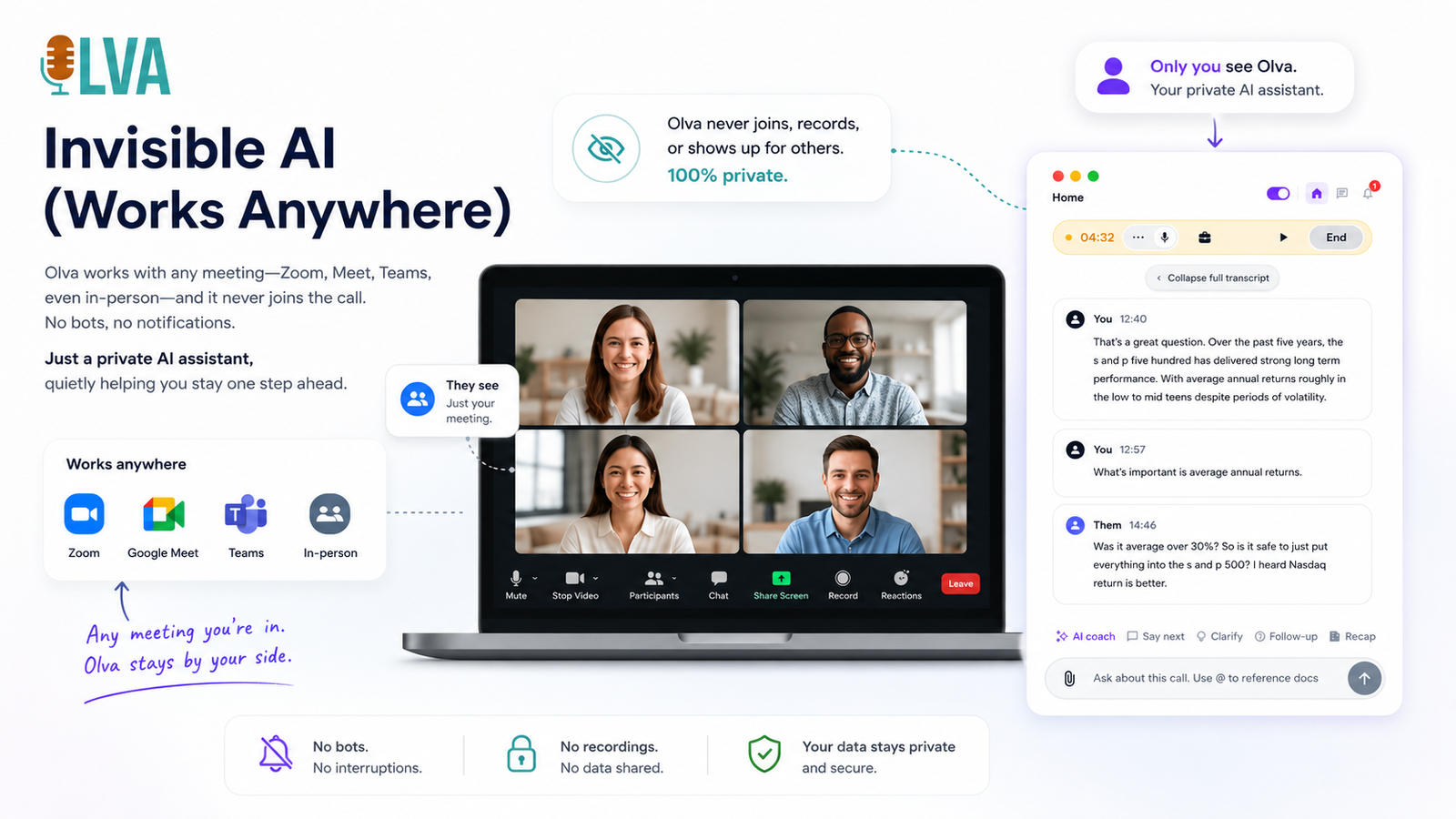
Importantly, this coaching is private and invisible—that means no meeting bots or visible participants, preserving the meeting’s dynamics while giving sellers a discreet advantage.
Document-aware answers: ground responses in facts
Executive conversations often reference contracts, financials, product specs, or prior proposal documents. Document-aware intelligence ingests those files and uses them to produce precise, context-aware answers during the meeting.
Scenario:
- VP Engineering asks about throughput limits in a particular product spec.
- Instead of giving a potentially risky off-the-cuff answer, the salesperson uses the live assistant to pull the spec section and respond accurately.
This reduces the chance of misstatements, builds trust, and speeds negotiation by reducing the need for follow-up clarifications.
Fact checking in the moment
Executives test facts. When someone challenges a metric or a capability, an immediate verification is invaluable.
Example:
- Executive: “Your competitor claims they have a 99.99% uptime SLA.”
- Live insight: Pulls public SLA language or previously uploaded competitor benchmarks and flags whether that claim is accurate. It can then suggest a diplomatic response or a request to verify with procurement later.
Fact checking prevents sellers from committing to statements that are later disproven and helps maintain credibility in front of senior stakeholders.
How this complements (and differs from) other meeting tools
Many tools—such as conversation intelligence platforms and transcription services—do excellent work capturing voice data, transcribing meetings, and providing post-meeting analytics. They’re invaluable for coaching and pipeline analysis after the fact.
Where typical tools excel:
- High-quality transcription and call recording
- Post-meeting summaries and analytics
- Sales coaching derived from historical trends
Where live intelligence adds distinct value:
- Real-time detection of buying signals and risks
- Instant, context-aware answers grounded in uploaded documents and meeting context
- Private AI coaching and suggested responses during the meeting
- Invisible operation (no bot participants or interruptions), preserving meeting dynamics and privacy
A fair approach is to treat conversation intelligence as complementary: use recordings and analytics to inform long-term coaching and pipeline health, and use live meeting intelligence to perform better during the meetings that matter most.
Practical playbook: using live insights in five steps
- Prepare: Upload relevant documents (contracts, SOWs, product specs) and add context to the deal record before the meeting.
- Monitor: Let the live assistant run invisibly in the background; it will transcribe and analyze the conversation in real time.
- Detect: Watch for alerts on buying signals, timeline changes, legal flags, and competitive mentions.
- Act: Use private live Q&A and suggested responses to ask the right clarifying questions, anchor commitments, or propose next steps.
- Record: After the meeting, review the post-meeting memory—decisions, open questions, action owners—and use it to update CRM and next-step plans.
This workflow preserves meeting flow while ensuring no signals are missed and follow-ups are precise and timely.
Real-world example: saving a deal during an executive briefing
Situation: An AE is in an executive briefing with a potential customer. Halfway through, the CIO says, “We can’t introduce anything that requires custom SAML work—it’ll take months.”
Without live insight: The AE notes it mentally, forgets to probe, and later learns procurement rejected the solution due to integration risk.
With live insight: The assistant flags the SAML concern as a technical risk, pulls the implementation note from the product spec, and privately suggests a response: “We support SAML via a standard connector that our professional services team can configure within 3–4 weeks for enterprise customers—would rapid implementation be acceptable if we committed to that timeline?”
Result: The AE asks the clarifying question, secures alignment on acceptable timelines, and converts an objection into a concrete implementation path.
Privacy and enterprise readiness
High-stakes meetings require discretion. Live meeting tools should prioritize privacy and security: no visible bot participants, user-controlled transcripts, and the ability to delete transcripts as needed. Enterprise sales teams should confirm that any meeting assistant they use aligns with internal compliance rules and data policies.
For teams evaluating solutions, look for: invisible operation, configurable data retention, document access controls, and enterprise-grade encryption.
Conclusion: win more enterprise deals by thinking during the meeting
Enterprise sales success often depends on what you do in the room—not just what you review afterward. Live insights and instant, document-aware answers give sales teams the ability to detect opportunities, mitigate risks, and respond with confidence during executive meetings.
Pair post-meeting analysis with real-time intelligence to create a complete, deal-focused workflow: use recordings and analytics to refine long-term strategy, and use live assistance to perform better in the moments that decide deals.
To explore live meeting intelligence built for executive-grade conversations, see how modern solutions apply these principles at https://olva.ai.
Key takeaways:
- Live insights detect buying signals and risks as they happen.
- Document-aware answers and fact checking let sellers respond accurately and confidently.
- Private AI coaching and live Q&A help sellers choose the right wording without interrupting the meeting.
- Combining live intelligence with post-meeting memory creates a powerful end-to-end playbook for winning enterprise accounts.