Turn Product Discovery Meetings into Faster Decisions: Live Insights & AI Coaching for Product Managers
Product discovery meetings are where product direction is born — but all too often they become delayed decisions, fragmented notes, and next-step ambiguity. As a product manager, you need meetings that produce alignment and decisions in the moment, not transcripts to sift through afterward.
This article shows how modern meeting intelligence — specifically live insights, opportunity detection, and AI coaching — helps product teams move from conversation to decision faster. We’ll cover real-world scenarios, practical workflows, and how an invisible, real-time assistant can transform discovery rituals so you leave meetings with clarity and actionable commitments.
(If you want to explore a purpose-built tool that does this live, see https://olva.ai for an example of how these capabilities work in practice.)
Why product discovery meetings stall
Before jumping to solutions, it helps to diagnose the common causes of slow decision-making during discovery:
- Information gaps: key specs, user research, or analytics aren’t immediately available.
- Unanswered questions: technical or stakeholder questions surface and remain unresolved.
- Cognitive overload: PMs juggle facilitation, note-taking, and real-time synthesis.
- Misaligned language: domain terms, acronyms, or customer quotes are misunderstood.
- Follow-up dependency: decisions are deferred to later because someone needs to check a doc or stakeholder.
These problems don’t disappear with better agendas alone. They require real-time intelligence that reduces friction during the meeting itself — surfacing relevant data, answering questions immediately, and coaching the PM through the conversation.
What real-time meeting intelligence looks like for product managers
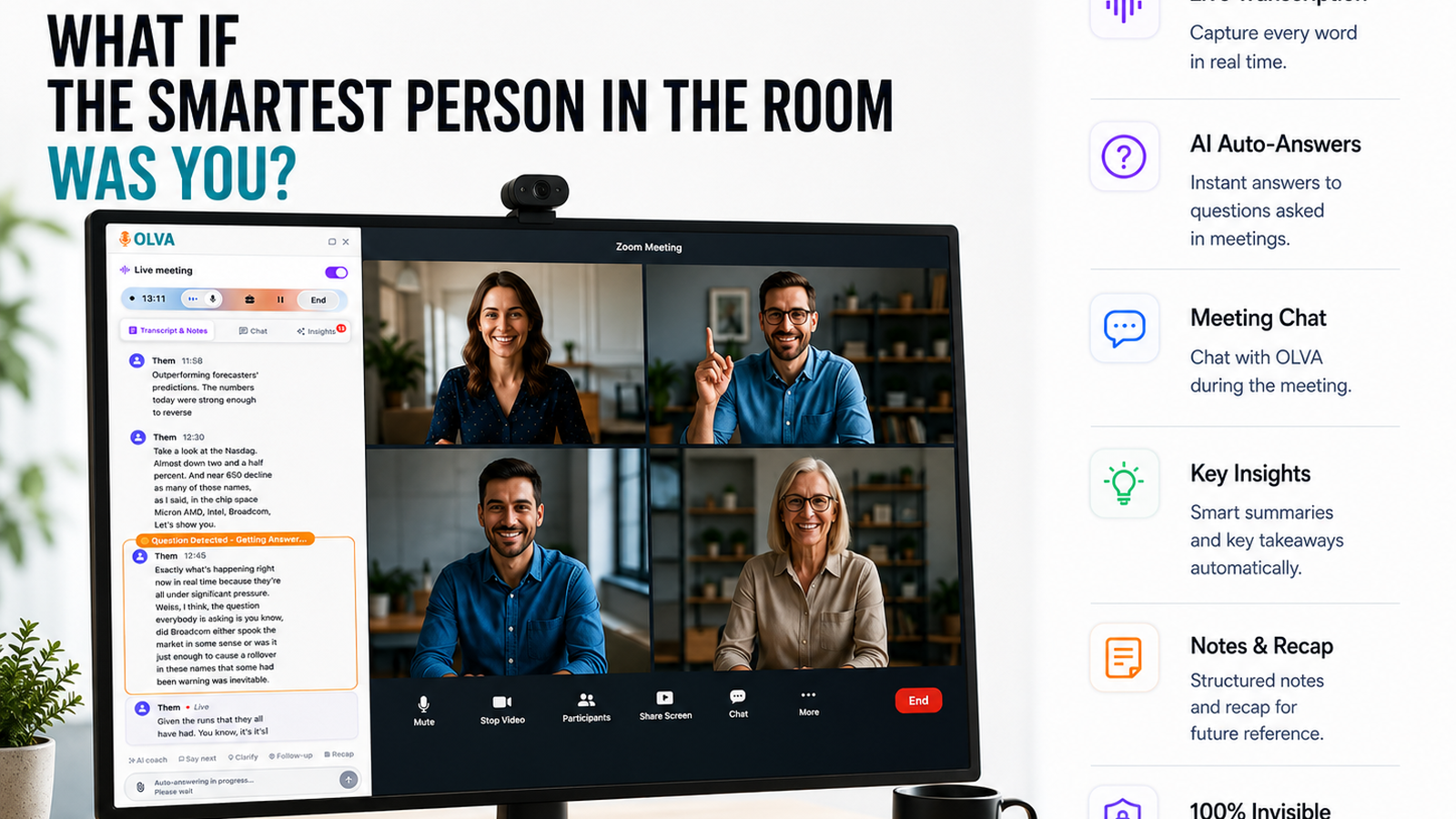
Real-time meeting intelligence is more than transcription or recording. It’s a set of capabilities that actively support decision-making while the conversation is happening:
- Live transcription: accurate, real-time capture of the conversation so nothing is missed while you facilitate.
- Automatic question detection: the system detects when a question or objection arises — technical, product, or pricing-related — and flags it instantly.
- Instant answers using context: answers sourced from uploaded documents (specs, roadmaps, research), prior meeting memory, and optional external references, delivered while the conversation unfolds.
- Live insights and opportunity detection: the assistant identifies signals such as expressed pain points, interest in features, or hidden risks and surfaces them as they appear.
- AI coaching and suggested responses: private, tactical guidance on what to ask or say next — phrased for the moment and tailored to the meeting’s goals.
When these capabilities are combined, meetings change from passive memory-capture sessions into active decision-making forums.
Practical scenarios: how live insights speed decisions
Below are four common discovery scenarios and how live intelligence changes the outcome.
Scenario 1 — Early customer discovery interview
Problem: A customer mentions multiple pain points and hints at willingness to pay, but the note-taking PM struggles to capture signals and prioritize follow-ups.
How live intelligence helps:
- Automatic question detection highlights the customer’s questions and objections as they happen.
- Opportunity detection surfaces buying signals (phrases like “we’d pay for that” or “this would save us X hours”) and logs them as potential experiments.
- Instant answers pull relevant product details (from uploaded docs) to clarify capability and avoid over-promising.
- AI coaching suggests follow-up questions to validate the signal (e.g., “How much would you estimate you’d pay monthly?”), helping the PM close the loop within the same call.
Result: The PM leaves the call with validated buying signals, a prioritized experiment to run, and fewer ambiguous follow-ups.
Scenario 2 — Cross-functional feasibility sync with engineering
Problem: Engineers raise technical constraints mid-meeting that derail prioritization; the PM must pause the meeting to consult specs or stakeholders.
How live intelligence helps:
- Live transcription captures the negotiations in real time so no detail is lost while the team discusses trade-offs.
- Document-aware intelligence retrieves the latest technical spec or architecture notes instantly.
- Fact checking verifies whether a claimed constraint is in the current spec or a legacy note.
- AI coaching suggests alternative scoping options or trade-offs the PM can propose immediately (e.g., “We can ship a v1 with feature X limited to Y to reduce backend complexity”).
Result: Decisions on scope and rollout approach happen within the meeting, reducing follow-up cycles and accelerating the roadmap timeline.
Scenario 3 — Prioritization workshop with stakeholders
Problem: Stakeholder opinions dominate, and qualitative arguments overshadow data and customer evidence.
How live intelligence helps:
- Opportunity detection highlights statements that indicate customer impact or revenue potential, helping quantify qualitative claims.
- Live insights surface relevant metrics or previous user interviews that support or contradict stakeholder assertions.
- AI coaching helps the PM frame trade-off questions to drive consensus (e.g., “If we choose A over B, what customer segment benefits most?”).
Result: Prioritization becomes evidence-driven and less reactive to loud voices in the room.
Scenario 4 — Hand-off to go-to-market and customer success
Problem: Important decisions and commitments are lost between teams after discovery meetings.
How live intelligence helps:
- Post-meeting memory creates searchable meeting records, action items, and open questions tied to the decisions made live.
- The invisible assistant ensures sensitive information remains private while delivering structured outputs for downstream teams.
Result: Faster, cleaner handoffs and fewer misunderstandings during execution.
How to structure discovery meetings for live decision-making
To get the most from live meeting intelligence, adjust your meeting workflow slightly:
- Prepare: Upload relevant documents (roadmap, specs, user research) so the assistant can reference them live.
- Define goals: State the decision(s) you want by the end of the meeting — this helps the assistant prioritize what to surface.
- Use live Q&A: Ask the assistant privately for clarifications, suggested phrasing, or quick summaries while facilitating.
- Accept suggested follow-ups: When opportunity detection flags a buying signal or risk, act on the suggested validation question immediately.
- Close with commitments: Have the assistant generate a short list of action items, owners, and open questions before the meeting ends.
These steps shift meetings from exploratory conversations to structured decision checkpoints.
Competitor landscape: what other tools do well — and where live intelligence matters
Many meeting tools today are strong at transcription, recording, and post-meeting summaries. Platforms like Otter, Fireflies, and meeting-add-ons in CRMs record conversations and produce searchable transcripts and highlights — valuable capabilities for auditability and downstream work.
However, their common limitation is timing: they primarily help you remember what happened, not influence what happens. They rarely offer:
- Invisible, private in-meeting coaching that doesn’t join the call as a visible bot.
- Automatic detection of customer signals and objections tied to instant recommended responses.
- Document-aware instant answers that use your uploaded specs and past meeting memory to answer questions during the conversation.
That’s where real-time assistants focused on live intelligence provide additional value. They don’t replace transcription or summaries; they add a live layer that helps you make better decisions in the meeting itself.
Privacy and meeting etiquette: invisible assistance that respects confidentiality
Product discovery often involves sensitive competitive insights or customer details. An effective live assistant should be private by design:
- No visible bot participants or awkward notifications during meetings.
- Transcripts and memory visible only to the user or their workspace with clear deletion controls.
- Document-aware answers restricted to the uploaded files and governed by access controls.
An invisible assistant preserves meeting flow while delivering support — helping PMs and cross-functional partners focus on decisions, not administration.
Measurable impact: KPIs product teams should track
Implementing live meeting intelligence should move the needle on concrete metrics. Track these to measure impact:
- Time-to-decision: reduce the average time between first discovery and a roadmap decision.
- Meeting count per decision: fewer meetings needed to reach the same decision.
- Follow-up volume: fewer asynchronous follow-ups and fewer “I thought you said...” incidents.
- Cycle time for experiments: faster rollout from idea to test launch due to clearer action items.
- Stakeholder satisfaction: qualitative feedback on clarity and alignment after discovery meetings.
Teams that adopt live insights often see faster roadmap cycles, clearer prioritization, and more reliable handoffs.
Implementation tips and prompts for PMs
- Pre-load key artifacts: roadmap snapshots, current specs, analytics dashboards, and representative user interviews.
- Use prompts like:
- “Summarize the last 5 minutes and list open questions.”
- “Is anyone expressing willingness to pay? Highlight exact phrasing.”
- “What technical constraints were mentioned and where do they conflict with the spec?”
- “Suggest three follow-up questions to validate this customer’s priority.”
- Keep coaching private: use the assistant’s private channel to avoid influencing the conversation unnaturally.
- Close the loop: before ending a meeting, ask the assistant to generate 3–5 action items with owners and due dates.
Conclusion
Discovery meetings should be decision engines, not memory-storage sessions. Live insights, opportunity detection, and AI coaching change the equation: they surface what matters, answer questions when they appear, and guide facilitation toward commitments made in the moment. For product managers, that means faster prioritization, fewer follow-ups, and cleaner handoffs to engineering and GTM partners.
If you’re ready to shift discovery from delayed decisions to live outcomes, look for meeting intelligence that works invisibly, references your documents, and helps you respond in real time. For an example of a purpose-built solution that emphasizes live assistance and privacy while providing these capabilities, see https://olva.ai.
When product discovery meetings help you decide, the roadmap stops being a backlog of ideas and starts becoming a plan of action.