Scale cross-team coordination with invisible AI and post-meeting memory
Cross-team programs are messy by design: shifting priorities, competing dependencies, dozens of stakeholders, and a steady stream of ad hoc questions that derail meetings. Program managers are expected to hold the system together — keep timelines intact, escalate issues early, and ensure decisions are captured and executed.
Traditional meeting tools help you remember what happened. That’s useful, but it’s not enough. To scale coordination across product, engineering, design, marketing and customer success, you need tools that help you act while conversations are happening and make that context reusable afterward.
This article explains why real-time meeting intelligence — particularly an invisible AI assistant combined with a searchable post-meeting memory — is a practical, scalable way for program managers to reduce friction, accelerate decisions and improve delivery predictability.
You’ll get:
- A clear view of cross-team coordination pain points
- Practical examples of how live assistance changes meeting outcomes
- A comparison to traditional meeting tools and where real-time intelligence adds value
- Implementation tips and metrics to track for fast impact
If you want to explore a solution built for this approach, see https://olva.ai.
The coordination problem: why meetings don’t scale
Program managers spend most of their time managing information flow, not people. Typical symptoms include:
- Long meetings with vague outcomes and action items that aren’t assigned or followed up on
- Repeated clarification requests across teams because decisions weren’t captured or context wasn’t shared
- Missed dependencies (e.g., an API change scheduled without notifying dependent teams)
- Decisions lost in chat threads or buried in lengthy recordings and transcripts
Most meeting platforms focus on post-meeting artifacts: recordings, transcripts, and summaries. Those are necessary, but they address only one side of the problem: memory. What’s missing is the ability to surface context and guidance while the conversation is still active.
How invisible AI during meetings changes the game
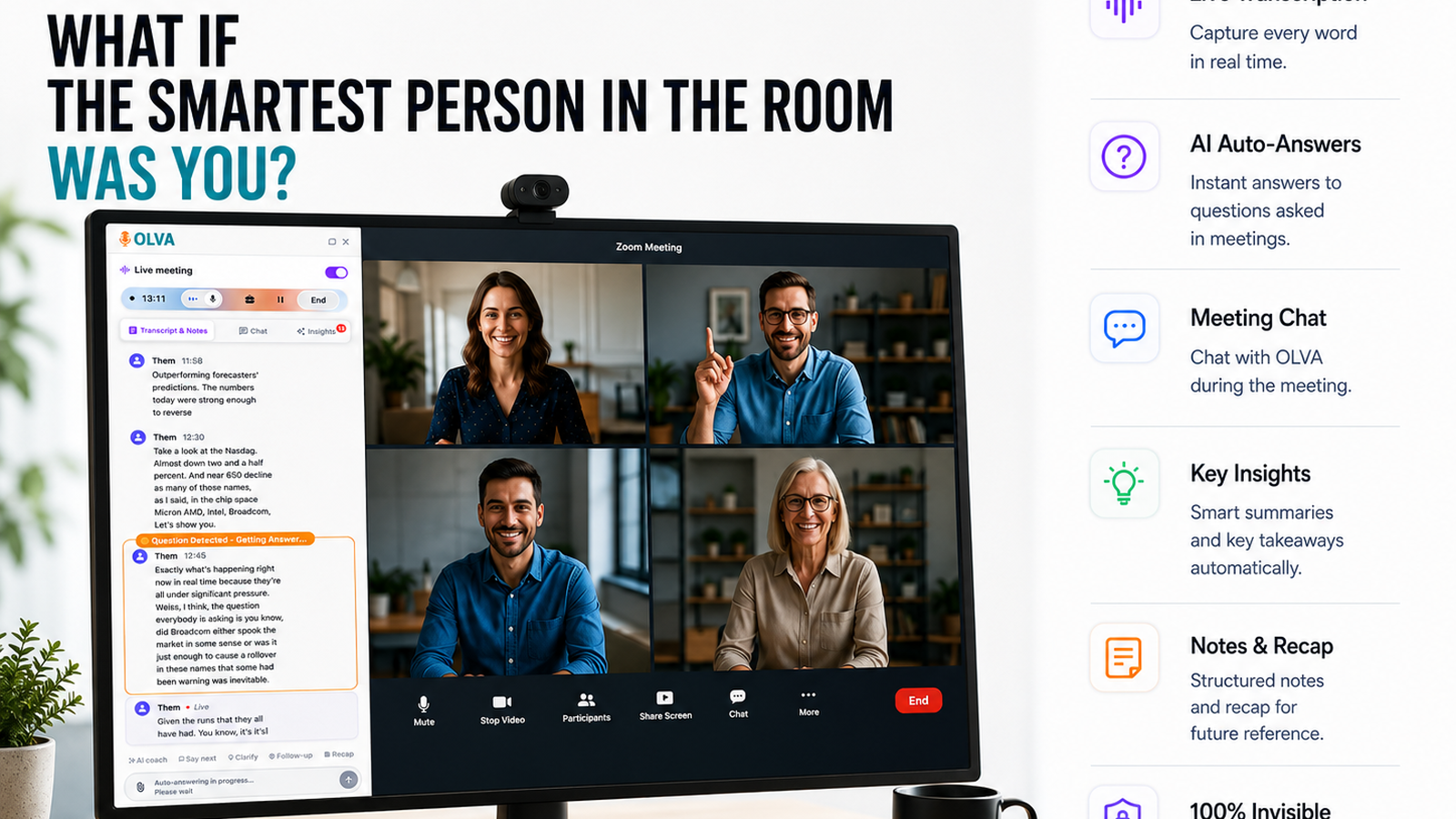
Imagine an assistant that listens silently, understands the context of a program review, and helps you act in real time — without joining as a visible bot or interrupting the conversation. That’s the core of the invisible AI model.
Key capabilities that matter for program managers:
- Live transcription for accurate, searchable context without note-taking
- Automatic question detection that highlights dependencies, clarifications, and risks as they arise
- Instant answers and document-aware intelligence so you can reference specs, SOWs, or timelines instantly
- Live insights and opportunity detection that surface unspoken risks (scope creep, blocker escalation) and follow-ups you might otherwise miss
- AI coaching that suggests how to phrase a scope change, escalate a risk, or get commitment on an action item
- Post-meeting memory that turns live insights and decisions into a searchable program history
These features are designed to reduce the cognitive load on the program manager and help teams commit to actions while the meeting is still in progress.
Practical scenarios: real-world examples for program managers
Example 1 — Release coordination meeting
- Situation: Engineering flags a possible delay due to an API refactor. Design and QA are present; product wants to understand scope impact.
- Invisible AI helps during the meeting:
- Automatic question detection surfaces the dependency: “Does this API refactor affect the public SDK?”
- Instant answers pull from uploaded API docs and the program’s timeline to indicate which teams are impacted.
- AI coaching recommends a concise escalation script to get a date commitment from engineering and a contingency plan from Product.
- Post-meeting memory records the decision, assigned owners, and the revised timeline. Everyone can later search for the term "public SDK" and find the exact discussion and action items.
Example 2 — Weekly cross-functional sync
- Situation: Several teams report “risks” but descriptions are inconsistent across speakers.
- Invisible AI helps during the meeting:
- Live insights cluster risk statements into categories (technical debt, resource gaps, external dependencies).
- Suggested follow-ups recommend clarifying questions to quantify impact (e.g., “How many story points will this add?”).
- The assistant auto-detects disengaged stakeholders and recommends an escalation path.
- After the meeting, post-meeting memory compiles a risk register with owners and confidence levels, making it easy to prioritize between sprints.
Example 3 — Stakeholder decision meeting
- Situation: Executives ask for cost/benefit trade-offs for an accelerated timeline.
- Invisible AI helps during the meeting:
- Document-aware intelligence pulls relevant budget and resource docs to generate an immediate summary.
- Live Q&A lets the program manager ask, “What’s the historical time-to-market impact of a 2-week acceleration?” and get an evidence-based response.
- Fact checking validates claims (e.g., whether a previous acceleration actually landed benefits) against past meeting records.
- The result: faster, evidence-based decisions and a clear post-meeting record of the chosen option and its owner.
Where existing tools help — and where they fall short
Many tools in the market offer valuable capabilities: Otter.ai and Fireflies are strong at transcription; Gong and Chorus provide call analytics and coaching focused on sales conversations; many meeting platforms offer recordings and basic summaries.
What these tools do well:
- Capture conversations for later review
- Provide good search and basic summaries from transcripts
- Offer analytics for user behavior or topics in sales and customer calls
Where they commonly fall short for program management:
- Real-time, context-aware assistance tailored to cross-team decision-making (not just sales coaching)
- Invisible operation that doesn’t add a visible bot to meetings or change meeting dynamics
- Document-aware instant answers tied to program artifacts like SOWs, architecture docs, or dependency matrices
- Continuous, searchable post-meeting memory that connects decisions across meetings and teams
Acknowledging the strengths of existing platforms is important: transcription and recordings are core capabilities and many solutions provide them reliably. The gap is in moving from “record and review” to “intelligently act in the moment,” which is where invisible AI and a connected memory layer add disproportionate value for program managers.
Implementation playbook: start small, deliver fast
- Pilot with a single program
- Choose a cross-functional program with predictable weekly syncs.
- Configure the invisible AI to use key program documents (timelines, dependency matrices, SLAs).
- Set clear success criteria: faster meeting time-to-decision, fewer reopened action items, improved on-time delivery.
- Standardize meeting templates and give the AI a role
- Use a consistent agenda template (status, blockers, decisions needed).
- The AI will better surface insights and suggested follow-ups when meetings are predictable.
- Train stakeholders on what the assistant does (and privacy guarantees)
- Explain that the assistant does not join as a visible bot, that it provides private, real-time help to the meeting host, and that transcripts can be controlled or deleted.
- Reinforce that the goal is to improve decisions and clarity, not surveillance.
- Iterate on prompts and documents
- Upload the artifacts that matter (specs, contracts, test plans) so the AI’s instant answers are accurate and actionable.
- Tune the AI to detect the signals you care about: dependency slips, scope creep, missing owners.
- Measure impact
- Track metrics such as percent of meetings that end with clear owners/dates, number of reopened action items, mean time to resolve blockers, and on-time delivery rate.
- Correlate improvements with AI usage to quantify ROI.
Metrics to watch
- Meeting outcomes clarity: percent of meetings with documented decisions and assigned owners
- Action item completion rate: percent completed by the due date
- Time to resolve blockers: median time from identification to resolution
- Rework rate: percent of work requiring rework due to missed dependencies
- Meeting duration and frequency: net time savings from more focused meetings
Privacy and team trust
Program managers must establish trust when introducing live meeting intelligence. Look for solutions that are private by design — no visible bots joining meetings, transcripts only visible to authorized users, and explicit controls to delete meeting data. These guarantees reduce resistance and make it easier to adopt the technology across teams.
Conclusion: move from remembering to performing
Scaling cross-team coordination is less about more meetings and more about better information flow during and after meetings. Invisible AI that listens without disrupting, provides instant, document-aware answers, detects critical questions, and captures decisions into a searchable post-meeting memory moves program managers from a reactive posture to a proactive one.
For program managers, that means fewer firefights, faster decisions, and a cleaner thread of evidence when you need to justify trade-offs or diagnose misses. The technical building blocks are available today — live transcription, automatic question detection, live Q&A and a persistent memory layer — and when combined, they allow you to coordinate larger, more complex portfolios without scaling headcount.
Explore how an invisible, meeting-first approach can change the way your programs run at https://olva.ai.