Reduce Portfolio Meeting Overhead with Proactive Insights, Opportunity Detection, and AI Coaching
Program managers oversee complex portfolios of projects, each with its own stakeholders, risks, and milestones. Portfolio meetings and steering committees are where program-level decisions get made, but they can also be the largest drain on time and attention. Too often these meetings focus on rehashing status updates, clarifying facts after the fact, and scheduling yet another follow-up meeting to resolve outstanding issues.
This article shows how program managers can reduce portfolio meeting overhead and improve program-level outcomes by shifting from passive record-keeping to proactive, live meeting intelligence. It explores practical ways to capture the right signals, detect opportunities and risks early, and use AI coaching to make each meeting drive decisions instead of creating more work. Examples and actionable steps are included, along with fair comparisons to existing meeting tools and a look at how invisible, document-aware AI assists can transform live decision-making.
Learn more about the platform referenced in this article at https://olva.ai.
The problem: why portfolio meetings become overhead
Common portfolio meeting pain points for program managers:
- Meetings are filled with status recaps that could have been read ahead of time.
- Important signals get buried in conversation and are discovered only after multiple follow-ups.
- Decisions are delayed because critical facts or contract clauses are not immediately available.
- Risk and opportunity signals are inconsistently tracked across projects.
- Meetings generate long notes that no one reads, then spawn more meetings.
These issues multiply across a portfolio. If each project requires clarifications after a meeting, the program manager becomes a bottleneck for follow-up and escalation rather than a driver of outcomes.
To reduce overhead, portfolio meetings must become decision-focused and proactive. That requires three capabilities:
- Surface relevant insights during the meeting, not after it.
- Detect opportunities and risks automatically so nothing slips through.
- Provide private, contextual coaching to help stakeholders respond effectively in the moment.
How live meeting intelligence changes the game
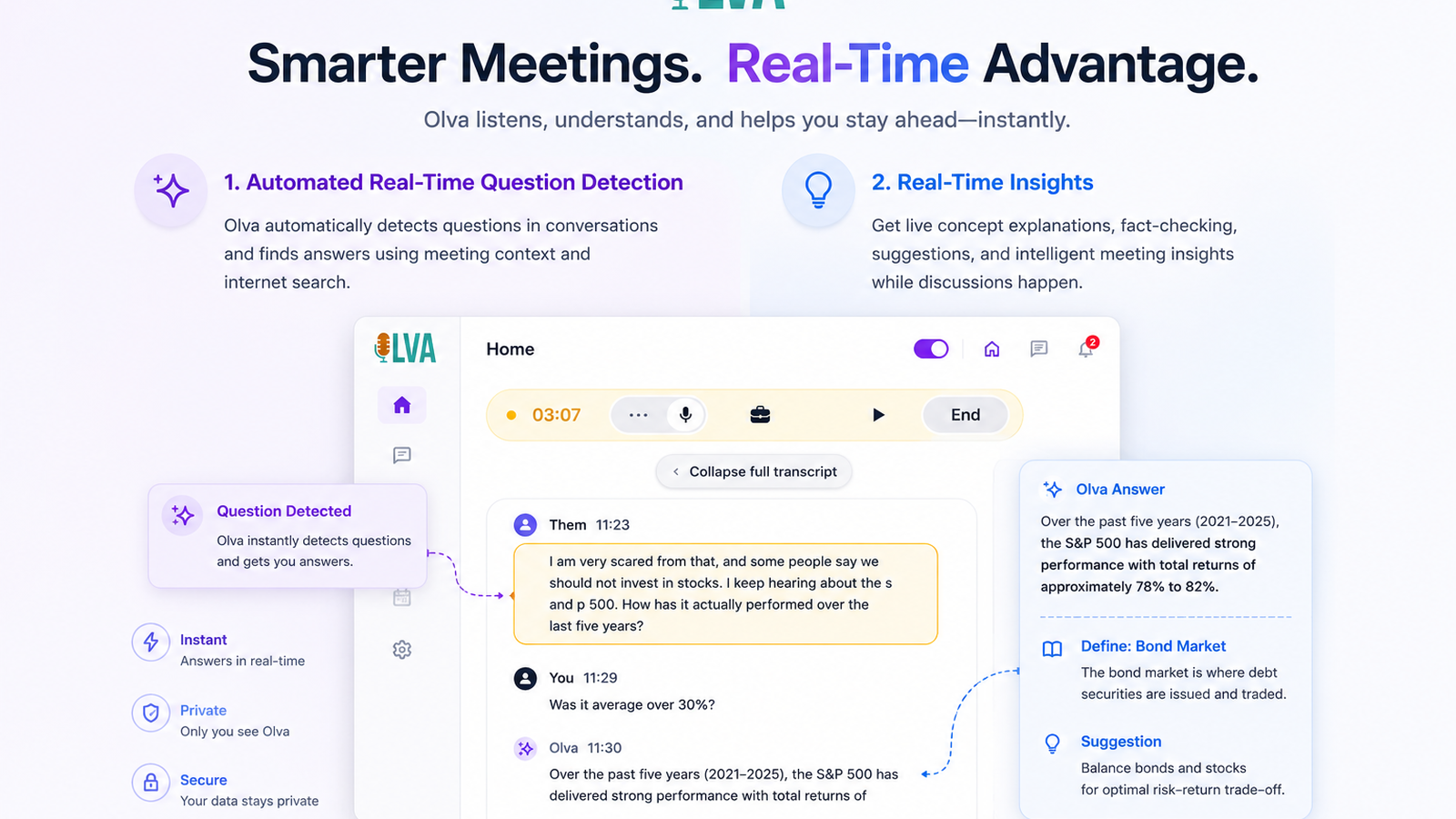
Live meeting intelligence combines real-time transcription, context-aware detection of important moments, and instant, document-aware answers. For program managers, the impact is practical:
- Faster decisions. Fact-checks and contract references are available immediately.
- Fewer follow-ups. Critical issues are resolved during the meeting when possible.
- Consistent tracking. Opportunity and risk signals are logged automatically and uniformly across projects.
- Better stakeholder experience. Attendees focus on conversation rather than note-taking.
These improvements come from augmenting human judgment with AI that listens, analyzes, and suggests — all without becoming a visible participant in the meeting.
Practical examples: live intelligence at work in portfolio meetings
Example 1: Steering committee evaluates a vendor change
- Situation: A project manager raises a potential vendor switch. Attendees ask about contract penalties and migration costs.
- Typical outcome: Conversation stalls, someone volunteers to check the contract after the meeting, another follow-up is scheduled.
- With live intelligence: The AI detects the pricing and contract question automatically, pulls the relevant clause from an uploaded contract, and surfaces an instant summary and potential financial impact. The program manager can ask a live follow-up suggested by the AI and make an informed decision in the meeting.
Example 2: Cross-project risk emerges during status updates
- Situation: Two projects report similar supply chain delays.
- Typical outcome: Separate risks are documented in individual trackers and only later correlated.
- With live intelligence: The assistant detects pattern overlap in real time and raises an opportunity detection alert: potential portfolio-level supply risk. The AI suggests actions like consolidating sourcing, escalating to procurement, or running a joint mitigation working group.
Example 3: Executive asks a technical clarification
- Situation: An executive requests the impact of a delayed API on a dependent product.
- Typical outcome: Engineers provide best guesses; a precise answer is promised later.
- With live intelligence: The assistant pulls specs from uploaded technical documents, verifies current dependencies from prior meeting memory, and provides a concise, referenced answer the program manager can present instantly.
Key capabilities program managers should prioritize
- Invisible AI assistance
A solution that listens and supports without joining the meeting as a visible bot preserves meeting dynamics and stakeholder comfort. Privacy and low disruption matter in executive forums and vendor negotiations.
- Live transcription
Accurate real-time transcripts free attendees from taking notes and make it easy to flag critical moments during the meeting.
- Automatic question detection
Automatically detecting questions, clarifications, or objections ensures nothing important is missed. Program managers no longer rely on manual callouts to find what matters.
- Instant answers and document-aware intelligence
The value jumps when the assistant can answer questions with context, pulling from uploaded contracts, specs, and previous meeting memory. That prevents delayed fact-finding and reduces follow-ups.
- Live insights, fact checking, and opportunity detection
AI that continuously analyzes conversation and surfaces fact-checks, terms, or emerging opportunities helps program managers see portfolio-level patterns and take action faster.
- AI coaching and live Q&A
Private prompts and suggested responses help program managers and PMs navigate objections, ask better questions, and steer conversations toward decisions.
- Post-meeting memory
A searchable meeting history with recaps, action items, and linked evidence helps sustain momentum without redundant status checks.
How this differs from traditional meeting tools
Many existing tools excel at transcription and post-meeting summaries. Platforms like Otter focus on note capture, while Gong and Chorus analyze sales conversations and provide rich post-call analytics. Those tools are excellent when the goal is to learn from past conversations or to improve talk patterns.
Where traditional platforms lag for program management is in the live, proactive layer:
- Most tools passively record and analyze after the meeting instead of surfacing the right evidence during the meeting.
- Typical analytics look at trends and talk-time rather than detecting live cross-project opportunities or pulling contract clauses on demand.
- Many are visible participants in meetings or require manual uploads and context configuration to be useful in real time.
That said, these tools are valuable for post-meeting learning. A fair approach is to leverage their strengths for historical analysis and pair them with a live assistant that focuses on real-time decision support.
Measurable benefits and KPIs to track
To prove reduced overhead and improved program outcomes, track:
- Meeting time saved: fewer status-only meetings or shorter meetings.
- Decision velocity: time from issue raised to decision made.
- Follow-up burden: number of follow-up meetings or unresolved actions per meeting.
- Escalation frequency: how often items require higher-level escalation.
- Portfolio risk discovery rate: number of emergent portfolio-level risks detected proactively.
Improvements in these KPIs translate to less admin time and better resource allocation across the portfolio.
Implementation tips for program managers
- Define meeting roles and goals
- Convert some portfolio meetings from status updates to decision forums.
- Send pre-reads and use live intelligence to surface only the items that need decisions.
- Upload the right documents beforehand
- Contracts, vendor SLAs, technical specs, and program charters are particularly valuable for document-aware answers.
- The AI uses these documents to provide immediate, referenced responses.
- Configure signal detection thresholds
- Train the assistant to flag certain phrases or patterns as buying signals, risk markers, or escalation triggers.
- Consistency across projects makes portfolio-level detection meaningful.
- Use private AI coaching during live meetings
- Program managers and PMs can receive suggested questions, phrasing to handle objections, or follow-ups privately without distracting the meeting.
- Review and close the loop with post-meeting memory
- Use automatically generated recaps and action items to drive accountability.
- Archive decision rationales and evidence so future meetings are faster.
Example rollout plan (8-week)
Week 1: Pilot with 2 high-priority projects. Upload contracts and specs.
Week 2-3: Configure detection rules and create a short training for PMs on using private coaching features.
Week 4: Run pilot portfolio review meeting. Collect feedback and tune alerts.
Week 5-6: Expand to additional projects and start tracking KPIs.
Week 7-8: Standardize agenda templates and integrate insights into program dashboards.
Privacy and governance considerations
When bringing AI into live meetings, address data governance proactively:
- Use invisible assistants that do not join meetings publicly and that keep data private to the user.
- Limit transcript retention and allow deletion of sensitive meetings.
- Document and communicate what documents are uploaded and how they will be used.
These practices preserve stakeholder trust and reduce legal or compliance friction.
Conclusion: shift from memory to performance
Portfolio meeting overhead is not just an efficiency problem. It erodes program momentum and decision quality. The solution is not more notes or longer meetings; it is smarter meetings that surface the right facts and actions at the right time.
By combining invisible AI assistance, live transcription, automatic question detection, document-aware instant answers, live insights, and AI coaching, program managers can transform portfolio meetings from administrative drains into decision engines. The result is fewer follow-ups, faster decisions, and clearer program outcomes.
Adopting live meeting intelligence does not replace existing tools that analyze past conversations. Instead, it complements them by ensuring the next decision is based on the best available evidence in the moment. For program managers ready to reduce overhead and improve outcomes, live, proactive AI is the next step in modern portfolio management. Explore how live assistance and document-aware intelligence can work in your meetings at https://olva.ai.