
Real-Time Fact-Checking in Sales Meetings: Build Credibility and Close Faster
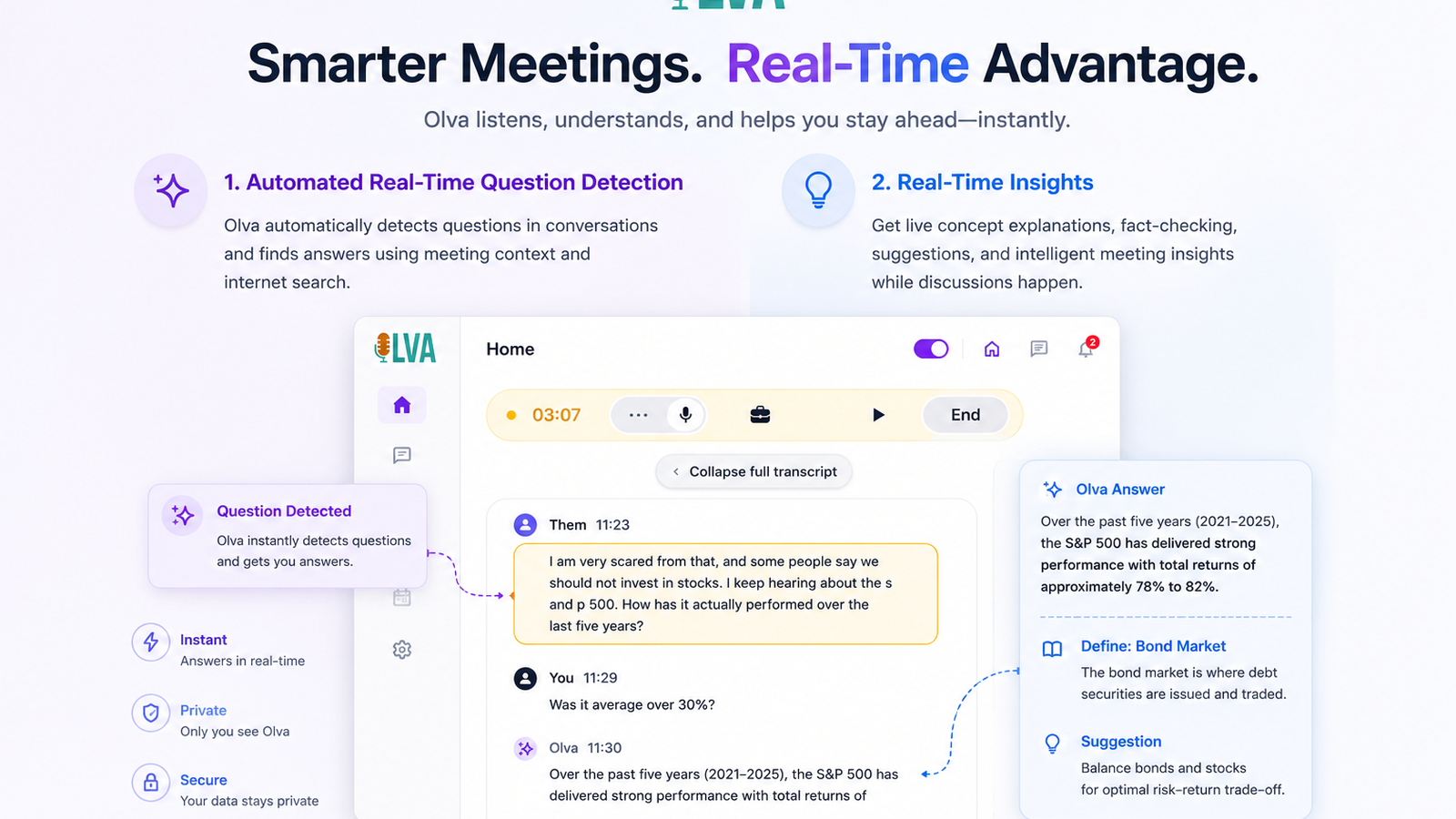
In modern B2B sales, credibility is currency. One misremembered metric, an incorrect pricing point, or a vague answer to a technical question can slow a deal, create unnecessary follow-ups, or erode trust. The solution is simple in theory but hard in practice: verify claims and respond accurately while the conversation is still happening.
This article explains how real-time fact-checking improves conversion rates and shortens sales cycles, offers step-by-step examples sales reps can use immediately, and explores how live meeting intelligence — including document-aware AI, instant answers, and invisible assistance — changes what good sales behavior looks like. Practical examples focus on sales reps, sales leaders, technical teams, and product managers who need to perform under pressure.
For more on live meeting intelligence, see https://olva.ai.
Why real-time fact-checking matters for sales
- First impressions matter. Quick, precise answers build trust in the moment.
- Misstatements require corrections later, which increase friction and reduce perceived competence.
- Prospects interpret hesitancy as uncertainty about product fit, pricing, or roadmap.
A single accurate answer can convert a skeptical buyer into a committed champion. Conversely, a fuzzy or incorrect response creates friction that multiplies into more demos, more approvals, and slower closes.
Common fact-checking failure modes during sales meetings
- Pricing confusion: quoting the wrong discount, list price, or billing cycle.
- Technical uncertainty: not knowing whether a feature supports a specific protocol or integration.
- Competitive claims: misrepresenting what competitors offer or failing to correct incorrect claims.
- Contract details: unclear answers about SLAs, data residency, or renewal terms.
These moments are high-leverage. Handling them well shortens cycles; handling them poorly creates follow-ups and risks losing momentum.
The traditional approach — and its limits
Many organizations rely on post-meeting tools: call recordings, transcripts, and analytics platforms that surface themes after the conversation ends. Tools like conversation intelligence platforms are excellent at uncovering trends, coaching opportunities, and pipeline-wide insights.
But post-meeting intelligence can only fix damage after it occurs. It helps coaching and pipeline analysis, not the live response that determines whether a prospect trusts you in the room.
Competitors that focus primarily on post-meeting analysis do strong work in retrospective coaching and deal hygiene. They are valuable for training and forecasting. Still, they leave a crucial gap: no realtime correction when facts are debated or questions surface.
What real-time fact-checking looks like in practice
Real-time fact-checking involves three capabilities working together:
- Live listening and transcription to capture what's said.
- Automatic detection of questions, claims, and forceful statements.
- Instant retrieval and verification from authoritative sources (uploaded contracts, product docs, pricing sheets, or curated internet sources) and presenting a concise, actionable answer.
When all three happen in the background and surface only what the rep needs, the meeting flows naturally — but the rep performs with better information and confidence.
Example scenarios and scripts
Scenario A: Pricing and discounts
- Prospect: "If we sign this quarter, what pricing tier and discount would apply for 100 seats?"
- Traditional response: pause, consult notes after the call, follow up with an email.
- Real-time fact-checking response: the assistant detects the question, checks the current pricing sheet and contract templates, and suggests: "For 100 seats, the per-seat price on the commercial tier is $X. With standard volume discounts at 100 seats, the effective per-seat price is $Y. Ask whether they prefer annual or monthly billing because discounts differ."
Script the rep could use: "For 100 seats, our commercial tier runs at $X per seat; with the standard 100-seat volume discount it’s effectively $Y per seat on annual billing. Would you prefer annual or monthly terms to see the exact numbers?"
Result: the rep answers confidently and narrows the next step.
Scenario B: Technical integration
- Prospect: "Does your API support SAML 2.0 and SCIM provisioning?"
- Real-time response: the assistant identifies the technical question, pulls the API reference from uploaded product docs, and returns a concise answer: "Yes, SAML 2.0 and SCIM are supported; SAML for authentication and SCIM for user provisioning. We also have code samples for the SCIM endpoints."
Script the rep could use: "Yes, we support both SAML 2.0 and SCIM. If you'd like, I can share implementation notes after the call or connect you with a solutions engineer now."
Scenario C: Competitive claim correction
- Prospect: "I heard Competitor X offers unlimited seats for the same price."
- Real-time response: the assistant detects the competitive claim and surfaces a neutral fact-check from the competitor’s public pricing page or your competitive battlecard, plus a suggested rebuttal.
Neutral correction: "Competitor X’s public page lists a per-seat metric only for their enterprise plan; we can outline differences in support and integrations if that would be helpful."
This approach avoids confrontations and keeps the focus on value rather than a price war.
How this changes sales behavior — four practical benefits
- Close faster: Accurate answers in-meeting eliminate avoidable follow-up questions and approvals.
- Increase conversion: Real-time verification builds trust with technical buyers and procurement.
- Reduce deal risk: On-the-spot fact-checking prevents costly contract misunderstandings.
- Better use of senior resources: Reps can confidently handle more complex topics and escalate only when necessary.
Technology components that enable live fact-checking
- Live transcription: captures every spoken detail so the assistant never misses a claim or question.
- Automatic question detection: identifies when a clarification, challenge, or objection requires verification.
- Document-aware intelligence: integrates product docs, pricing sheets, contracts, and competitive playbooks.
- Instant answers and live Q&A: deliver clear responses in seconds, allowing the rep to speak decisively.
- AI coaching and suggested follow-ups: recommend next questions, objection-handling lines, and escalation points.
- Invisible assistant and privacy: operates without joining the meeting as a visible bot, ensuring no awkward interruptions.
Fair look at competitors
Many conversation intelligence platforms excel at recording and analyzing calls, surfacing themes like objections or talk-time ratios after the fact. That retrospective visibility is valuable for coaching, pipeline management, and compliance.
However, if your primary goal is to improve in-the-moment performance — to verify claims and answer complex questions while they're still relevant — you need live capabilities that go beyond post-meeting analysis. The ideal solution pairs retrospective insights with real-time verification and discreet in-meeting coaching.
Why invisible, document-aware assistance matters
An assistant that joins meetings as a visible bot can change participant behavior and raise privacy concerns. Invisible assistants that run locally or private-by-design let reps use live intelligence without making the presence of an AI overt. Document-aware intelligence lets the assistant answer from authoritative sources you control: pricing sheets, product specs, legal language, and competitive battlecards.
This combination preserves privacy, reduces distraction, and ensures accuracy because the assistant references your source material — not just generic web results.
Implementation checklist for sales teams
- Centralize authoritative documents: pricing, SLAs, product specs, competitive playbooks, and contract templates.
- Train the assistant with those documents so answers are grounded in your company sources.
- Enable live transcription and automatic question detection during calls.
- Define escalation rules (when to route to a solutions engineer or legal) and templates for suggested responses.
- Monitor usage and outcomes: track reductions in follow-up emails, time-to-close, and win rates on opportunities where live fact-checking was used.
Measuring success: KPIs that improve with real-time fact-checking
- Reduction in follow-up emails per deal
- Decrease in time-to-close
- Increase in conversion rate from demo to negotiation
- Higher NPS or satisfaction scores in early-stage buying meetings
- Fewer contract revisions due to misstatements
These KPIs are measurable and directly tied to answering correctly in the moment.
Privacy and compliance considerations
Real-time assistants should be private by design. Choose solutions that:
- Avoid joining meetings as a visible bot unless explicitly required.
- Limit access to transcripts and allow deletion of meeting data on demand.
- Respect company policies about sensitive data and legal obligations.
An invisible assistant that uses your uploaded documents and local meeting context reduces the need to query external sources and keeps sensitive details under control.
Real-world adoption: a short playbook for rollout
- Pilot with top-performing reps who handle complex deals.
- Supply the assistant with up-to-date pricing and technical docs.
- Run shadow sessions where reps receive live coaching suggestions in a non-customer setting.
- Collect qualitative feedback and iterate templates for suggested responses.
- Expand to the broader team once the assistant reliably reduces uncertain answers and supports escalations.
Conclusion
Real-time fact-checking turns moments of doubt into opportunities to build credibility. For sales reps and leaders, the difference between a hesitant answer and a verified, confident response is often the difference between a stalled opportunity and a closed deal. Tools that only analyze calls after they end are valuable, but they miss the most important moment: the present.
Modern meeting intelligence that combines live transcription, automatic question detection, document-aware answers, instant verification, and discreet in-meeting coaching gives reps the confidence to respond accurately, seize buying signals, and shorten sales cycles. When those capabilities operate invisibly and privately, reps stay focused on the conversation while the assistant handles verification behind the scenes.
Learn how live fact-checking and in-meeting assistance can upgrade your team's performance at https://olva.ai.