Olva Mobile for Product Discovery: Run Better Interviews Anywhere
Product discovery often happens away from the desk. Whether you're interviewing a customer at their office, running guerrilla research in a cafe, or taking notes in a user testing lab, the mobile environment introduces logistical and cognitive challenges that hurt interview quality and slow requirement capture.
Olva Mobile reframes product discovery by bringing live meeting intelligence to the palm of your hand. Instead of recording and remembering later, Olva helps product managers, UX researchers, and product ops perform better during interviews: spotting opportunities, suggesting follow-ups, clarifying ambiguous language, and surfacing facts and context in real time.
This article explains why mobile discovery is different, common pitfalls teams hit, and practical workflows that show how Olva Mobile improves interview quality, speeds requirements capture, and keeps research rigorous and private.
Why mobile product discovery needs a different approach
Mobile interviews are convenient and often more authentic, but they introduce constraints:
- Environment noise and interruptions make it harder to track details.
- You can’t rely on complex tooling or additional meeting participants.
- Cognitive load is higher: running the conversation, listening closely, and trying to take accurate notes at the same time.
- Important cues and follow-ups are easy to miss, leading to fuzzy requirements later.
Traditional meeting tools focus on recording and transcription after the fact. That helps with documentation but doesn’t help you during the moment that matters most: the interview itself. Product discovery needs live assistance to capture nuance, test assumptions, and pursue opportunities while the subject’s attention is focused.
What does better look like in mobile interviews?
For product teams, a better interview accomplishes these things in real time:
- Identify key problem statements, constraints, and use cases as they emerge.
- Detect and clarify ambiguous requirements or unstated assumptions.
- Surface buying signals or expansion opportunities for customer-facing teams.
- Prompt the interviewer with high-impact follow-ups and phrasing adjustments.
- Capture accurate, searchable records without breaking rapport.
Olva Mobile is designed to deliver those capabilities invisibly while you talk.
Competitors: what they do well and their limits for mobile discovery
Many tools help with post-interview tasks. For example:
- Transcription-first platforms provide accurate searchable transcripts and integrations with note apps. This is useful when you need to audit every word.
- Recording-focused services offer high-quality audio capture and playback for deeper analysis.
- Some meeting assistants can join calls as a bot and generate post-meeting summaries and action items.
These capabilities are valuable, but they largely focus on remembering, not on helping you perform better during the interview. When you're away from your desk, you need assistance that is unobtrusive, instant, and aware of the conversation context.
Limitations you may encounter with typical tools:
- A visible bot joining a meeting can change participant behavior and reduce candor.
- Post-hoc summaries miss the chance to probe deeper when a pain point first appears.
- Heavy interfaces and multi-step workflows are impractical when you’re holding a phone and juggling a conversation.
How Olva Mobile changes the game (without being a sales pitch)
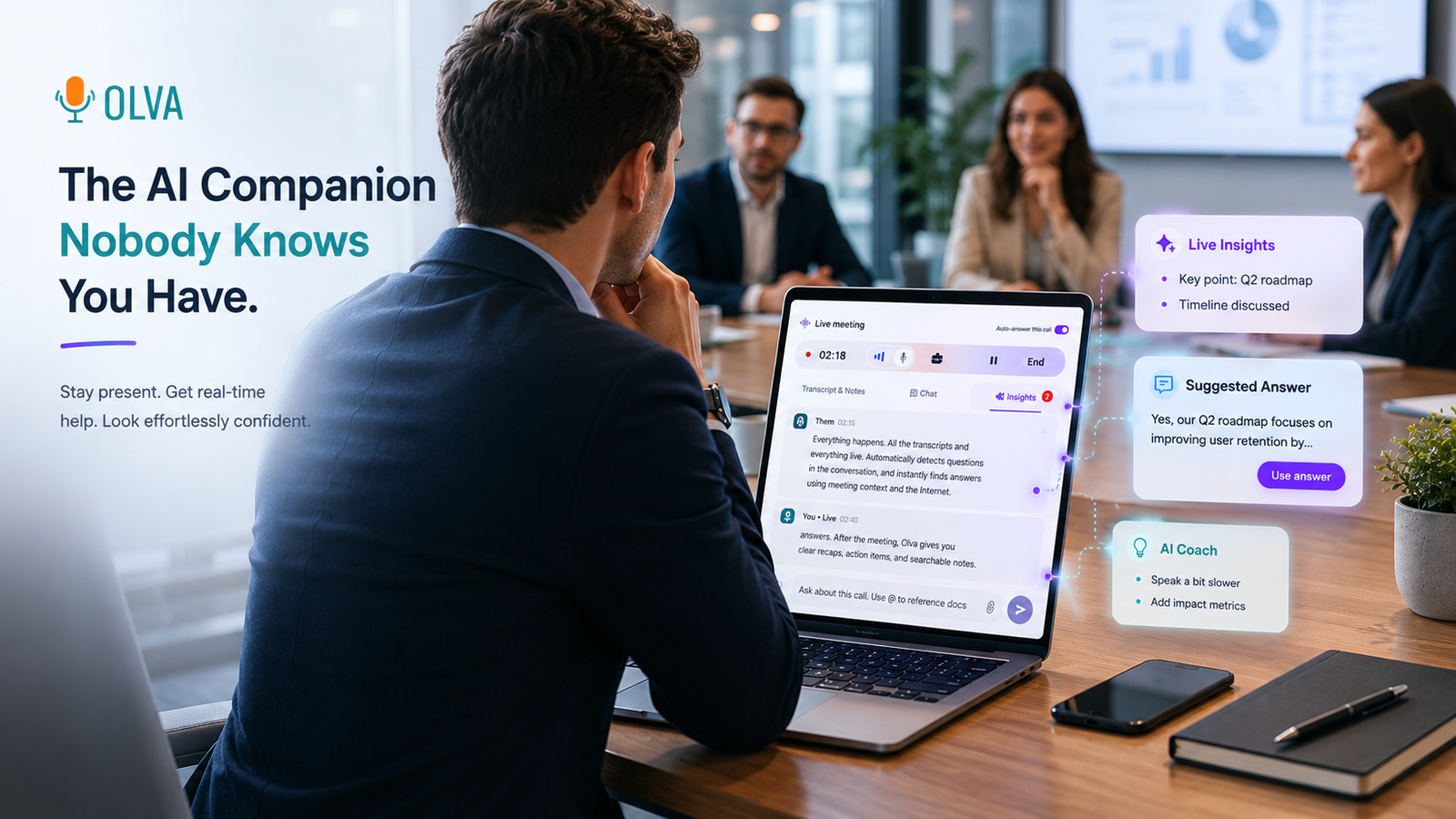
Olva Mobile focuses on live meeting intelligence designed specifically for the realities of product discovery on the go. The value is in intervening during the interview, not just after. Key capabilities that matter for PMs, UX researchers, and product ops:
- Invisible AI assistant: Olva works without joining the call as a visible bot. That preserves natural conversation, avoids awkward notifications, and keeps the interaction private and focused.
- Live transcription: Olva transcribes both your voice and participant audio in real time so you can stop frantic note-taking and stay engaged.
- Automatic question detection: Olva identifies when participants ask clarifying questions, raise objections, or mention constraints. It flags these automatically so you can follow up right away while the detail is fresh.
- Instant answers and document-aware intelligence: If you upload a product brief, roadmap, or spec to Olva, the assistant can use that context to generate accurate responses or explain trade-offs during the interview.
- Live Q&A and AI coaching: Ask Olva what to say next, how to rephrase a question, or to summarize the last 3 minutes. The assistant acts like a private coach in your ear.
- Live insights, fact checking, and opportunity detection: Olva surfaces contradictions, defines jargon, verifies simple claims, and highlights buying signals or feature requests as they occur.
- Post-meeting memory: Notes, decisions, and action items are stored and searchable so requirement artifacts can be reconciled across interviews.
Privacy and usability: Olva keeps everything private by design. No extra bot participants, the transcript can be deleted anytime, and data is visible only to the user.
You can learn more at https://olva.ai.
Practical workflows: running a mobile discovery interview with Olva
Below are detailed, repeatable workflows you can adopt for better interviews and cleaner requirements capture.
- Pre-interview: prepare and upload context
- Upload relevant documents such as the current PRD, competitor matrix, or previous interview notes to Olva. Document-aware answers mean Olva can refer to those documents during the interview.
- Set the session goal in Olva: 'Validate the core jobs-to-be-done for power users' or 'Identify top 3 friction points in onboarding.'
- Live interview: remain present while Olva works in the background
- Start Olva Mobile before the conversation. The assistant remains invisible so the participant feels comfortable.
- Let Olva transcribe in real time. Declutter your screen and use the extra cognitive bandwidth to listen for emotion, phrasing, and frequency of pain points.
- Watch Olva's live insights stream (discreetly) for automated prompts like 'Clarify what you mean by onboarding' or 'Potential expansion signal detected: mentions budget increase.'
- Use live Q&A and AI coaching
- If a participant raises a complex technical constraint, ask Olva: 'Summarize the last 2 minutes in one sentence' or 'How should I rephrase to test for priority?' Olva will provide suggested phrasing informed by the uploaded documents and the conversation.
- If a stakeholder asks for a trade-off, pull an instant answer from Olva that references your product spec.
- Capture and act on discovered requirements
- When Olva detects an explicit requirement or a repeated pain point, it flags it as a candidate requirement and suggests follow-up questions to validate priority and frequency.
- After the interview, Olva generates a concise requirement draft with source snippets and confidence levels, ready for your backlog.
Practical example: validating a feature request on site
Scenario: while interviewing an operations manager, they mention that their team spends 20 minutes daily reconciling two dashboards.
- Olva detects this as an operational pain signal and highlights it as a potential high-impact requirement.
- You ask Olva, in the moment: 'What follow-up should I ask to quantify impact?' Olva suggests, 'How many team members perform this task weekly, and what are the concrete consequences when it fails?'
- The participant answers, you confirm frequency, and Olva auto-generates a requirement candidate: 'Dashboard reconciliation automation — reduces 20 minutes per day per operator; potential savings: X hours/month.'
That requirement is now anchored to the exact transcript segment and will be available in post-meeting memory for prioritization and validation.
Templates and suggested live prompts for product discovery
Here are simple prompts you can use with Olva Mobile during interviews:
- 'Summarize last 3 minutes' — quick synthesis when the conversation is dense.
- 'List ambiguous terms' — gets Olva to highlight unclear language you should clarify.
- 'What follow-up would reveal priority?' — helps validate whether a request is a must-have.
- 'Find contradictions to earlier interviews' — uses post-meeting memory to surface inconsistencies.
- 'Use the uploaded spec to explain trade-offs' — pulls document-aware context into the conversation.
Use these sparingly so Olva is an aid, not a distraction. The goal is to remove friction and keep the conversation human.
Handling privacy and participant comfort
Mobile interviews require trust. Olva's invisible design addresses common concerns:
- No visible bot participant affecting candor.
- Localized control: you decide when Olva is active, what transcripts are saved, and when to delete sensitive data.
- Designed for private, researcher-first workflows rather than public recording platforms.
By keeping Olva discreet and under your control, participants are more likely to speak openly, which leads to higher-quality insights.
Measuring impact: what to expect after adopting Olva Mobile
Teams using live meeting intelligence in discovery report improvements in three measurable areas:
- Faster requirement capture: fewer follow-up interviews needed to clarify basics.
- Higher confidence in requirements: live fact checking and source-linked excerpts reduce ambiguity.
- Improved prioritization: opportunity detection highlights high-impact problems sooner, shortening validation cycles.
These outcomes translate into faster iterations and fewer late-stage surprises during development.
When to still rely on post-hoc tools
Olva is built for live assistance, but that doesn’t replace every tool in your stack. Continue to use specialized research repositories, analytics platforms, and long-form usability analysis. The best practice is to combine Olva Mobile's live intelligence with your existing documentation and analysis workflows so live capture feeds into deeper research and roadmap planning.
Final thoughts: perform better during discovery, not just remember it
Product discovery is an active craft. The best interviewers notice small signals, press when necessary, and detect hidden assumptions that become requirements. Olva Mobile is designed to be that quiet partner: invisible, context-aware, and focused on making interviews more effective in the moment.
Whether you are a product manager validating a new hypothesis, a UX researcher running usability sessions, or product ops consolidating requirements across accounts, Olva Mobile helps you ask the right follow-ups, capture high-confidence requirements, and keep research private and manageable.
To see how this works in practice and to try guided setups for product discovery workflows, visit https://olva.ai.
Quick checklist: run better mobile interviews with Olva
- Upload a short context packet before the interview (spec, roadmap, competitor notes).
- Start Olva Mobile in invisible mode and let live transcription run.
- Use automatic question detection to flag clarifications and objections.
- Ask Olva for suggested follow-ups and phrasing only when you need to steer the conversation.
- Mark candidate requirements during the call so they appear in post-meeting memory for prioritization.
By moving from recall to real-time assistance, you capture better requirements, run more confident interviews, and shorten the path from discovery to delivery.
Conclusion
Mobile product discovery demands tools that support active listening and instant decision-making. Traditional recording and transcription services help with documentation, but they don’t reduce the cognitive burden of running an interview.
Olva Mobile brings live intelligence to the field: invisible assistance, real-time transcription, automatic question detection, instant answers using uploaded documents, live Q&A, and opportunity detection. These capabilities help PMs, UX researchers, and product ops perform better in the moment and capture clearer, higher-confidence requirements.
Run better interviews. Capture requirements with confidence. Learn more at https://olva.ai.