Invisible AI in Meetings: Boost Confidence & Speed Responses for Neurodivergent Employees
Invisible AI in Meetings: Boost Confidence & Speed Responses for Neurodivergent Employees (Dyslexia & Dyspraxia)
Meetings are where ideas align, decisions happen, and teams move forward — but they can also be high-stress environments for neurodivergent employees. People with dyslexia or dyspraxia may experience processing delays, difficulties with real-time language processing, or extra cognitive load when juggling note-taking, screen content, and social cues. For team leads, HR managers, recruiters, and remote managers, creating meeting environments that enable everyone to contribute confidently is both a legal and moral imperative — and it also unlocks better business outcomes.
This article explains practical steps managers can take, why real-time, invisible AI assistance matters, and how modern tools (including Olva) can help neurodivergent employees participate more effectively in meetings in the moment — not just remember what happened later.
Why neurodiversity changes the meeting dynamic
Dyslexia and dyspraxia affect people differently, but there are common meeting-related challenges:
- Processing speed: following rapid exchanges or complex explanations can be difficult, leading to delayed responses even when the individual understands the content.
- Working memory strain: juggling what was just said, taking notes, and planning a reply consumes cognitive resources.
- Multimodal overload: simultaneously watching slides, listening, and reading chat increases stress and can reduce comprehension.
- Motor planning and coordination: for dyspraxia, note-taking or switching tools during a meeting may be awkward or slow.
These challenges are not deficits in competence; they're differences in how information is processed. Simple adjustments and the right assistive technology can dramatically reduce friction.
Practical, low-cost accommodations every manager can adopt
Before technology, managers can already do a lot to make meetings more accessible:
- Share agendas and key documents at least 24 hours in advance.
- Use clear slide layouts and avoid dense text.
- Slow the pace and pause frequently for questions.
- Encourage typed chat as an alternative to speaking.
- Allow turn-taking signals (raise hand, emoji) and explicit time to respond.
- Offer one-to-one pre-briefs for complex topics.
These practices are essential. But they don't fully solve the problem of real-time comprehension and response speed. That's where invisible, meeting-aware AI can be a game-changer.
What “invisible AI” means — and why invisibility matters
Invisible AI refers to assistance that works unobtrusively in the background of meetings without joining as a visible bot participant. Benefits include:
- No distracting bot participants or notification clutter.
- Privacy and psychological safety: participants aren’t constantly reminded an AI is in the room.
- Seamless workflow: the user receives support through their own interface without disrupting the meeting.
For neurodivergent professionals, invisibility reduces social pressure; they get help privately and discreetly, supporting natural participation rather than spotlighting accommodations.
Core real-time capabilities that support dyslexia and dyspraxia
Several live features provide immediate value — especially when they operate during the conversation rather than after it:
- Live transcription: Real-time captions reduce the need to mentally rehearse sentences or rely solely on auditory processing. They allow attendees to reread what was said instantly.
- Automatic question detection: The system highlights incoming questions, clarifications, or technical queries so the user can prioritize responses without losing the thread.
- Instant answers and Live Q&A: When a question arises, AI can draft suggested replies or pull accurate facts from relevant documents immediately.
- Live insights and Opportunity detection: AI surfaces what matters — e.g., a customer’s buying signal or a misinterpreted point — so users can respond strategically.
- AI coaching: Private nudges suggest phrasing, simplifications, or follow-up questions tailored to the moment.
- Document-aware intelligence: The AI can reference uploaded contracts or specs instantly, reducing the need to flip through documents under time pressure.
- Post-meeting memory: searchable meeting history and indexed transcripts make follow-up easier and reduce pressure to capture everything in real time.
Taken together, these capabilities lower cognitive load, accelerate response speed, and increase confidence for employees who process information differently.
Practical examples: how invisible AI helps in real meetings
Example 1 — Sales demo with a prospect (remote):
- Challenge: A team member with dyslexia struggles to answer a technical pricing question on the spot.
- Invisible AI in action: Live transcription captures the question, automatic question detection flags it, and document-aware intelligence pulls the relevant pricing clause from the uploaded proposal. The AI suggests a concise reply and a clarifying follow-up question. The employee delivers the answer confidently and proposes a short next step.
Example 2 — Cross-functional planning meeting:
- Challenge: Rapid-fire back-and-forth and complex acronyms make it hard for a participant with dyspraxia to keep pace.
- Invisible AI in action: Live insights define acronyms when they appear, summarize the previous five minutes on demand, and privately suggests a simple script for requesting a pause or repeating a decision.
Example 3 — Interview or recruiter call:
- Challenge: The candidate processes questions more slowly and needs extra time to respond.
- Invisible AI in action: Transcription ensures the interviewer reads back the question accurately; AI coaching recommends phrasing adjustments and prompts the interviewer to provide a moment of silence. The recruiter uses screen-share invisibly to view notes without interrupting the interview flow.
These examples show how support in the moment — not after — preserves conversational flow and dignity while improving outcomes.
Comparing mainstream meeting tools and invisible, live assistance
Many existing meeting platforms and add-on tools excel at post-meeting capabilities: accurate transcripts, searchable records, AI summaries, and automated minutes. Those strengths are valuable, especially for documentation and compliance.
However, post-meeting tools still leave a gap for neurodivergent employees who need help during the conversation itself. This is where live, invisible assistance differentiates:
- Competitors may provide transcripts and summaries, but often as after-the-fact artifacts rather than real-time coaching.
- Some solutions join meetings as visible bots, which can increase participant anxiety and reduce privacy.
- A few tools offer live captions, but lack contextual features like automatic question detection, instant document-aware answers, or private AI coaching.
A balanced approach recognizes the strengths of both categories. Use post-meeting tools for records and compliance, and adopt invisible, live assistants for in-the-moment support that raises participation and response speed.
Olva’s approach to live, private meeting assistance
Olva (https://olva.ai) is built around the philosophy that most meeting tools help teams remember meetings — but modern professionals need help performing better while meetings are happening. For neurodivergent employees, that distinction matters.
Key benefits relevant to dyslexia and dyspraxia:
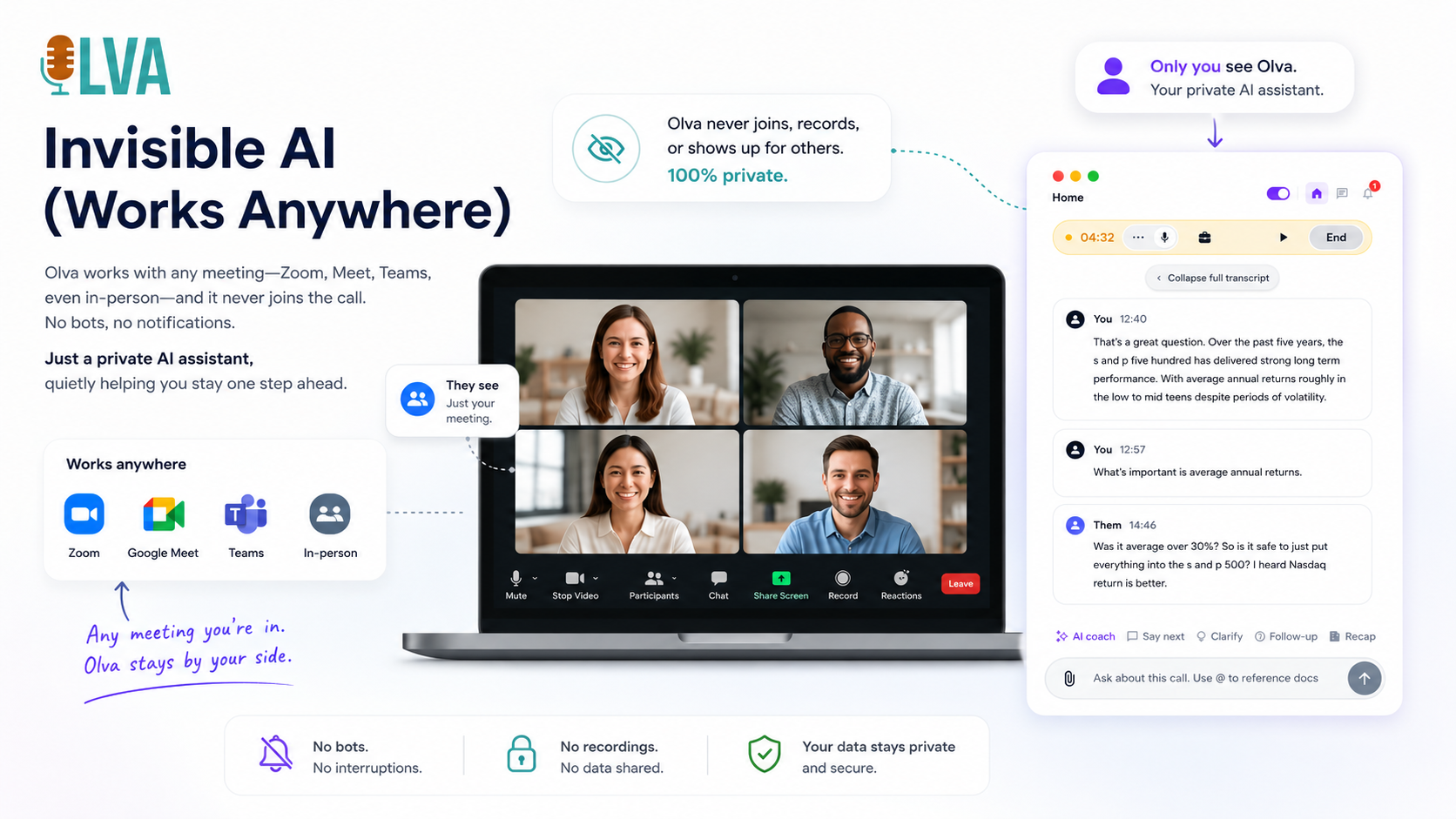
- Invisible AI Assistant: Olva works without joining as a visible participant, preserving privacy and lowering social pressure.
- Live Transcription: Real-time captions for both user and participant audio reduce the reliance on auditory-only processing.
- Automatic Question Detection & Instant Answers: Olva flags questions and generates context-aware replies immediately, reducing response latency.
- Live Q&A & AI Coaching: Users can privately ask Olva what to say next or request a simplified explanation, receiving real-time phrasing suggestions.
- Live Insights & Fact Checking: Olva surfaces what matters, defines jargon, and validates claims so users can respond accurately without searching documents mid-meeting.
- Document-Aware Intelligence: Uploaded contracts, product docs, or interview guides are available instantly for accurate answers.
- Privacy by Design: No bots in the meeting, data visible only to the user, and transcripts can be deleted — important considerations for HR and legal teams.
These features combine to create a discreet safety net that supports both comprehension and eloquence during high-stakes conversations.
Implementing invisible AI thoughtfully — policies and best practices
When introducing invisible meeting AI into your organization, follow these steps to maximize benefits and maintain trust:
- Start with a pilot: Choose a volunteer team with diverse needs and measure outcomes like response time, meeting participation, and satisfaction.
- Communicate transparently: Explain what the tool does, privacy controls, and how data is used. Emphasize privacy-by-design aspects such as no visible bots and user-only access to transcripts.
- Integrate with accommodations: Use AI as part of an accommodation plan, not a replacement for human-centered adjustments (agenda sharing, slower pace, chat options).
- Train managers: Teach leaders how to interpret AI-suggested prompts and respect the discretion of neurodivergent team members.
- Monitor and iterate: Collect feedback from neurodivergent employees and adjust settings or policies accordingly.
Measurable benefits to expect
Organizations that adopt live, discreet meeting assistance typically see:
- Faster response times during meetings and fewer follow-up clarifications.
- Increased participation from employees who previously held back.
- Higher meeting satisfaction ratings from neurodivergent and neurotypical staff alike.
- Fewer missed opportunities due to miscommunication — especially in sales or customer-facing calls.
These benefits translate to improved inclusivity, higher retention, and better team performance.
A final note on accessibility, dignity, and performance
Accessibility in meetings is about more than compliance — it’s about enabling people to do their best work in the moment. For employees with dyslexia or dyspraxia, invisible meeting AI provides a discreet support layer that preserves dignity while enhancing competence.
When combined with thoughtful meeting practices — clear agendas, deliberate pacing, and psychological safety — live AI assistance can transform meetings from stressful ordeals into productive spaces where diverse thinkers contribute at their full potential.
For teams exploring these solutions, the next step is to evaluate tools that emphasize in-the-moment assistance, privacy, and document-aware intelligence. To learn more about an approach built for live meeting support and discretion, see Olva at https://olva.ai.
Conclusion
Neurodiversity is a strategic advantage when teams create environments that enable everyone to contribute. Invisible, real-time AI addresses one of the most common friction points: participating confidently and responding quickly during meetings. By combining straightforward accommodations with live transcription, automatic question detection, instant answers, and private AI coaching, organizations can reduce cognitive load, accelerate decision-making, and lift the performance of neurodivergent team members — all without drawing unwanted attention or compromising privacy.
The right blend of human empathy and discreet technology turns meetings into places where clarity, speed, and confidence coexist. That’s better for people — and better for business.