How Reusable Meeting Contexts Cut Prep Time in Half: A Playbook for Sales & Customer Success
Preparation is the single biggest predictor of meeting outcomes for sales and customer success teams. Yet account executives and CSMs spend hours reassembling the same customer background, product notes, proposals, and discovery points before recurring calls. Reusable meeting contexts — a lightweight way to capture role-specific notes and attach relevant documents ahead of a conversation — directly address that inefficiency.
This playbook shows how to design, build, and use reusable meeting contexts so your team spends less time preparing and more time selling, advising, and closing. It includes tactical templates, practical examples, and workflow steps that work for one-off discovery calls, recurring QBRs, renewal negotiations, and expansion conversations. Where it helps, we reference OLVA's reusable meeting contexts feature and how document-aware, in-meeting intelligence can use those contexts to deliver better, faster support during live conversations. For more on OLVA, see https://olva.ai.
Why reusable meeting contexts matter
Common prep problems for revenue teams:
- Re-assembling the same account facts from multiple sources (CRM notes, Slack, previous decks).
- Re-uploading or re-linking documents for each meeting.
- Inconsistent terminology or account background across reps and CSMs.
- Losing institutional knowledge when a manager, AE, or CSM transitions accounts.
Reusable meeting contexts solve these by letting you create a named, portable snapshot of the facts, goals, terminology, and supporting documents for a customer, segment, or meeting type. Instead of rebuilding context each time, you select the saved context and start the meeting with standardized background loaded.
Key benefits:
- Faster prep: Open a saved context instead of copying notes from multiple systems.
- Consistency: Standardized account language, goals, and priorities reduce confusion.
- Better in-meeting support: When an assistant (like OLVA) has the right context, answers, insights, and coaching are more relevant.
- Reuse across workflows: Contexts work for single customers, roles (e.g., technical champion vs. economic buyer), or meeting templates (e.g., discovery, QBR).
What to include in a meeting context (practical checklist)
A good context is concise, targeted, and reusable. Use this checklist to build contexts for different meeting types.
- One-line purpose
- Example: "QBR — align on adoption KPIs and agree on pilot expansion scope."
- Role & attendee expectations
- Who typically joins and what they care about (e.g., "Product lead cares about API stability; Finance cares about TCO").
- Account background (2–4 bullets)
- ARR, contract end date, key integrations, previous commitments, notable risks.
- Goals & success metrics
- What success looks like for this customer: KPIs, usage targets, timeline.
- Known objections or sensitivities
- Pricing sensitivity, compliance needs, previous implementation issues.
- Terminology map
- Customer-specific names for features, internal product names, or abbreviations.
- One-paragraph pitch / positioning for this account
- How you frame value relative to their goals.
- Attachments (optional)
- Contracts, SOWs, architecture diagrams, recent SLAs, product docs. Convert to text or markdown for searchability.
- Suggested agenda and 3–5 priority questions
- Keep the agenda short and the questions outcome-oriented.
Pro tip: Keep contexts under one page of readable text when possible. The goal is quick reference, not a novel.
How to build contexts for common revenue scenarios
Below are context templates you can copy and adapt.
Template: Discovery Call Context
- Purpose: Identify pain, decision process, budget, timeline
- Attendees: Champion (Product), Economic buyer (Finance) — expect procurement questions
- Background: Trial started 2026-03-01; trial usage 35% of seat target; main integration = Salesforce
- Goals: Confirm success criteria and next-step timeline; qualify budget
- Objections: Concern about implementation timeline; unclear ROI model
- Terminology: "Active seats" = seats with daily usage; "Pilot" = proof-of-concept
- Agenda: 1) Quick recap of goals; 2) Demo focused on their top pain; 3) Decision-maker questions; 4) Next steps
- Priority questions: What metric will define pilot success? Who signs procurement? When must decision be made?
Template: Quarterly Business Review (QBR) Context
- Purpose: Align on progress vs. KPIs and surface expansion opportunities
- Attendees: CSM, Product Champion, Executive Sponsor
- Background: Annual contract $120k; last QBR highlighted onboarding delays; NPS 6.8
- Goals: Show value delivered, agree on next quarter objectives, introduce packaged expansion
- Objections: Low adoption in EMEA due to training gap
- Terminology: "Adoption Score" = weekly active users / total licensed users
- Attachments: Onboarding runbook (PDF), usage dashboard export (CSV)
- Agenda: 1) Wins and KPIs; 2) Roadblocks; 3) Plan for next quarter; 4) Follow-ups & owners
Template: Renewal/Expansion Context
- Purpose: Secure renewal and identify expansion paths
- Attendees: CSM, Account Executive, Procurement contact
- Background: Renewal date 2026-11-30; expansion opportunity +$40k
- Goals: Lock renewal, get agreement on pilot for new module
- Objections: Budget cycle ends mid-fiscal year; legal requires privacy addendum
- Attachments: Current contract (DOCX), proposed SOW (PPTX)
- Priority questions: What is the procurement timeline? Who will champion the expansion internally?
Using contexts in the meeting: before, during, and after
Pre-meeting (5–15 minutes saved immediately)
- Select the relevant saved context when you start OLVA or your meeting prep tool.
- Skim the one-line purpose, attendee expectations, and 3 priority questions.
- Attach or confirm any supporting documents are included with the context.
Result: Instead of 30–60 minutes of prep, you often need 5–15 minutes to personalize the context.
During the meeting (real-time advantage)
- If your assistant can use meeting context alongside the live transcript (as OLVA does), it can surface answers and insights that reference the saved context. Example capabilities:
- Instant answers that consider account goals and terminology.
- Document-aware Q&A where OLVA pulls relevant passages from attached docs converted to markdown.
- Question detection that highlights customer objections flagged in the context so you can respond proactively.
Practical example:
- You’re in a renewal call. The customer says, "We're worried about the implementation timeline." OLVA, knowing the customer previously struggled with onboarding (from the saved context), suggests a short script to reassure the customer and offers to pull the onboarding runbook paragraph and timeline into chat so you can reference it immediately.
After the meeting (faster handoffs and follow-up)
- The meeting transcript remains the source of truth, but the saved context can be combined with the transcript to generate more accurate summaries and action items tied to your known priorities.
- Use the context to populate follow-up templates so every customer receives consistent next steps.
Folder-level defaults and team consistency
For teams that handle many accounts or run similar meeting types, assign default contexts to folders (or account groups). That simple governance step ensures recurring meetings start with the right background without asking every rep to recreate or choose the context manually.
Use cases:
- Segment-level contexts: "Enterprise Finance" folder has standard procurement timeline, contract thresholds, and compliance notes.
- Role-specific contexts: "Technical Champion" context includes typical architecture constraints and test-case examples.
This is especially useful when an account changes owners — the successor can open the account folder and start meetings with an established contextual baseline.
Practical playbook: 7-step rollout for Sales and CS teams
- Start small (pilot 3–6 accounts)
- Pick a mix: one strategic renewal, one active expansion, one low-touch account.
- Create context templates using the checklists above
- Keep them short and focused; store them in a shared drive or directly in OLVA contexts.
- Attach canonical documents (SOWs, contracts, runbooks)
- Convertible formats are best (PDF, DOCX, PPTX). OLVA extracts readable content and converts it into markdown so the assistant can reference it without storing the original file.
- Train team members on one-line purpose and priority questions
- Reinforce the habit of saving new learnings back into the context.
- Use the context during live calls
- If you use OLVA, select the context when starting the meeting so live transcript + saved context powers contextual answers and insights.
- Inspect time saved and adjust
- Measure average prep time before and after. Track consistency of follow-ups and action item accuracy.
- Scale to folders and team defaults
- Assign default contexts to folders for repeatable meeting types and customer segments.
Metrics to measure ROI of context reuse
Track these to quantify the value of reusable contexts:
- Prep time per meeting (minutes) before vs. after
- Number of documents attached per meeting vs. reused from context
- Consistency score of follow-ups (e.g., percent of meetings with clear next steps)
- Time to close renewals or expansions (compare similar cohorts)
- Internal survey: perceived readiness on calls (Likert scale)
Realistic target: cutting prep time in half for recurring meeting types is achievable when contexts are well-designed and attached to folders.
Common pitfalls and how to avoid them
Pitfall: Overly long contexts
- Fix: Keep to one page; use attachments for deep details.
Pitfall: Outdated information
- Fix: Add a "last updated" line and make updating a step in post-meeting action items.
Pitfall: Poor adoption
- Fix: Require one context selection for recurring meeting templates and include context creation in onboarding.
Pitfall: Using context as a single source of truth
- Fix: Treat the live transcript as the authoritative record. If the transcript contradicts the saved context, the transcript wins — update the context afterward.
Example workflows: plug-and-play scripts
- Discovery call: fast prep
- Open "Discovery — New Logo" context.
- Confirm 3 priority questions and one-line purpose.
- Start OLVA with the selected context; let it surface customer-specific terminology and relevant docs during the call.
- Post-call: accept suggested action items and update the context with any new decision-maker names or procurement timelines.
- QBR: consistent reporting
- Open account folder with default QBR context.
- Attach latest usage export; OLVA will reference it during the meeting (document-aware answers) and include it in the summary.
- Post-call: OLVA generates a meeting recap that already aligns with the context’s KPIs.
- Renewal negotiation: reduce negotiation cycles
- Open the Renewal context with contract milestones and previous legal notes.
- During meeting, OLVA flags pricing sensitivity lines and pulls the relevant clause from the contract attachment so you can reference it immediately.
- Post-call: send a follow-up populated from the renewal template in the context.
How OLVA’s meeting contexts help in practice
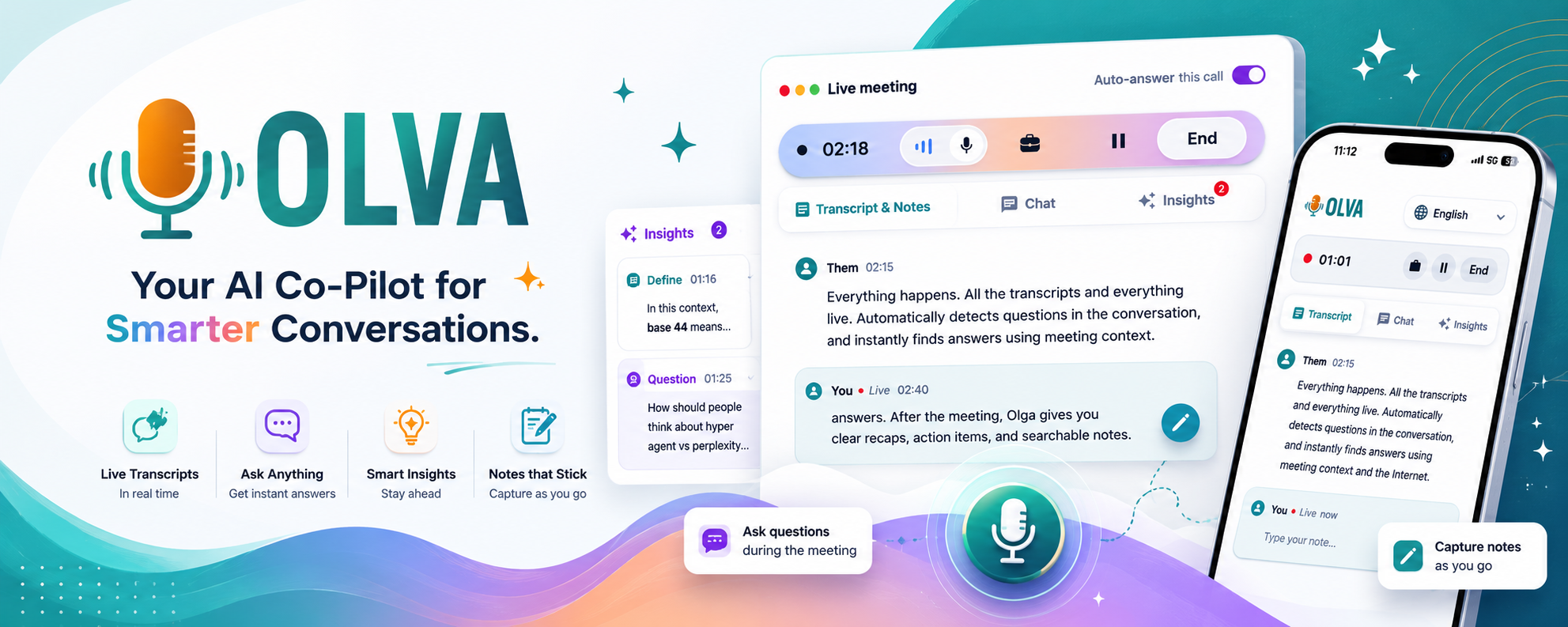
OLVA’s reusable meeting contexts combine written notes with attached documents that are converted to markdown and stored as part of the context. When you select a context at the start of a meeting, OLVA uses it alongside the live transcript to:
- Answer questions with account-specific language and priorities in mind.
- Surface relevant passages from attached documents without you searching the original files.
- Improve prompt relevance for in-meeting coaching and suggested replies.
A critical safety: the live transcript remains the source of truth if it conflicts with the saved context. That ensures meetings reflect what was actually said while still giving you the advantage of pre-loaded, reusable background. If you want to learn more about OLVA and reusable meeting contexts, visit https://olva.ai.
Quick checklist to get started this week
- Create one context for a high-value account or recurring meeting type.
- Attach 1–3 canonical documents (contract, onboarding runbook, usage export).
- Add 3 priority questions and a one-line purpose.
- Start the next meeting with the context selected and measure prep time.
- Update the context after the call with new findings.
Conclusion
Reusable meeting contexts are a low-effort, high-impact way to reduce prep time and raise the quality of sales and customer success conversations. They drive consistency across a team, make live assistance more relevant, and free up reps and CSMs to focus on discovery, coaching, and closing rather than reassembling background information.
For teams using in-meeting AI assistants, contexts add an extra multiplier: the assistant can combine saved background with the live transcript to produce better answers, find the right document passages, and suggest more relevant coaching in real time. Start with a pilot, measure prep time and follow-up consistency, then scale contexts to folders and common meeting types.
If you want to explore reusable contexts that attach documents and work with live transcript-aware assistance, see OLVA’s meeting contexts at https://olva.ai for details and examples.
Appendix: Context templates (copyable)
Discovery Context
- Purpose: [one line]
- Attendees: [who and what they care about]
- Background: [ARR, start date, integrations]
- Goals: [3 bullets]
- Objections: [known sensitivities]
- Terminology: [customer terms]
- Attachments: [contract, runbook, dashboard]
- Priority questions: [3 questions]
QBR Context
- Purpose: Align on progress vs. KPIs
- Attendees: [name roles]
- Background: [contract value, NPS]
- Goals: [1–3 objectives]
- Attachments: [usage CSV, onboarding doc]
- Agenda: [short agenda]
Renewal Context
- Purpose: Secure renewal & identify expansion
- Attendees: [procurement, sponsor]
- Background: [renewal date, financials]
- Attachments: [contract, SOW]
- Priority questions: [procurement timeline, champion]
End of playbook.