Closing More Deals with Live Q&A: Instant Answers for Pricing & Contract Questions
In high-stakes sales meetings, pricing and contract questions are decision points — not footnotes. An unanswered pricing objection or a fuzzy clause in a contract can stall or kill momentum instantly. Sales teams typically rely on follow-up emails, internal Slack threads, or delayed calls with legal and finance. Those delays cost time and, more importantly, momentum.
This article explains how live Q&A and instant answers change that dynamic. It shows practical ways account executives, sales leaders, legal, finance, and customer success can handle pricing and contract questions in the moment — keeping the conversation moving and closing more deals.
We’ll also explain how modern meeting intelligence tools differ. Many platforms record and analyze meetings after the fact. Olva focuses on helping you during the conversation with invisible, document-aware, real-time intelligence. Learn more at https://olva.ai.
Why pricing and contract questions matter — and why they often derail deals
Pricing and contract questions are negotiation triggers. Common patterns include:
- Buyer asks about discounts, pilots, or billing cycles.
- A procurement or legal rep raises a clause — SLA, indemnity, or data residency — that requires review.
- Finance asks for TCO comparisons or ROI evidence.
- Customers ask for custom payment terms or non-standard clauses.
Typical responses are slow: pause the meeting, promise to escalate, and follow up later. That delay gives buyers time to reconsider, loop in competitors, or deprioritize the deal. The faster you answer precisely and confidently, the more likely you are to maintain momentum and close.
Live Q&A + Instant Answers: what changes during the meeting
Live Q&A and instant answers bring subject-matter knowledge into the conversation in real time. Instead of promising to check and reply, you answer immediately — with accuracy, references, and a next step.
Core benefits:
- Maintain momentum: resolve objections without a long pause.
- Increase credibility: show you can answer contract or pricing details on the spot.
- Shorten sales cycles: avoid back-and-forth that delays close.
- Reduce legal bottlenecks: supply clause-level clarity while the negotiation is active.
But not all meeting tools are equal. Some focus on recording, transcription, and post-meeting analytics. Those are useful for coaching and pipeline analysis. They don’t help you navigate the moment when the buyer asks, "Can you split payments over 12 months?" or "What happens if we need uptime credits?"
What modern meeting intelligence should do in a pricing/contract moment
To be useful during a negotiation, an assistant should:
- Detect questions automatically as they happen (not just tag them later).
- Provide contextual answers that use your contract templates, pricing sheets, and past negotiation history.
- Offer suggested phrasing and coaching so reps respond confidently.
- Flag opportunities (upsell signals, urgency) and risks (deal-breaker clauses) as they appear.
This combination turns a passive transcript into an active partner in the meeting.
Competitors: what they do well — and where live Q&A matters
Many popular platforms (Otter.ai, Gong, Chorus, Fireflies) excel at recording meetings, producing transcripts, and surfacing post-meeting insights. They’re invaluable for coaching, pipeline analysis, and compliance. For many teams, those tools have improved win rates by making knowledge reusable.
However, most of them focus on post-meeting workflows: analyze what happened, coach afterward, and support asynchronous collaboration. That approach still requires a time gap between the question and the resolution.
Where live Q&A matters is in the moment. Buyers decide during the conversation. Tools that only help after the meeting can’t fix a lost deal that slipped away while you were waiting for an answer.
How Olva’s live Q&A and instant answers help (without the sales pitch)
Olva is built to assist users during meetings — quietly, privately, and contextually. Here’s how those capabilities map to real sales and legal needs:
- Invisible AI Assistant: Olva runs without joining as a visible bot, so there are no awkward bot participants or notifications. That privacy is especially important in contract negotiations and executive discussions.
- Live Transcription: Real-time transcription captures the conversation so Olva can use the exact thread of the meeting to inform answers.
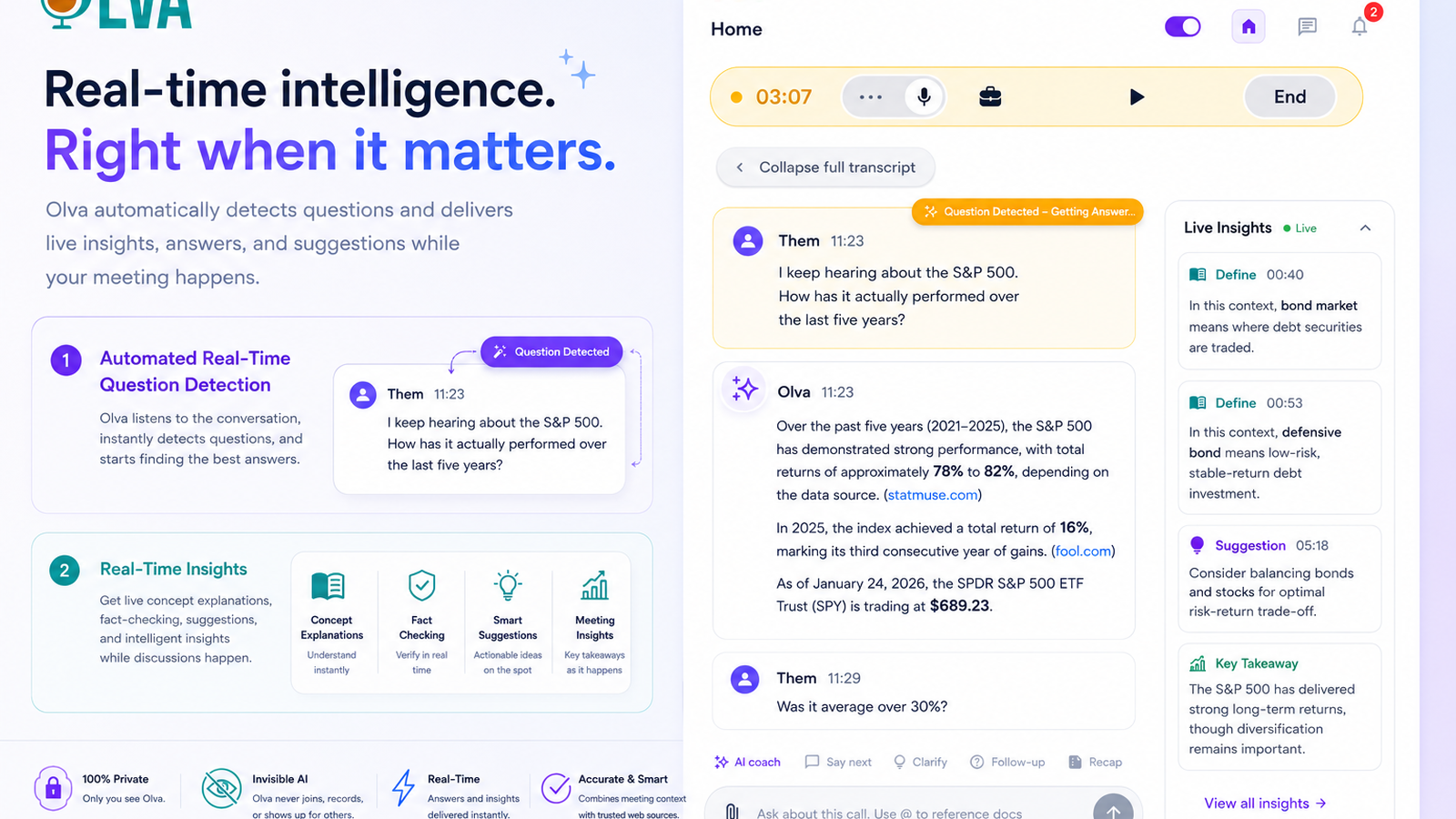
- Automatic Question Detection: Olva detects when a pricing or contract question is asked and alerts the user discreetly — no need to wait for a human to flag it.
- Instant Answers & Live Q&A: When a question is detected, Olva uses uploaded documents (contracts, pricing guides), past meeting memory, and optional web checks to generate an immediate, evidence-backed response.
- Document-Aware Intelligence: Feed Olva your contract templates, SOWs, and pricing decks. Answers reference clause language or exact pricing tiers.
- AI Coaching: Olva suggests phrasing, escalation language, or negotiation tactics — privately — so your rep can respond confidently.
- Live Insights & Opportunity Detection: Beyond answering, Olva surfaces signals such as buying intent, budget readiness, or risk factors that should change your next question.
- Fact Checking: Olva verifies claims (e.g., “Your SLA is 99.9%?”) using the contract text or official docs.
- Post-Meeting Memory: Olva stores decisions and answers so follow-ups are consistent and searchable.
These features emphasize helping you during the meeting — not only creating a transcript afterward.
Practical examples: how a meeting unfolds with instant answers
Example 1 — Pricing objection during a demo
Scenario: The buyer says, “We need a 30% discount to justify this.”
How live Q&A helps:
- Automatic detection: Olva flags the objection as a pricing question.
- Instant answer: Olva searches your pricing rules and previous negotiated discounts and suggests a range (e.g., "Standard discount cap: 20% for deals under $50k; approved exceptions require manager sign-off.") and proposes scripts: "I understand the need for a lower rate — we typically offer a 15–20% introductory discount for first-year commitments of 12 months. Would a 12-month term help bridge the gap?"
- Coaching: Olva suggests a concession ladder and next-step questions to uncover budget: "Is this discount a deal breaker or a preference?" and a closing prompt: "Would an extended payment term be equivalent to a deeper discount for you?"
- Outcome: The rep asks targeted questions and offers a compliant option without ending the meeting.
Example 2 — Contract clause clarification with document-aware answers
Scenario: A procurement rep asks, "What indemnity language do you accept for EU contracts?"
How live Q&A helps:
- Document reference: Olva pulls the uploaded EU contract template and highlights the indemnity clause.
- Instant answer: Olva summarizes allowed edits and notes any clauses that require legal approval (e.g., broad IP indemnities exceeding company risk threshold).
- Suggested phrasing: "We typically accept limited indemnities tied to direct damages; for wider indemnities we escalate to legal. I can propose a compromise clause now if you'd like."
- Outcome: The rep can propose a compliant alternative during the call, reducing procurement’s need to pause negotiations.
Example 3 — Finance asks for TCO comparison
Scenario: Buyer: "How does total cost of ownership compare to Competitor X over three years?"
How live Q&A helps:
- Instant comparator: Olva uses stored price lists and common competitor benchmarks (and optional web checks) to provide a side-by-side cost summary and call out where your offering provides ROI (support, lower onboarding, consolidated billing).
- Opportunity detection: Olva surfaces expansion signals (interest in consolidation) and suggests probing questions: "What costs are you most concerned about — licensing, implementation, or support?"
- Outcome: The rep shares a credible, data-backed comparison before the meeting ends.
Tactical playbook: how to use live Q&A effectively in sales meetings
- Prepare: Upload current pricing sheets, contract templates, playbooks, and approved concession thresholds before the call.
- Set guardrails: Work with legal and finance to define automatic approval thresholds so answers stay compliant.
- Listen first: Use Olva’s live transcription and question detection to ensure you’re answering the real issue.
- Paraphrase: Repeat the buyer’s concern and then use Olva’s suggested phrasing to respond confidently.
- Use document-aware responses: When legal language matters, quote the clause and offer a compliant alternative.
- Capture decisions live: Olva’s post-meeting memory stores negotiated concessions and action items to avoid miscommunication later.
Roles: what each team gains
- Account Executives: Close deals faster by answering pricing and contract questions on the spot and steering negotiations.
- Sales Leaders: Shorten sales cycles and improve forecast accuracy by reducing open action items.
- Legal & Finance: Reduce repetitive reviews by defining guardrails and letting the live assistant apply them.
- Customer Success: Avoid post-sale contract surprises; get consistent handoffs and accurate commitments.
Privacy and governance
Contract and pricing discussions are sensitive. Tools that join meetings as visible bots can create privacy concerns and interrupt buyer dynamics. Olva emphasizes invisible assistance and private AI support — the assistant helps the user without appearing as a meeting participant. Transcripts and data are visible only to the user and can be deleted on demand, supporting compliance and confidentiality.
Measuring impact (what to track)
Track these leading indicators to quantify the effect of live Q&A:
- Time to close (average days in negotiation stage).
- Percent of deals closed without legal rework cycles.
- Number of in-meeting concessions versus post-meeting concessions.
- Win rate in deals where live Q&A was used.
While results vary by organization, teams that reduce post-meeting follow-ups often see faster closes and fewer surprise concessions.
Conclusion
Pricing and contract questions are often turning points in a sale. Traditional approaches — pausing to check with legal or sending follow-ups — lose momentum and create friction. Live Q&A and instant answers let sales teams resolve objections and clarify contract points while the buyer is still engaged.
Tools that only analyze meetings later are important for coaching and process improvements, but the competitive advantage belongs to teams that can act in the moment. By combining automatic question detection, document-aware intelligence, instant answers, and private AI coaching, teams can keep negotiations moving and close more deals.
For teams that prioritize in-meeting performance, modern meeting intelligence — such as the capabilities available at https://olva.ai — represents a practical shift: not just remembering meetings, but succeeding in them.