Reduce No-Decisions: AI Question Detection and Suggested Follow-Ups for Better Sales Handoffs
No-decisions — deals that stall because next steps are unclear — are one of the costliest and most persistent problems in B2B sales. They waste rep time, inflate pipeline friction, and erode forecast accuracy. For sales ops, AEs, customer success, and product managers, the standard toolkit (recordings, manual notes, CRM updates) helps preserve what was said — but it doesn't change the moment of the meeting where a decision could have been made.
This is where modern AI meeting assistants change the equation. Instead of simply helping teams remember meetings, they help people perform better during them. By detecting questions and cues in real time and suggesting relevant follow-ups, AI reduces ambiguity and creates clearer, faster handoffs between sales and post-sale teams.
This article explains how AI-powered question detection and suggested follow-ups reduce no-decisions, with practical examples, a fair comparison to current market tools, and tactical steps you can apply in your organization today.
Why no-decisions happen (and why they keep happening)
Common root causes:
- Unanswered or deferred customer questions (pricing, integration, timelines) leave stakeholders uncertain.
- Missing alignment on next steps after discovery or demo.
- Handoffs that lack context or actionable asks for CS/product teams.
- Inaccurate or incomplete capture of buying signals and objections.
Traditional solutions (full meeting recordings, manual notes, or summary emails) help with documentation but rarely prevent the moment of hesitation when a stakeholder is ready to proceed but still has a concern.
To reduce no-decisions, teams need two capabilities:
- Detect the precise moments that create uncertainty (questions, objections, hesitation).
- Turn those moments into action by suggesting the right follow-ups — in the meeting, immediately.
What AI question detection does better than manual note-taking
AI-powered question detection listens for conversational cues and classifies them in context: pricing concerns, technical gaps, competitive mentions, stakeholder hesitation, and more. This matters because:
- It surfaces questions you might have missed while focusing on the demo.
- It classifies the type of question so follow-ups can be tailored (technical vs. procurement vs. timeline).
- It reduces dependence on the note-taker’s judgment or note quality.
Example: during a product demo, a procurement manager mentions, "We need something cloud-hosted and SOC2-compliant." A human note-taker might flag this as compliance interest. An AI that detects and classifies the question as a security/compliance requirement can prompt a rep to show the SOC2 attestation page or share the relevant PDF from the product folder — while the meeting is still active.
Suggested follow-ups: turning detection into decisions
Detecting a question is only half the battle. The real value comes from immediate, relevant suggested follow-ups that drive the conversation forward. Suggested follow-ups should be:
- Context-aware (based on what was said in the last 5–10 minutes).
- Document-aware (able to reference uploaded PDFs, contracts, or spec sheets).
- Prioritizing actions that reduce ambiguity (clarifying scope, confirming stakeholders, proposing timelines).
Practical follow-up suggestions:
- If a buyer asks about pricing tiers: “Would a one-page price summary sent now help, or would you prefer a tailored quote for X seats?”
- If a technical question arises: “Can I loop in our solutions engineer on a short follow-up call next Tuesday?”
- If the stakeholder hesitates: “What would need to happen for your team to proceed in the next 30 days?”
These prompts are designed to convert uncertainty into a clear next action.
Live, in-meeting value: why timing matters
Most meeting tools capture information for post-meeting review. That’s useful for onboarding and coaching — but it doesn’t prevent a no-decision during the call.
In-meeting features that matter:
- Real-time question detection alerts the rep to critical queries as they happen.
- Instant answers (document-aware) let reps pull in an appropriate slide, policy excerpt, or price detail immediately.
- AI coaching suggests language to reframe or handle objections in the moment.
The difference is like having a discreet, expert assistant whispering the best next step while you lead the conversation — without interrupting the flow or adding a visible bot into the meeting.
A fair look at market alternatives
Tools like Gong, Chorus, and Fireflies have raised the bar for call intelligence: they provide excellent transcription, searchable recordings, and strong analytics for coaching. They are valuable for post-call analysis, trend spotting, and enabling coaching programs.
Where many of those tools excel:
- High-quality transcriptions and recordings.
- Robust post-meeting analytics and manager dashboards.
- Playback and snippet exporting for training and QA.
Where they are often less focused:
- Providing live, unobtrusive support inside the meeting.
- Generating context-aware suggested follow-ups in real time.
- Seamlessly integrating uploaded documents to answer questions instantly while the conversation continues.
This is not to diminish the strengths of existing vendors — it’s to highlight capability gaps that matter for reducing no-decisions. The tools that help teams most are those that combine excellent post-meeting analysis with live, actionable intelligence during the call.
How Olva fits into the workflow (without turning meetings into a spectacle)
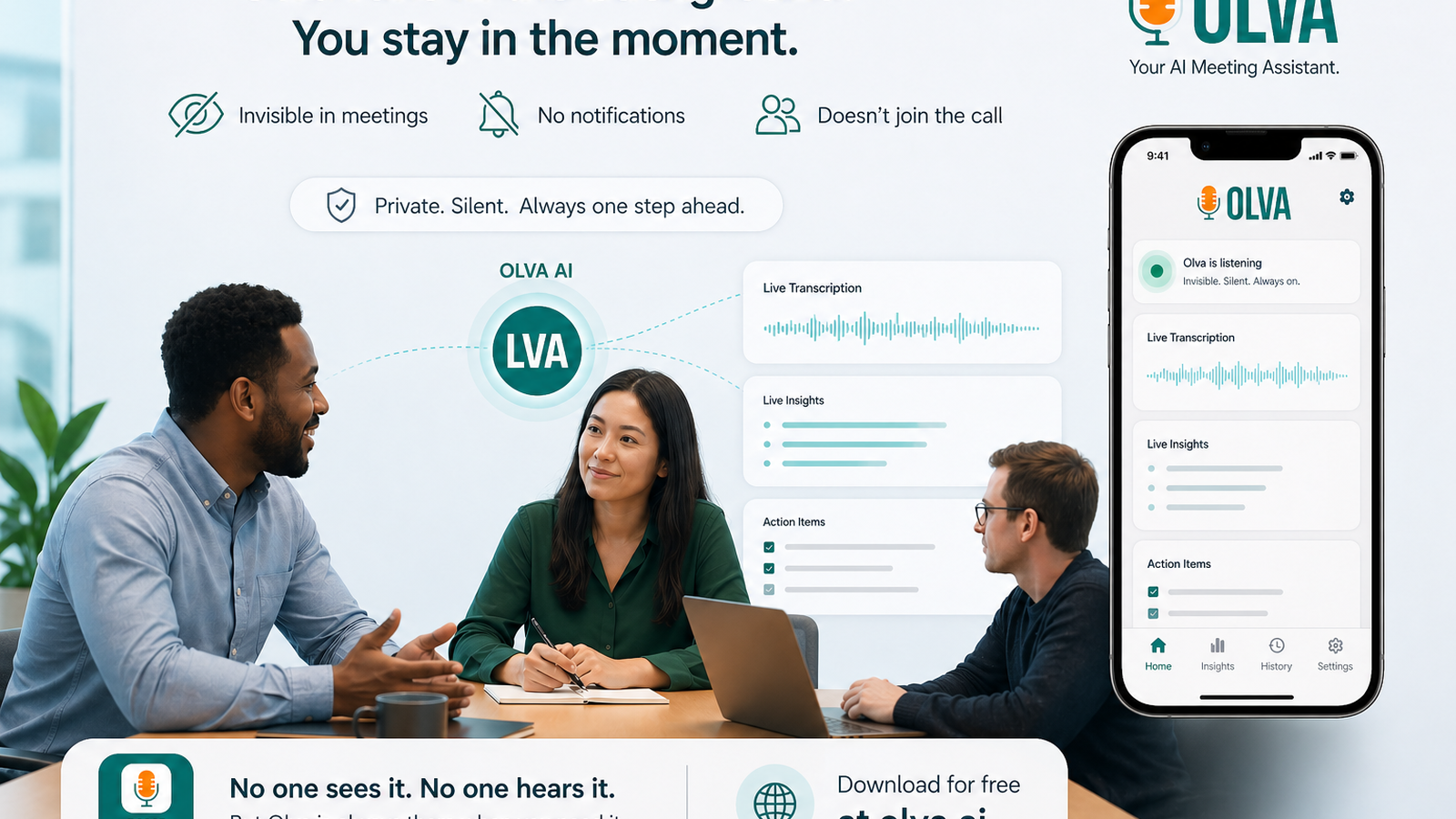
Olva is designed to be an invisible AI meeting assistant that works during the conversation — not just after. Key features that directly reduce no-decisions:
- Invisible AI Assistant: Olva does not join as a bot participant. No awkward notifications or visible presence that can change meeting dynamics.
- Live Transcription: Accurate, real-time capture of both user and participant audio so nothing falls through the cracks.
- Automatic Question Detection: Olva detects customer objections, product questions, pricing discussions, and hesitation.
- Instant Answers & Document-Aware Intelligence: When a question is detected, Olva pulls relevant content from uploaded documents or your meeting memory and generates suggested responses or materials to share.
- Live Q&A and AI Coaching: Reps can privately ask Olva for phrasing, clarifications, or follow-up questions while the meeting is still ongoing.
- Live Insights & Opportunity Detection: Olva surfaces buying signals and risk indicators — insights that shape the most appropriate follow-up.
- Post-Meeting Memory: Everything is stored in a searchable way so subsequent handoffs to CS or product teams happen with complete context.
Visit https://olva.ai for product details and examples of how teams use live meeting intelligence to close more decisively.
Real-world examples: reducing no-decisions with AI in the meeting
- Faster security confirmation
Scenario: A buyer asks about hosting and compliance late in the demo.
AI action: Olva identifies this as a security/compliance question, automatically retrieves the SOC2 report from an uploaded dossier, and suggests: “Offer to share the SOC2 attestation now and propose a short follow-up with security stakeholders.”
Result: The buyer gets immediate confidence-building documentation and a clear next step, reducing hesitation.
- Pricing clarity that closes
Scenario: Mid-demo, a procurement manager asks about discounts for annual billing.
AI action: Olva detects a pricing question, offers suggested phrasing to the AE (e.g., “For annual billing, many customers save X%; if annual pricing is your priority, I can prepare a quick tailored quote.”), and suggests sharing a one-page price comparison.
Result: The conversation moves to a pricing decision rather than a pause.
- Clean handoffs to CS after purchase intent
Scenario: During demo, the buyer signals expansion opportunities.
AI action: Olva flags the buying signal, recommends next steps (schedule an implementation scoping session, gather technical contacts), and populates a CRM note and a handoff checklist for CS.
Result: Handoffs are complete, contextual, and actionable — reducing friction after contract signing.
Tactical steps to implement AI-driven follow-ups in your organization
- Define priority question types to detect: pricing, compliance, integrations, timelines, and stakeholder readiness.
- Upload key documents (contracts, SLAs, product specs) to make follow-ups document-aware.
- Train reps on in-meeting AI usage and private prompts: practice asking for suggested phrasing or quick summaries during calls.
- Standardize handoff templates that AI can populate automatically (CRM notes, CS checklists, next-step emails).
- Measure impact: track reduction in stalled deals, time-to-close, and the percentage of meetings with clear next steps.
These steps turn AI from a novelty into an operational lever that reduces no-decisions across the funnel.
Measuring success: KPIs that show fewer no-decisions
Track these metrics to quantify impact:
- Decrease in deals marked as "stalled" or "no decision".
- Increase in meetings that end with an agreed next step and owner.
- Shorter average time between demo and next-step meeting or quote.
- Higher conversion from qualified opportunity to closed-won within X days.
- Improvements in forecast accuracy and reduced pipeline padding.
Use a combination of CRM data and call intelligence to attribute improvements to AI-driven in-meeting actions.
Privacy and human-centered design
Reducing no-decisions doesn't require a visible, intrusive bot. Privacy matters: Olva is private by design, does not join meetings as a bot participant, and gives users control over transcripts and memory. This keeps conversations natural while still providing the live intelligence reps need.
Conclusion: Move from remembering to performing
No-decisions are the product of ambiguity. To reduce them, organizations need tools that detect uncertainty in real time and turn it into action. AI-powered question detection and suggested follow-ups change meetings from static recordings into dynamic decision environments.
For sales ops, customer success, AEs, and product managers, the path to fewer no-decisions is operational and behavioral: identify the signal types that cause stalls, equip reps with live, context-aware support, and standardize handoffs that preserve the momentum built during the meeting.
By focusing on in-meeting performance — not just post-meeting analysis — teams can close more deals, shorten sales cycles, and deliver smoother transitions from prospecting to onboarding. Solutions like Olva demonstrate how invisible, document-aware, and coaching-enabled AI becomes a practical advantage in that moment when it matters most: during the conversation.
To learn more about practical implementations and examples, explore https://olva.ai and see how live meeting intelligence transforms handoffs and reduces no-decisions.