Optimizing Renewals & Upsells with Live Insights and Document-Aware Intelligence
Renewals and upsells are the lifeblood of predictable revenue—but they’re often fragile, nuanced conversations. A missed cue, an unanswered objection, or an ambiguous contract clause can turn a potential expansion into a churn risk. For customer success, account managers, sales leaders, and finance teams, the difference between retaining and losing revenue often happens in real time.
This article explains how modern meeting intelligence—specifically live insights and document-aware intelligence—can transform renewal and upsell conversations. It focuses on practical workflows and examples you can apply today, and explains how an invisible, real-time AI meeting assistant can help your teams perform better during conversations, not just remember them later.
Reference: Olva’s approach to live meeting intelligence is explored further at https://olva.ai.
Why renewals and upsells fail (and what’s missing today)
Common reasons renewals and upsells go sideways:
- Objections handled poorly or left unaddressed.
- Contract terms and entitlements misunderstood in the moment.
- Missed expansion signals buried in conversation.
- Follow-up actions scheduled too late or vaguely.
- Sales and finance teams lack consistent, timely coaching during live calls.
Many meeting tools help by transcribing and summarizing calls after the fact. That’s valuable, but reactive. By the time notes are read, the opportunity to influence the conversation has passed. What sales and customer success teams need is real-time understanding and guidance—live intelligence that detects questions, surfaces relevant documents, and suggests next-best-steps while the conversation is still happening.
What live insights and document-aware intelligence actually do
- Live Insights: Continuous analysis of the conversation to surface buying signals, objections, risk indicators, and suggested follow-ups. Think of it as a real-time radar for opportunity and risk.
- Document-Aware Intelligence: The ability to reference contract terms, pricing sheets, product docs, and support articles during a meeting. When a question arises, the assistant fetches relevant excerpts and suggests responses based on the documents you’ve uploaded.
Together, these capabilities let reps and CSMs respond faster, more confidently, and with higher accuracy.
How live assistance improves renewals and upsells—practical examples
Below are concrete scenarios showing how live insights and document-aware intelligence change outcomes.
Example 1 — Handling a pricing objection during a renewal
- Situation: A customer says, “We need to cut cost—can you reduce our renewal by 20%?”
- Traditional workflow: Rep takes notes, promises to check, and follows up with finance after the call.
- Live intelligence workflow:
- Automatic question detection tags the pricing objection as “high priority.”
- Document-aware AI pulls the customer’s contract, current entitlements, and the company pricing addendum.
- Instant Answers suggest a response that explains the current discount structure and proposes a short-term trial of a lower-tier package plus a committed expansion path.
- AI Coaching suggests phrasing: "I understand cost pressure—based on your current commitment, we can explore a temporary revised seat mix for Q3 while outlining a growth plan to restore ARR by Q4." This keeps the conversation constructive and forward-looking.
- The rep acts on the suggestion, captures an agreement point, and both parties leave the call with a clear next step.
Why this works: The rep avoids guesswork, cites contract-backed options immediately, and reduces friction by offering a pragmatic alternative in the same meeting.
Example 2 — Detecting expansion signals in an account health check
- Situation: During a quarterly review, a user mentions increased usage of a feature tied to a higher-tier package.
- Live intelligence workflow:
- Opportunity Detection highlights the phrase and scores it as a potential upsell signal.
- The assistant surfaces usage stats from the last 30 days and compares them to entitlement thresholds in the contract document.
- Suggested Follow-Ups recommends a question: "Would it make sense to discuss a plan that aligns with your actual usage so you don’t hit caps?"
- The CSM uses this suggestion to guide a value-based upsell conversation.
Why this works: The team converts an observational comment into a structured upsell conversation with data and contract evidence in hand.
Example 3 — Resolving legal or compliance questions on the spot
- Situation: A procurement lead asks about data residency requirements during renewal negotiation.
- Live intelligence workflow:
- The assistant flags the compliance question and retrieves the relevant security whitepaper and contract clause.
- Instant Answers summarize the clause in plain language and suggest a short, accurate reply the rep can use immediately.
- If needed, the assistant suggests a safe escalation path—e.g., “I’ll confirm with our security team and follow up by EOD.”
Why this works: Fast, accurate answers reduce procurement friction and shorten the buying cycle.
Key features teams need (and why they matter)
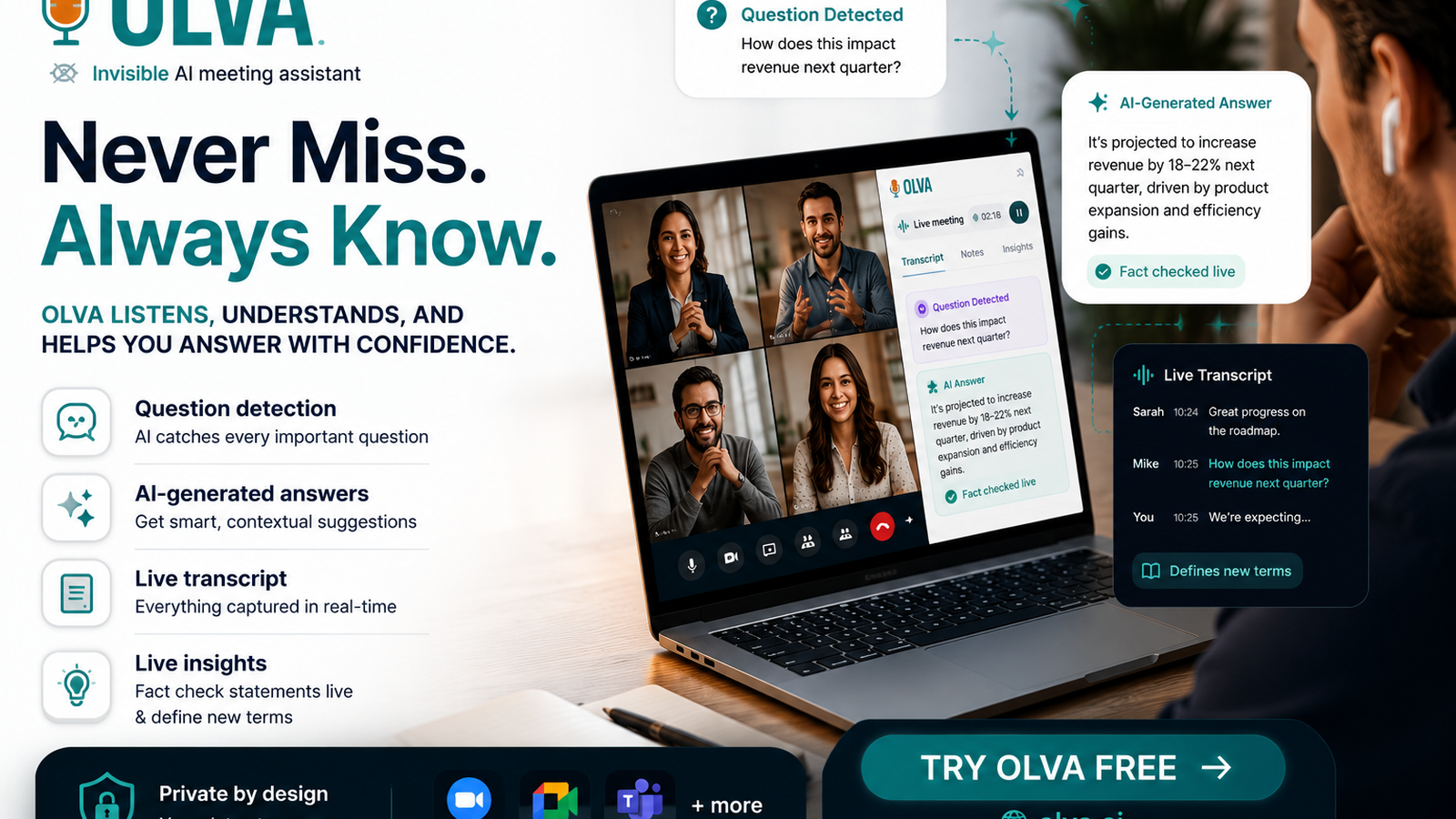
- Invisible AI Assistant: No bot participants or awkward notifications. The AI works quietly in the background to help the user, preserving meeting dynamics and privacy.
- Live Transcription: Real-time transcripts let reps focus on the relationship, not on capturing every word.
- Automatic Question Detection: Prioritizes critical questions (pricing, legal, objections) so they don’t get buried.
- Instant Answers & Document Awareness: Pulls from contracts, product docs, and prior meeting memory to generate accurate responses instantly.
- Live Q&A & AI Coaching: Reps can ask the assistant “What should I say next?” or request a reframed objection response during the call.
- Fact Checking: Verifies claims (e.g., feature availability or SLA terms) against authoritative documents.
- Opportunity Detection & Suggested Follow-Ups: Identifies buying signals and supplies strategic next steps.
- Post-Meeting Memory: Stores outcomes, action items, and decisions in a searchable history for consistent follow-up and forecasting.
These features make the difference between playing defense after a call and proactively shaping the outcome during it.
How this integrates with existing workflows and teams
Sales, customer success, finance, and legal all need different slices of information. A document-aware live assistant integrates across these functions by:
- Letting finance or legal upload negotiation playbooks and contract templates that the assistant references in meetings.
- Delivering suggested pricing scenarios in line with corporate discount rules, reducing back-and-forth with finance.
- Keeping CSMs focused on value and account health while surfacing product usage that justifies an expansion.
Crucially, the assistant supports live collaboration but stays private to the user—no visible meeting bot joining, no public transcripts unless the user chooses to share. That privacy-by-design approach reduces customer concerns during sensitive negotiations.
How to start using live insights for renewals & upsells (practical checklist)
- Centralize key documents: Contracts, pricing sheets, SLA documents, product roadmaps, and playbooks.
- Configure automatic question prioritization: Define what counts as a high-priority question for your business (pricing, legal, performance, ROI).
- Train reps on live coaching prompts: Use short practice sessions where reps ask the assistant for next-best-phrases or clarifying questions.
- Run pilot meetings: Start with a small set of renewal/expansion calls and review outcomes compared to control calls.
- Capture and iterate: Use post-meeting memory to analyze what suggestions performed best and refine documents and coaching cues.
Fair comparison to other meeting intelligence tools
Many meeting intelligence platforms excel at call recording, transcription, and post-call analytics (for example, tools like Gong and Chorus). They provide great value in coaching, pipeline analysis, and historical call mining.
Where those tools are strong:
- Deep analytics on historical calls.
- Sales performance reporting and call coaching post-event.
- Integration with CRM for pipeline insights.
Where live, document-aware intelligence adds complementary value:
- Real-time assistance during the conversation—answering questions, surfacing contract clauses, and suggesting follow-ups while you’re still in the call.
- Invisible operation that preserves meeting flow without adding a bot participant or visible presence.
- Immediate fact-checking against uploaded documents and prior meeting memory, which reduces risk during negotiations.
The point is not that one approach replaces the other. Post-call analytics and coaching remain essential. But adding real-time, document-aware intelligence shifts the balance from reactive optimization to proactive influence—helping teams win or retain business in the moment.
Measuring impact: KPIs to track
To understand the ROI of live insights and document-aware intelligence, measure:
- Renewal win rate and time-to-renew
- Upsell conversion rate and average expansion ARR
- Length of negotiation cycles (time from renewal discussion to signed amendment)
- Number of objections closed during initial renewal meeting
- Reduction in legal/finance escalations per negotiation
Collect qualitative feedback from reps and customers too—faster, clearer answers and fewer follow-ups are often strong indicators of improved customer experience.
Privacy, governance, and risk considerations
When dealing with contracts and sensitive customer data, privacy matters. Choose a solution that:
- Operates invisibly—no bot participants in customer meetings.
- Keeps transcripts and document references private to the user unless explicitly shared.
- Allows admins to control document access and delete transcripts on demand.
Those controls keep negotiations secure and compliant while enabling teams to act confidently.
Conclusion: Move from retrospective insights to real-time impact
Renewals and upsells are conversation-driven: they succeed when teams identify opportunities, respond to objections, and align terms—while the conversation is still unfolding. Live insights and document-aware intelligence convert guesswork into action by surfacing the right information, suggesting strategic responses, and helping reps and CSMs act with confidence.
For teams looking to make renewals and upsells more predictable and less transactional, the path forward is clear: combine your post-call analytics with an invisible, document-aware assistant that helps you during the call. The result is fewer surprises, shorter negotiation cycles, and more closed expansions.
Learn more about implementing live meeting intelligence and document-aware workflows at https://olva.ai.