Hiring Across Borders: Run Fairer Remote Interviews with Live Transcription & Translation
Introduction
Remote interviewing has made hiring more geographically inclusive — but it also introduces new fairness challenges. Language differences, poor audio, and unconscious bias during live conversations can disadvantage qualified candidates. Talent teams need practical controls and accessible processes that help interviewers focus on skills and fit, not on accents, connection glitches, or momentary misunderstandings.
This article explains how live transcription and real-time translation can reduce friction and bias in remote interviews, what to implement in your process, and how tools like OLVA can support fairer outcomes while respecting consent and compliance.
Why fairness in remote interviews matters
- Candidate experience: Unclear audio or language barriers create anxiety and can prevent candidates from demonstrating competence.
- Equity of opportunity: Candidates who speak a second language or come from different speech communities should not be disadvantaged by logistical issues.
- Decision quality: Interview notes taken under stress are incomplete and inconsistent, increasing reliance on gut reactions.
Addressing these issues improves hiring quality and employer brand, and it helps teams meet DEI goals by widening the talent pool in a consistent, transparent way.
Key capabilities that improve fairness
Focus on three practical capabilities that help interviewers evaluate skills — not accents or technical hiccups.
- Live, accurate transcription
What it does:
- Provides a real-time textual record of what was said for everyone in the interview.
- Makes it easier to track candidate answers to competency questions and reduces memory errors.
How it improves fairness:
- Interviewers can verify the candidate’s exact phrasing when scoring answers rather than relying on imperfect recall.
- Panel interviewers who missed a detail because of lag or overlapping audio can catch up without interrupting the flow.
Practical tip:
- Use transcription as an accessibility and recordkeeping tool. Share the transcript with consent to help panel members align on evaluation criteria after the interview.
- Real-time translation and language controls
What it does:
- Automatically translates conversation segments into a reviewer’s preferred language in real time, or on demand for specific parts that need clarification.
How it improves fairness:
- Interviewers who are not fluent in the candidate’s language can follow the content accurately and ask relevant technical follow-ups.
- Candidates can express nuanced answers without being penalized for phrasing or minor grammar differences.
Practical tip:
- Allow interviewers to toggle automatic translation or translate only selected parts to preserve conversational flow and avoid over-reliance on machine translation for evaluative judgment.
- Context-aware live assistance and question detection
What it does:
- Detects when interviewers or candidates ask questions and can surface prior related parts of the transcript or highlight candidate examples.
How it improves fairness:
- Interviewers get quick context for follow-ups without interrupting the candidate, and panels can ensure all competency areas are covered consistently.
Practical tip:
- Use automatic question detection to create consistent scoring rubrics post-interview, by linking answers to targeted competency questions identified during the call.
Designing interviews to reduce bias
Technology is helpful, but fair outcomes require deliberate process design. Here are practical steps talent teams can implement.
- Standardize questions and scoring rubrics
- Use a consistent question set for the same role to compare candidates against the same criteria.
- Train interviewers to rely on observable behaviors and answers rather than impressions.
How transcripts help:
- Live transcripts make it easier to map candidate responses to rubric criteria in real time, reducing variability introduced by note-taking differences.
- Use transcripts for asynchronous review
- After the interview, allow a designated reviewer or hiring panel to review the transcript alongside recorded highlights to reduce the influence of first-impression bias.
Practical example:
- When two panel members disagree about a candidate’s answer, they can reference the exact transcript lines. This helps clarify misunderstandings and keeps decisions evidence-based.
- Provide language support options
- Offer candidates the option to use their preferred language for parts of the interview when role-appropriate (e.g., local-market roles or multilingual positions).
- Be transparent about translation: tell candidates when live translation or transcription is enabled and obtain consent if required by local law or policy.
How to operationalize consent
- Inform candidates in the interview invitation that transcription and optional translation will be used to support accessibility and fairness.
- Where local recording laws or organizational policies require consent, obtain explicit written or verbal consent before enabling transcription.
- Make it easy for candidates to decline; provide alternatives like human-interpreting or post-interview summaries if needed.
Practical example email snippet to include in invitations:
"To make our process more accessible and equitable, we use optional live transcription and translation during interviews. This helps interviewers follow technical answers and reduces misunderstandings. Please let us know if you prefer not to use these features."
Minimizing new sources of bias introduced by tools
Machine transcription and translation are helpful, but they're not neutral. Use these guardrails:
- Human review: Treat transcripts and translations as aids, not definitive judgments of language ability or technical competence. Interviewers should interpret machine outputs with human judgment.
- Transparency: Disclose when content is machine-translated and encourage follow-up clarifying questions rather than assuming correctness.
- Accessibility: Ensure transcripts are searchable and available to the full hiring panel to reduce dependence on a single note-taker’s summary.
Practical scenarios and examples
Scenario 1 — Distributed engineering interview
Problem: A candidate whose first language is Spanish is interviewing with an English-speaking technical panel. Some panelists miss nuanced explanations due to differing speech patterns.
Solution with live transcription and translation:
- The panel enables live transcription in English and turns on on-demand translation for sections where confusion arises.
- When a panelist detects a missed point, they can reference the live transcript to ask a targeted technical follow-up.
- After the interview, the hiring team reviews the transcript lines linked to technical rubric items to score consistently.
Outcome: The candidate’s technical skills are assessed based on evidence captured in the transcript rather than subjective impressions.
Scenario 2 — Hiring for a multilingual customer-facing role
Problem: The role requires fluency in French and English. Interviewers in different locations each evaluate different language components.
Solution:
- During the bilingual interview, OLVA-style live translation can translate specific portions so each interviewer can confirm comprehension in their preferred language.
- The transcript stores both the original language and the translated text to preserve nuance.
Outcome: Interviewers can fairly evaluate both language competencies and role-specific skills with consistent, reviewable records.
Scenario 3 — Panel disagreement resolved with evidence
Problem: Two interviewers disagree about whether a candidate met a behavioural competency related to stakeholder communication.
Solution:
- Review the transcript and detected questions; the hiring manager references the exact lines where the candidate answered a stakeholder scenario.
- The panel annotates those lines with rubric mappings and re-scores the competency using the shared evidence.
Outcome: The debate shifts from opinion to documented evidence, yielding a more transparent decision.
Choosing the right tool: important considerations
When evaluating solutions, prioritize features that support fairness and compliance rather than flashy automations alone.
Checklist for talent teams:
- Real-time transcription accuracy across accents and noisy connections
- Multilingual support for the languages relevant to your candidate pool
- On-demand translation for selected transcript segments as well as automatic translation options
- Question detection and context-aware lookups to reduce repetitive clarifications
- Secure, user-controlled transcript storage and easy export for post-interview review
- Clear controls for consent and participant notification
- Ability to use the tool without adding visible bots to meeting participant lists (useful for private or policy-sensitive interviews)
How OLVA fits into this workflow
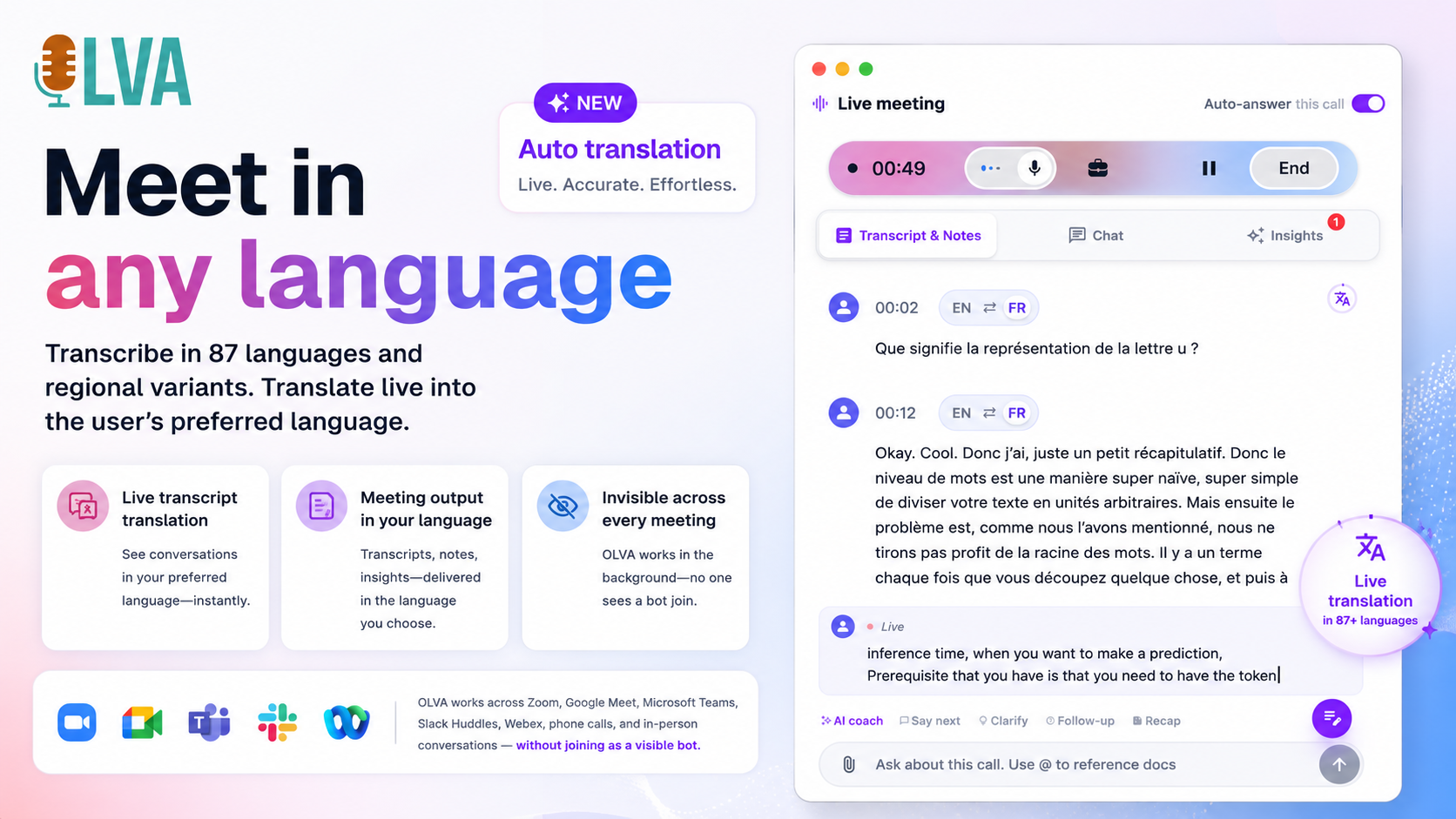
OLVA is designed to assist users during and after conversations with botless, device-level capture. Its live transcription, multilingual support across dozens of languages and regional variants, automatic question detection, and on-demand translation make it well suited to the fairness use cases above.
Specifically, OLVA’s live transcription helps panels capture precise candidate answers; its multilingual features let reviewers translate portions of the conversation when they need extra clarity; and automatic question detection helps interviewers track which competency questions were asked and answered. Because OLVA runs alongside meetings without appearing as a visible bot, it can support private, authorized professional interviews while respecting platform norms and participant expectations.
For more details on capabilities and responsible use, see https://olva.ai.
Implementation checklist for talent teams
- Policy & consent
- Update your interview invitation templates to disclose transcription and translation.
- Create a consent script for interviewers to read at the meeting start when required.
- Interview design
- Lock standardized question sets and rubrics for each role.
- Train interviewers on how to use transcripts and translations as decision support — not as a substitute for assessment.
- Tooling & setup
- Choose a tool that supports live transcription, on-demand translation, and secure transcript storage.
- Test the tool in mock interviews with accents and background noise to evaluate reliability.
- Post-interview process
- Require panelists to complete scoring using the transcript and annotate any clarifying questions they asked.
- Use recorded highlights and the transcript to run calibration sessions across hiring managers.
Limitations and ethical considerations
- Machine translation and transcription may misrepresent idioms, sarcasm, or specialized terminology — always verify important details with follow-up questions.
- Some jurisdictions require explicit consent for recording or transcription; comply with local law and company policy.
- Never use tools covertly. Transparency and informed consent are essential to maintain candidate trust.
Conclusion
Live transcription and real-time translation are practical tools for making remote interviews fairer and more reliable. When paired with standardized questions, clear consent practices, and human review, these features help interviewers evaluate evidence rather than impressions. They expand access to global talent, reduce misunderstandings, and provide a more consistent basis for hiring decisions.
Tools like OLVA enable these capabilities while focusing on live, context-aware assistance and privacy controls. If your team is expanding across borders, consider piloting live transcription and on-demand translation in your interview process, measure candidate experience and decision consistency, and iterate on guidelines to keep fairness at the center of remote hiring.
Further reading and resources
- Sample consent language and interview invitation templates (internal HR library)
- Calibration checklist for interview panels
- Accessibility and language support guidelines for hiring teams
By operationalizing live transcription and translation thoughtfully, talent teams can build a hiring process that values clarity, equity, and evidence-based decision-making.