Customer Success Across Languages: Live Transcripts and Translation to Improve Retention
Introduction
Customer success teams increasingly operate across geographies, time zones, and languages. That diversity expands market opportunity — and also raises the risk of miscommunication, missed commitments, and churn. For customer success managers (CSMs), account managers, and support leads, the ability to understand and respond accurately during conversations is essential to retention. This article explains practical strategies for using live transcription and real-time translation in customer conversations, illustrates actionable workflows, and shows how tools like OLVA can help deliver consistent, multilingual customer experiences.
Why multilingual conversations matter to retention
- Misunderstandings drive friction. Small misinterpretations about timelines, scope, or feature behavior can compound into larger trust issues.
- Customers who feel heard renew at higher rates. Language comprehension is part of empathy: customers need to feel understood in their preferred language.
- Faster resolution reduces churn. The quicker you can diagnose a problem and confirm next steps, the less likely a customer will decide to look elsewhere.
Live transcripts and translation are not a panacea, but they reduce cognitive load, speed up response time, and create an auditable record of what was discussed — all of which support retention-focused activities.
Key capabilities that matter in customer conversations
When evaluating or designing a workflow, prioritize these capabilities:
- Live transcription: accurate, near-real-time text of the conversation your team is having with the customer.
- Automatic and on-demand translation: the ability to see the transcript in your preferred language automatically, or to translate any selected segment when extra clarity is needed.
- Question detection and context-aware answers: the system detects customer questions and helps surface the correct context or pre-approved responses.
- Document-aware intelligence: linking contracts, onboarding guides, support articles, or tickets so the assistant can reference them during the call.
- Privacy and consent controls: ensuring recordings/transcripts follow legal and organizational rules.
Practical use cases and workflows
- Onboarding calls: reduce rework and align expectations
Problem: Onboarding conversations often include complex setup steps, timelines, and role-based responsibilities. With multilingual customers, the risk that a setup detail is missed increases.
Workflow:
- Before the call, upload the onboarding checklist and the customer’s signed agreement to your meeting assistant.
- During the call, use live transcription to follow any fast exchanges and confirm commitments in text.
- If a customer speaks in a different language, enable automatic translation into your default language so you can follow in real time. If a particular sentence is unclear, use on-demand translation to view that line in the customer's language and in your language.
- Immediately after confirming a next step verbally, create an action item in the transcript (or have the assistant extract it automatically). Share the written action item with the customer in their preferred language.
Why it improves retention:
- Clear, written commitments reduce scope creep and misaligned expectations. Customers are more likely to continue when onboarding succeeds first.
- Escalations and technical troubleshooting: reduce resolution time
Problem: Escalations involve technical details, and misunderstandings can lead to repeated efforts and frustration.
Workflow:
- Start the call with live transcription enabled so engineers and CSMs can quickly jump to the parts they need.
- If non-native speakers are present, use live translation to level the field and reduce real-time interpretation errors.
- Use document-aware intelligence to surface relevant KB articles, logs, or configuration files without leaving the call.
- Let the assistant detect questions (for example, “Is this covered in our SLA?”) and bring the relevant contract clause or previous decision into view.
- Capture action items with owners and deadlines in the transcript and route them to your ticketing system.
Why it improves retention:
- Faster, accurate troubleshooting strengthens trust. When customers see follow-through and timely fixes, they renew.
- Quarterly business reviews (QBRs) and renewal conversations: align outcomes and value
Problem: Renewal discussions can fail when value is not clearly demonstrated to stakeholders who speak different languages.
Workflow:
- Record a multilingual QBR with live transcription and generate a summary capturing usage metrics, wins, issues, and recommended next steps.
- Translate the executive summary into the customer’s language and send an editable slide deck that highlights agreed KPIs and next steps.
- Use the assistant’s searchable meeting history to reference earlier commitments, showing continuity and accountability.
Why it improves retention:
- Clear demonstration of outcomes in the customer’s language reduces friction in renewal negotiations and preserves long-term relationships.
Operational best practices for multilingual customer success
- Establish clear consent and recording policies
- Always follow local recording and privacy laws and your company’s policies. Notify participants and obtain consent when required.
- Offer alternatives for customers who decline transcription or translation, such as sending written recaps after the call.
- Standardize post-meeting outputs
- Translate and share meeting summaries, action items, and decisions in the customer’s preferred language within 24 hours.
- Use templates for follow-ups to ensure essential details (owner, due date, acceptance criteria) are always included.
- Train CSMs on how to use live tools effectively
- Teach when to rely on live translation and when to verify with the customer (for example, before committing to contractual changes).
- Encourage a habit of confirming key points in the customer’s language when possible: “To make sure I understood, we will do X by Y — is that correct?”
- Maintain translation quality control
- Use human review for sensitive or contractual language. Machine translation is fast and helpful for understanding, but legal or pricing commitments should be double-checked.
- Maintain glossaries for product terms and common phrases to reduce variation across translations.
Measuring impact on retention
Track metrics that tie language-enabled workflows to customer outcomes:
- Time to resolution (average time to close support tickets after meetings)
- Number of follow-up clarifications required (lower is better)
- Renewal rate by region/language cohort
- Net promoter score (NPS) or Customer Satisfaction (CSAT) before and after introducing live transcription/translation
- Time between onboarding and first value milestone
Practical tips for measurement:
- Start with a pilot group of customers in two language cohorts and compare outcomes to a control group.
- Tag meetings where translation or transcription was used and correlate with ticket velocity, action-item completion rate, and renewal decisions.
Examples of language-aware meeting scripts and phrases
- When confirming a commitment: “I will send the installation checklist today and we’ll reconvene on Tuesday. I’ll also include this in the follow-up email in [customer language]. Does that timing work for you?”
- When clarifying a technical point: “I want to be sure I understood your concern about X. Can you repeat the example? I’ll note it in the transcript and translate it so our engineering team has the exact wording.”
- When the customer prefers their language: “Would you like me to send the summary in [customer language] after the call?”
How OLVA supports multilingual customer success (practical, non-salesy explanation)
OLVA is designed to help users during and after conversations, and several of its features map directly to the workflows above:
- Live transcription: follow fast conversations and capture an accurate, searchable record.
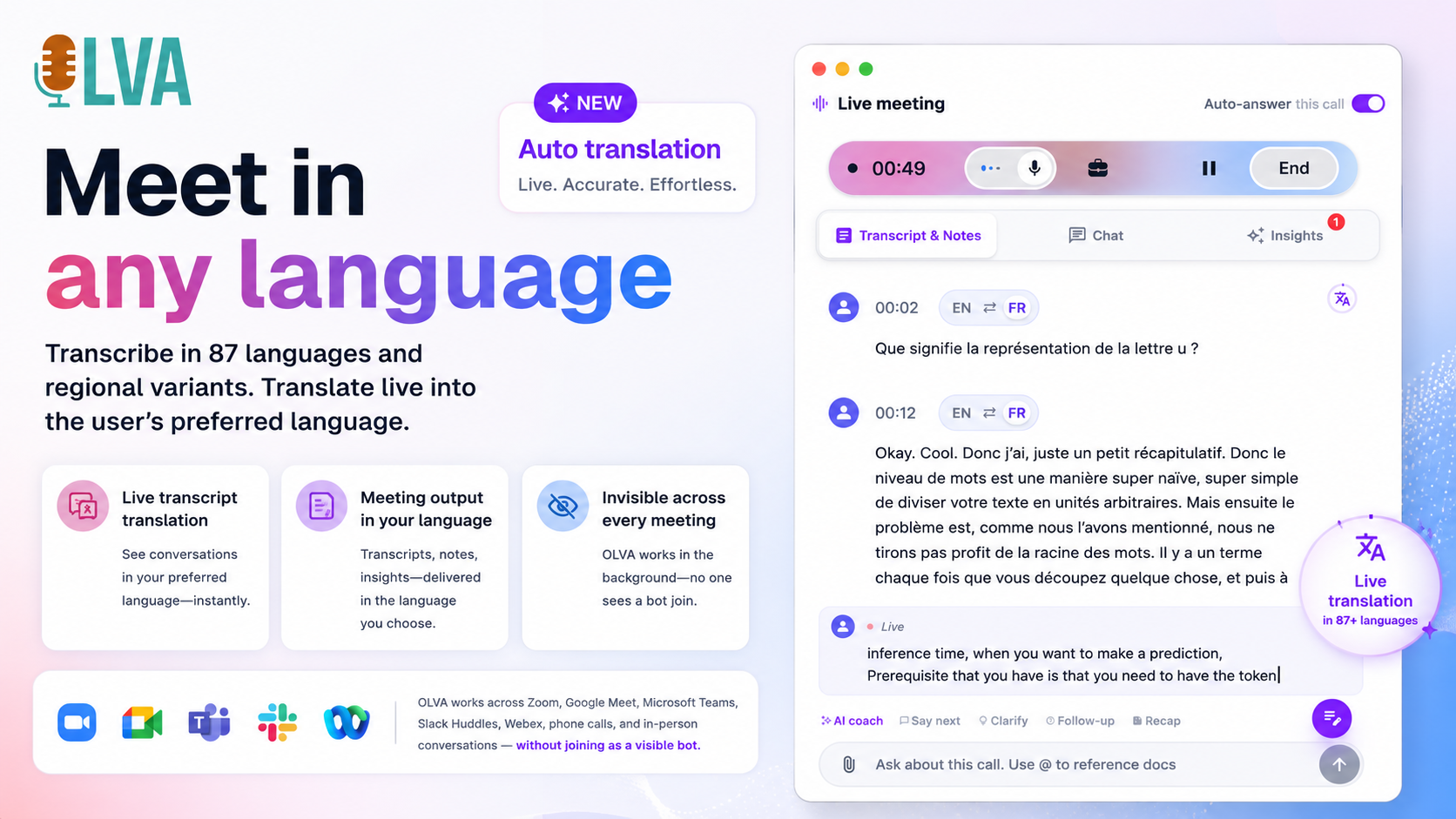
- Multilingual support (87 languages and variants): automatically translate meeting content into your preferred language or manually translate selected sections when you need extra clarity.
- Automatic question detection and instant context-aware answers: surface questions and relevant meeting context so CSMs can respond more confidently during the call.
- Document-aware intelligence: reference contracts, onboarding checklists, or support docs while the conversation is happening so answers are grounded in the right materials.
- Post-meeting summaries, action items, and editable slide decks: share translated, structured outputs that reinforce commitments and reduce ambiguity.
Note: OLVA operates botless and privately on the user’s device, so it can assist without joining the meeting as a visible participant. Users are still responsible for obtaining consent and following applicable recording policies. For more details on OLVA’s capabilities, visit https://olva.ai.
Example end-to-end scenario using live transcripts and translation
Situation: A CSM at a SaaS company runs a renewal call with a French-speaking customer. The CSM’s native language is English. The customer raises concerns about recent performance and requests a price adjustment.
- Before the call: the CSM uploads the contract and recent usage reports to OLVA so they are available as reference.
- During the call: OLVA transcribes the meeting live and automatically translates the transcript into English for the CSM. OLVA detects a customer question about SLA credits and surfaces the relevant contract clause.
- Real-time help: The CSM uses OLVA’s instant answer capability to draft a clear explanation of the SLA and proposes a follow-up remediation plan. The CSM paraphrases the plan and asks for confirmation. OLVA translates the paraphrase into French so the customer can verify.
- After the call: OLVA generates a summary, extracts three action items, and creates a short slide deck summarizing usage, the agreed remediation, and the next steps. The CSM reviews, makes minor edits, and sends the materials in French within the agreed 24-hour window.
Outcome: The customer feels understood, the remediation plan is documented in their preferred language, and the renewal proceeds with a commitment to re-evaluate performance in 60 days.
Limitations and responsible use
- Machine translation and transcription are helpful but not infallible. Use human review for contract language, pricing changes, legal terms, or anything with material risk.
- Respect privacy and legal requirements. Obtain consent where required and be transparent with customers about what will be recorded, transcribed, or translated.
- Avoid overreliance on translation to mask poor product documentation. Parallel investments in localized product content, training, and support articles produce compounding benefits.
Getting started checklist for customer success teams
- Choose a meeting assistant that supports live transcription and translation and test it in internal meetings.
- Define a consent and privacy policy for transcription and translation and roll it out with CSMs.
- Pilot with a small cohort of multilingual customers and collect baseline metrics.
- Create templates for translated follow-ups and action items.
- Train CSMs on when to use machine translation vs. human review.
- Measure outcomes and iterate on the process.
Conclusion
Live transcription and translation change the dynamics of multilingual customer conversations by reducing misunderstanding, accelerating resolutions, and creating persistent records that strengthen accountability. For customer success teams focused on retention, these capabilities shift the conversation from reactive triage to proactive partnership: you can detect issues sooner, confirm commitments clearly, and demonstrate value in the customer’s preferred language.
When deployed responsibly — with attention to consent, quality control, and human review — real-time transcription and translation become force multipliers for CSMs, account managers, and support leads. Tools like OLVA are designed to provide these capabilities during meetings and afterward, helping teams surface context-aware answers, capture action items, and translate outputs that keep customers aligned and satisfied. For a practical look at how this works in product form, see https://olva.ai.
By pairing language-aware meeting workflows with strong operational practices, customer success teams can dramatically reduce friction and create repeatable, measurable improvements in retention.
Call to action
If your team supports customers who speak multiple languages, start with a small pilot: enable live transcription and translation for a subset of renewal and escalation meetings, measure the impact on resolution time and renewal outcomes, and iterate. Document the consent process and prioritize human review where needed — then scale what works.