Delivering Better Consulting Recommendations When Meetings Happen in Multiple Languages
Consultants, agency leads, project managers, and client-service teams increasingly operate across borders, cultures, and languages. That diversity brings opportunity—and a real challenge: how do you reliably capture nuance, spot unspoken risks, and provide recommendations that actually reflect what clients said when parts of the meeting are in a different language?
This article explains practical workflows, communication techniques, and tooling strategies to improve the quality of consulting recommendations in multilingual meetings. It includes field-tested examples and step-by-step approaches you can apply today, and shows where real-time meeting intelligence—like live translation and contextual answers—helps reduce misunderstandings without replacing human judgment.
If you want hands-on tooling that works during the conversation and after it ends, learn more about OLVA’s live, botless meeting assistant at https://olva.ai.
Why multilingual meetings make recommendations harder
Multilingual meetings complicate consulting work in several predictable ways:
- Loss of nuance: Tone, idioms, and soft qualifiers often don’t survive literal translation.
- Asymmetric comprehension: Some participants understand most of the conversation while others miss key points.
- Cognitive load: Listening, translating mentally, taking notes, and preparing responses at once increases the chance of error.
- Fragmented records: When parts of the discussion are in one language and parts in another, post-meeting summaries and action items can miss context or mix meanings.
For consulting teams who must convert conversations into scoping documents, recommendations, and deliverables, these issues translate into wasted time, scope creep, unclear decisions, and client friction.
Principles to reduce risk and increase clarity
Before tactics and tools, commit to a few operating principles that preserve client trust and improve outcomes:
- Consent and transparency: Always confirm transcription/translation and recording policies with attendees, honoring legal and organizational requirements.
- Clarify language expectations: At the meeting start, confirm which language(s) will be used for the main deliverables and whether translations will be treated as authoritative.
- Validate rather than assume: When in doubt, ask for clarification during the meeting instead of reconstructing intent later.
- Capture context: Save full meeting transcripts (with speaker attribution) so recommendations can reference exact phrasing when necessary.
- Use human review: Machine translation and AI summaries are decision support—always include a human check for recommendations that have financial, legal, or strategic impact.
These principles set a foundation; below are practical tactics to operationalize them.
Practical tactics for multilingual consulting meetings
Tactic 1 — Set a meeting language policy
- Before the meeting, state whether the official record and deliverables will be in Language A, Language B, or bilingual.
- Note exceptions (for example, if a technical participant will speak in a different language but those remarks will be translated only informally).
- Example: “We’ll take live notes in English and provide a bilingual summary (English/Spanish) within 48 hours. Please let us know if you want sections quoted verbatim in the original language.”
Tactic 2 — Use real-time translation and transcript visibility
- Real-time transcripts and live translation let participants follow along even when they don’t speak the active language.
- Make translation visible to participants or share real-time text chat so everyone can flag misunderstandings immediately.
- Practical example: A project kickoff runs primarily in French, but two senior stakeholders prefer English. Enabling live English translation lets them follow the thread and interject corrections in real time rather than discovering issues in the project brief.
Tactic 3 — Detect and capture questions and decisions as they occur
- Missing a question or a spontaneous decision is higher risk in multilingual settings. Use a system that flags questions and decisions automatically so they aren’t lost in translation.
- Example: During a scoping session, a client asks about liability in their local language. Automated question detection surfaces that question in your working language for immediate clarification and later inclusion in the contract appendix.
Tactic 4 — Use short confirmation loops
- After complex points, summarize the gist and ask for confirmation—"To confirm, you want X by Y date?"—and capture the confirmation in both the original language and the agreed project language.
- Example: When a client outlines feature priorities in Portuguese, you repeat the top three priorities in English, then ask the client to confirm. Record both statements.
Tactic 5 — Preserve original-language quotes for sensitive items
- For contractual obligations, regulatory comments, or anything legally sensitive, preserve the original transcript excerpts alongside translations in the deliverable. That way your recommendations cite both the client’s exact words and your interpreted meaning.
Tactic 6 — Build bilingual templates for deliverables
- Use templates that present executive summaries in the project language plus an appendix with original-language excerpts and annotated translations.
- This approach reduces rework when stakeholders want to verify phrasing later.
How to structure review and delivery workflows
Step 1 — Capture the meeting fully
- Record audio and retain a time-stamped transcript with speaker labels. If you use live translation, preserve both the original transcript and the translated stream.
- Why: Recommendations often depend on who said what and when. Clear attribution reduces misinterpretation.
Step 2 — Triage moments that need human review
- Automatically identify instances requiring manual attention: ambiguous statements, conflicting commitments, or potential risks.
- Flag those moments in the transcript for specialist review (legal, technical, local-market expert).
Step 3 — Human-verified translation for deliverables
- Use machine translation for speed, but route decision-critical passages to human translators or bilingual consultants for verification.
- Example workflow: Machine-generated bilingual draft → consultant verifies technical sections → legal reviews contractual language → final bilingual recommendation shared with client.
Step 4 — Annotate recommendations with provenance
- When you make a recommendation that rests on client statements, cite the transcript excerpt (original language + translation) and include a short note describing the inference path.
- Example citation: "Client said (Spanish): ‘Necesitamos soporte local 24/7’ — translated: ‘We need local 24/7 support.’ Recommendation: Include Level 3 local support in the managed services scope. Source: 00:18:45–00:19:03."
Step 5 — Share a clear executive summary and an annotated appendix
- Executive summary: One page in the agreed project language with key recommendations, priorities, and next steps.
- Annotated appendix: Full transcript excerpts of important passages, original-language quotes, and translator notes where applicable.
Examples and scenarios
Scenario A — Discovery call with multilingual stakeholders
Situation: A consulting team runs discovery with participants who switch between German and English.
Approach:
- Start with a brief language plan: primary deliverable in English; German quotes preserved.
- Use live transcription and automatic question detection so the team doesn’t miss clarifying questions asked in German.
- After the call, generate a bilingual summary: English recommendations plus German transcript excerpts for legal and regulatory clarifications.
Outcome: The project scoping document reflected client priorities accurately; later negotiations avoided disputes about misunderstood feature requirements.
Scenario B — Technical review with a local engineering team
Situation: Local engineers present constraints in Mandarin, while the client’s program manager prefers English.
Approach:
- Use live translation to follow the technical thread and flag any ambiguous terms.
- Capture the exact original-language term and ask the engineers for a one-sentence clarified definition in English.
- Route ambiguous technical terms to a subject-matter expert who is bilingual for final inclusion in the technical appendix.
Outcome: The final recommendation avoided incorrectly scoped development work and reduced rework.
Scenario C — Contract negotiation across languages
Situation: Contract terms are discussed across French and English; liability and SLAs are debated.
Approach:
- Immediately capture the exchange with full transcript and preserve verbatim original-language statements for legal review.
- Use short confirmation loops to ensure both sides agree on key terms and record those confirmations in both languages.
- Before finalizing, have legal counsel verify critical clauses in the original language.
Outcome: The signed contract reflected a shared understanding and reduced post-signature disputes.
Tooling: what to look for in meeting intelligence platforms
A strong multilingual meeting workflow relies on tools that make real-time conversation accessible and the record trustworthy. Look for capabilities like:
- Live transcription with speaker attribution across multiple languages.
- Optional automatic translation into your working language while preserving the original transcript.
- Automatic question detection and live insights to surface clarifications during the call.
- Document-aware intelligence so the assistant can refer to proposals, contracts, or technical specs while the meeting is happening.
- Post-meeting outputs: searchable transcripts, editable summaries, action items, and exportable bilingual artifacts.
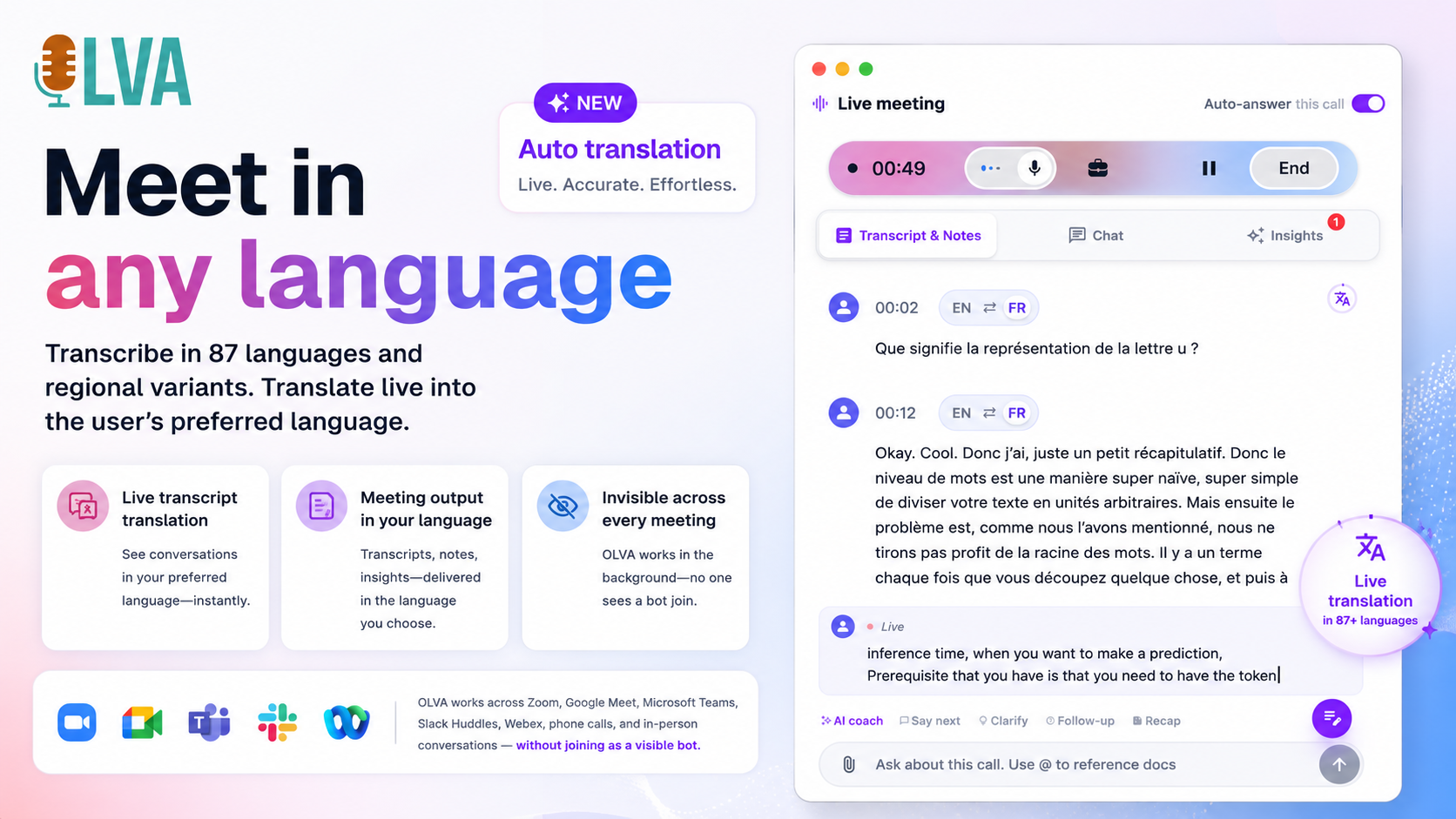
OLVA (https://olva.ai) is an example of a botless meeting assistant designed to help during conversations and after they end. It supports live transcription and multilingual capabilities, surfaces detected questions and contextual insights during meetings, and produces organized post-meeting summaries and artifacts that can include original-language excerpts alongside translations. Because OLVA runs privately alongside meetings without appearing as a visible bot, it’s suited to environments where a non-intrusive assistant and real-time support are valuable. Remember to follow applicable consent and recording rules before using such tools.
Checklist: running a multilingual client meeting that yields strong recommendations
Before the meeting:
- Confirm recording/transcription permissions with attendees.
- Decide and communicate the project’s official language(s) for deliverables.
- Upload any relevant documents (RFPs, specs, contracts) so the meeting assistant can reference them.
During the meeting:
- Enable live transcription and translation if available.
- Use automatic question detection to capture client questions.
- Summarize key points aloud and ask for confirmation.
- Preserve original-language quotes for legal or sensitive items.
After the meeting:
- Triage ambiguous or high-risk transcript moments for human review.
- Produce a bilingual executive summary plus an annotated appendix of original-language excerpts.
- Route decision-critical passages to legal or subject-matter reviewers before finalizing recommendations.
Common pitfalls and how to avoid them
Pitfall: Treating machine translation as final.
- Avoidance: Always use human verification when accuracy matters—contracts, regulatory statements, and pricing commitments.
Pitfall: Not capturing speaker attribution.
- Avoidance: Ensure transcripts identify who said what. Recommendations often depend on the authority of the speaker.
Pitfall: Overloading live notes with interpretation.
- Avoidance: Distinguish between factual transcript excerpts and interpretive recommendations. Label interpretive notes clearly and include their provenance.
Pitfall: Assuming silence equals agreement.
- Avoidance: Use explicit confirmation loops for important decisions.
Final thoughts: recommendations that reflect what was actually said
Delivering reliable consulting recommendations from multilingual meetings requires a disciplined mix of process, people, and the right tools. Start by setting clear expectations about recording and deliverable language, capture the conversation comprehensively, and design workflows that escalate ambiguous or legally sensitive passages to human experts.
Real-time meeting intelligence that provides live transcription, automatic question detection, and optional translation can materially reduce misunderstandings when used responsibly. Tools that operate during the conversation and produce organized post-meeting artifacts—transcripts, bilingual summaries, and annotated appendices—help you move from conversational fragments to clear, defensible recommendations.
Use machine capabilities to surface potential issues and speed production, but retain human review for any high-stakes conclusions. That combination preserves the efficiency benefits of multilingual assistance while keeping final recommendations accurate, context-aware, and defensible.
For teams looking to implement these practices quickly, evaluate tools that support live, private, during-meeting assistance and preserve original-language records alongside translations. Learn more about an option designed for live meeting support at https://olva.ai.
Conclusion
Multilingual meetings are common and often valuable—when managed intentionally. By establishing simple language policies, enabling live transcription and translation, enforcing short confirmation loops, preserving original-language quotes, and routing critical passages to reviewers, consulting and client-services teams can create recommendations that truly reflect client intent.
Adopt these practices to reduce rework, avoid disputes, and deliver clearer, more actionable recommendations. With the right process and tooling, language differences become manageable details rather than hidden risks.