How AI Meeting Tools Accelerate the Sales Funnel with Real-Time Answers & Live Coaching
In competitive sales cycles, speed and relevance win. Modern buyers expect clear, confident answers in the moment — not a delayed follow-up email days later. AI meeting tools that offer real-time question detection, instant answers, and live coaching change the game by helping reps perform better during meetings, not just remember them afterward.
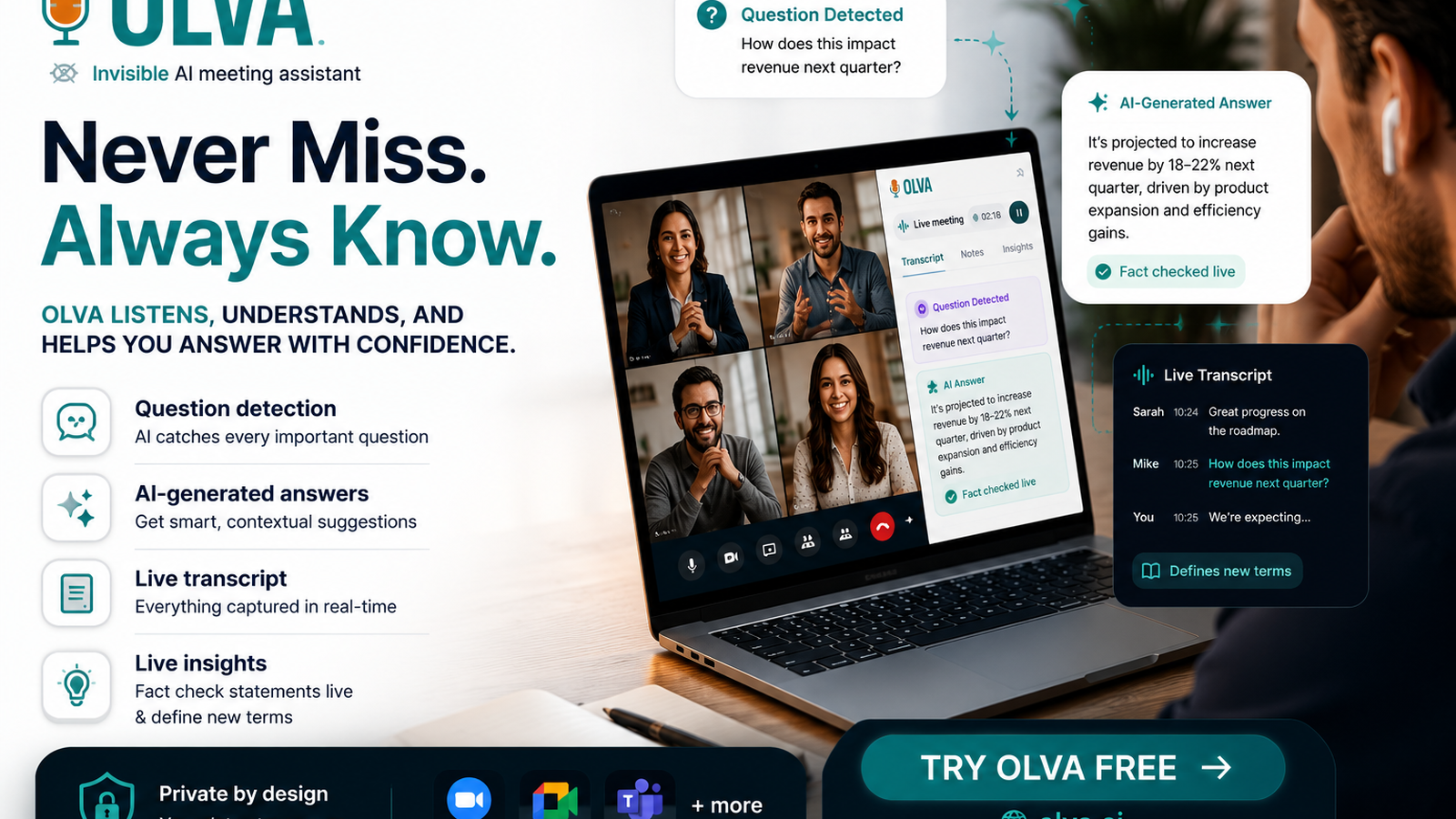
This post explains how AI meeting intelligence shortens the sales funnel at every stage: qualification, discovery, demo, negotiation, and close. You'll get practical examples sales and customer success teams can use immediately, a fair comparison to existing tools, and clear reasons why an invisible, live-first assistant like Olva can be a strategic advantage.
If you want a quick look at a solution built for real-time meeting support, visit https://olva.ai.
Why “during meeting” capabilities matter
Most meeting tools focus on recording, transcription, and retrospective analytics — valuable, but reactive. The faster you can detect a signal (a question, objection, or buying cue) and respond with a well-informed, concise answer, the higher the likelihood of advancing the deal in that same conversation.
Key distinctions:
- After-the-fact tools help you remember what happened. Real-time tools help you act while it’s happening.
- Reactive summaries and transcripts improve process. Live coaching and instant answers improve outcomes.
The rest of this article lays out practical ways real-time intelligence accelerates pipeline velocity.
Stage 1 — Faster qualification: spot intent before it slips away
Challenge: Early discovery calls are noisy. Prospects ask probing questions, but reps can miss buying intent or fail to qualify constraints.
How real-time AI helps:
- Automatic question detection surfaces clarifying questions and budget signals as they occur.
- Live insights flag opportunity indicators (decision timeline, stakeholders, budget signals) so reps can pursue qualification in the moment.
- Live transcription frees reps from note-taking so they can ask higher-quality follow-ups.
Practical example:
During a discovery call a prospect says, “We’re evaluating solutions this quarter and have a 90-day rollout window.” Olva detects the timeline phrase as a buying signal, highlights it to the rep, and suggests a follow-up: “Who else is involved in the approval process?” — giving the rep a path to qualify authority and next steps immediately.
Result: Faster, more accurate qualification reduces time wasted on unqualified leads and speeds promising deals to the next stage.
Stage 2 — Better discovery with live coaching and fact checking
Challenge: Complex product discussions invite technical questions and unforced errors. Reps sometimes give incomplete or incorrect answers that slow momentum.
How real-time AI helps:
- Live Q&A gives reps instant, meeting-aware answers drawn from the conversation and uploaded documents.
- Fact checking verifies claims on the fly so reps avoid committing to inaccurate specs or timelines.
- AI coaching suggests phrasing to simplify technical explanations for non-technical stakeholders.
Practical example:
A prospect challenges the rep: “Can your platform support 3rd-party integrations with XYZ system?” Olva recognizes the question, searches the uploaded product docs in seconds, and displays a concise answer the rep can use live: “Yes — we have an API connector for XYZ; implementation typically takes 2–3 weeks with our setup guide.” The assistant also gives a short script: "If integration matters to your team, could we schedule a technical session next week?"
Result: Faster, accurate answers build credibility and reduce friction for technical stakeholders.
Stage 3 — Demo mastery: answer questions without breaking flow
Challenge: Demos require momentum. Pauses to look up specs or consult teammates create awkward gaps and erode credibility.
How real-time AI helps:
- Invisible AI assistance stays out of the meeting roster (no bot participants), helping reps privately without distracting others.
- Instant answers and document-aware intelligence pull relevant product details, pricing rules, and prior meeting notes while the demo continues.
- Suggested follow-ups help turn questions into next steps.
Practical example:
During a demo a buyer asks about pricing tiers for enterprise usage. Instead of stopping the demo to search the pricing doc, the rep receives an instant answer with the correct tier and recommended wording: "For enterprise usage above X units, we recommend Tier 3 — would you like a customized quote based on your expected monthly volume?" This keeps the demo seamless and shifts to a closing moment.
Result: Demos feel confident and professional, increasing conversion rates and shortening negotiation windows.
Stage 4 — Negotiation and objection handling in real time
Challenge: Negotiations hinge on handling objections, timing, and concessions precisely.
How real-time AI helps:
- Automatic question detection flags objections and pricing discussions as they happen.
- Live coaching suggests objection-handling scripts and escalation paths (discount guidelines, approval steps).
- Opportunity detection recognizes upsell or expansion cues so reps can pivot to selling additional value.
Practical example:
A prospect raises a classic objection: “That price is higher than Vendor B.” Olva detects a pricing objection, pulls competitive positioning notes, and suggests a rebuttal: "Our platform includes ongoing migration support and a lower TCO at 18 months — can I walk you through what those savings look like for your team?" It also suggests a follow-up question to reveal the buyer’s priorities: "Is total cost of ownership or upfront price the bigger concern today?"
Result: Faster, more consistent objection handling increases the chance of preserving margin while moving the deal forward.
Stage 5 — Close and next steps: keep momentum after the meeting
Challenge: Deals stall when next steps are unclear.
How real-time AI helps:
- Suggested follow-ups and action item detection create clear next steps during the meeting.
- Post-meeting memory stores decisions, open questions, and assigned tasks for on-demand reference.
- Live transcription provides a searchable record so nothing gets lost in follow-up.
Practical example:
At the end of a negotiation, Olva captures the verbal agreement and suggests concise summary wording the rep can use to confirm next steps in chat: "Great — we’ll deliver a tailored proposal by Friday. Could you confirm who will approve the budget?" That immediate confirmation reduces back-and-forth and improves conversion velocity.
Result: Clear, actionable next steps translate to higher close rates and shorter sales cycles.
How AI meeting tools fit into a broader tech stack (a fair look at competitors)
There are strong tools that focus on call recording, transcription, and post-call analytics (examples include Gong, Chorus, Otter, and Fireflies). These platforms excel at conversation intelligence, coaching programs, and pipeline analytics after the fact.
What those tools do well:
- Robust post-call analytics and dashboards to understand patterns across teams.
- Centralized recordings and transcripts for training and deal review.
- Integrations with CRM systems for pipeline reporting.
Where live-first assistants add value:
- Real-time question detection and instant answers change outcomes in the meeting itself instead of relying only on after-the-fact analysis.
- Invisible assistance removes meeting clutter (no bot participants) and preserves privacy while giving reps private coaching.
- Document-aware intelligence uses uploaded contracts, pricing sheets, and product docs to give accurate, contextual answers in seconds.
A balanced approach: Use post-call analytics to refine playbooks, but pair them with live meeting intelligence to win individual conversations. Olva is designed to complement — not replace — the analytics-driven tools teams may already use, by focusing on enabling better performance during meetings.
Privacy and user control
Privacy matters in sales conversations. Live-first assistants should be private by design. Important considerations include:
- Invisible participation: no visible bot in the meeting roster.
- User-only visibility: intelligence and transcripts remain visible only to the user unless they choose to share.
- Deletable transcripts: the ability to delete meeting data anytime provides control.
Olva emphasizes these points and provides an invisible screen-share mode so reps can present while keeping the assistant private.
Quick scripts and prompts reps can use with an AI meeting assistant
- Detect and qualify: “I heard you mention a 90-day timeline — who else is involved in that decision?”
- Handle pricing objections: “I understand price is a concern. Can I show why our total cost of ownership differs from Vendor B?”
- Technical deflection: "That’s a great technical question — can I schedule a 30-minute session with our engineer, or would a brief written answer now be helpful?"
- Close for commitment: "If we send a tailored proposal by Friday, would you be ready to review it with stakeholders next week?"
Use live coaching suggestions to refine tone and phrasing in the moment.
Measuring impact: KPIs that improve with real-time meeting intelligence
Trackable improvements after deploying live meeting assistance typically include:
- Shorter average sales cycle length
- Higher conversion rate from discovery to demo
- Increased win rate on negotiated deals
- Reduced time to first response for technical questions
- Higher rep productivity (fewer meetings per closed deal)
Combine these KPIs with post-meeting analytics to get a full picture of performance improvements.
Conclusion — move from remembering to succeeding
AI meeting tools that operate in real time — detecting questions, providing instant answers, offering live coaching, and surfacing opportunity signals — change the dynamic of sales conversations. Instead of treating meetings as transcripts to be analyzed later, they become stages where deals are advanced then and there.
For teams that need to win competitive deals and reduce friction across complex buying cycles, pairing post-call analytics with a live-first assistant delivers the best of both worlds. If you want to explore a tool designed specifically to help during meetings (not just after), learn more at https://olva.ai.
By spotting intent, answering accurately, and coaching reps in the moment, real-time meeting intelligence accelerates the funnel — and helps teams win more business with fewer follow-ups.
Have a specific scenario you want to optimize? Try mapping a recent stalled deal to the stages above and identify where a real-time prompt or fact-check would have changed the outcome.