Run Better Executive Meetings with Multilingual Teams: Real‑Time AI for Clarity & Confidence
Global leadership teams are routine today—but running high-stakes executive meetings across languages introduces a distinct set of risks: missed nuances, hidden objections, unclear commitments, and delayed decisions. The consequence is not merely slower execution; it can be costly strategic drift.
This article explains practical ways executives, founders, board members, and consultants can run better multilingual meetings using invisible, real-time AI. It focuses on live clarifications, risk detection, and decision-level confidence—capabilities that help leaders act during the meeting, not just review it later.
Throughout the piece, you’ll see examples that reflect real meeting dynamics and how live meeting intelligence changes outcomes. For those who want to evaluate solutions, this article compares common meeting tools fairly and highlights the additional value of real‑time, invisible AI assistance like Olva (https://olva.ai).
Why multilingual executive meetings are uniquely fragile
Multilingual meetings raise several predictable challenges:
- Language gaps hide objections. A negotiation point or reservation in a non‑primary language can go unnoticed.
- Terminology mismatches create ambiguity. Different markets use different legal, accounting, or product terms.
- Tone and implication are hard to assess. Short phrases in another language can carry cultural meaning that affects risk.
- Decisions get deferred. Leaders default to “we’ll follow up” when clarity is expensive to achieve live.
For executives, these frictions translate into three measurable costs: delayed decisions, misaligned strategy, and lost revenue or increased risk. The good news: modern meeting intelligence reduces these costs by working live—detecting and clarifying issues as they emerge.
What ‘working live’ means and why it matters
Most meeting tools are optimized for after-the-fact value: transcripts, summaries, action-item lists. Those are valuable for documentation and follow-up, but they don’t change what happens during the conversation.
Working live means the AI helps you while the conversation is happening. That matters because the best moments to influence outcomes—addressing an objection, clarifying a contractual point, or gently probing an ambiguous commitment—occur in the room, not in the meeting notes.
Key live capabilities that matter to executives:
- Real‑time transcription across participant audio and languages
- Automatic detection of questions, objections, and ambiguity
- Instant, context‑aware answers and phrasing suggestions
- Live insights: opportunity and risk signals, fact checks, and term definitions
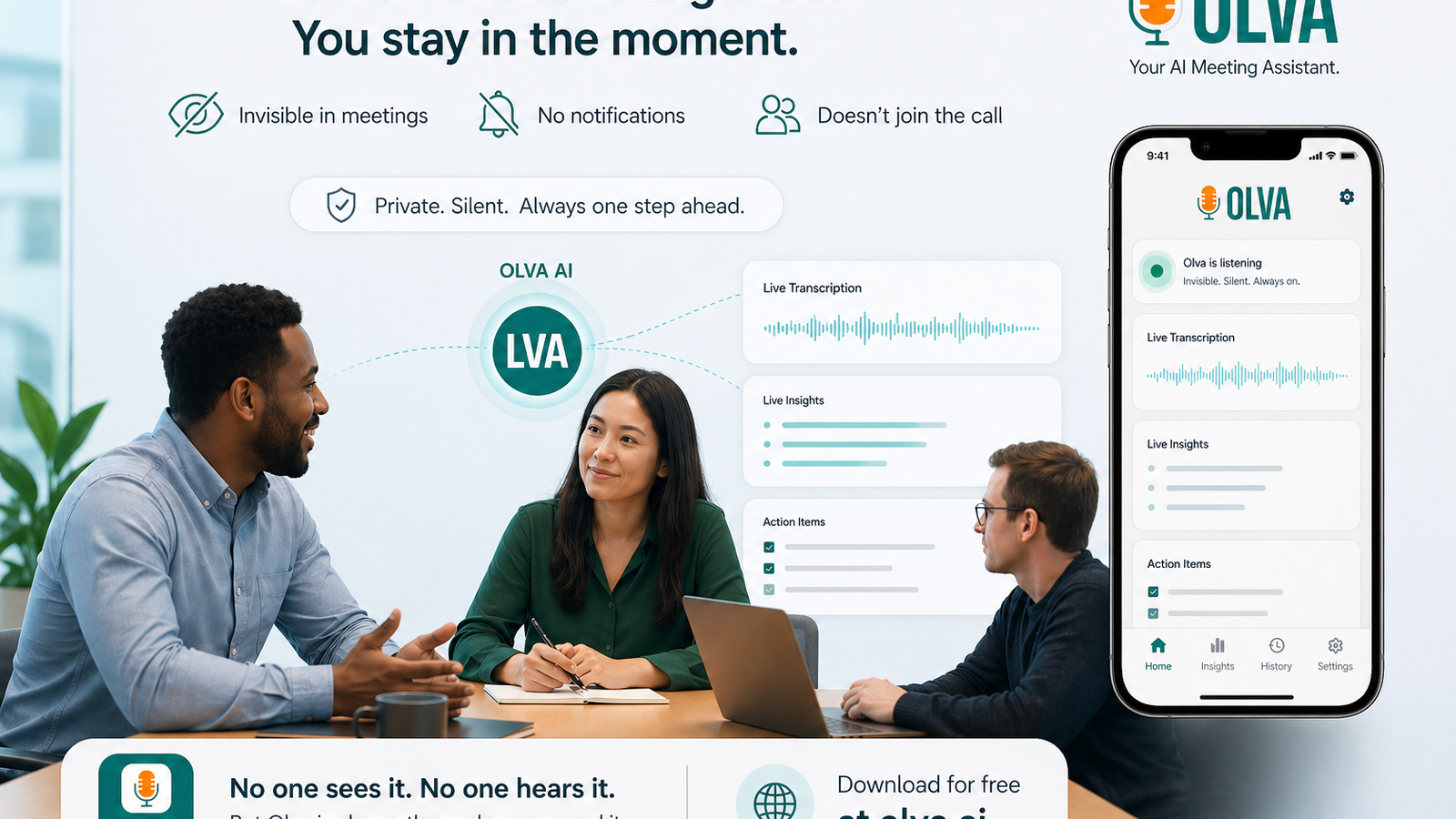
- Private, invisible assistance so meeting dynamics stay natural
These capabilities reduce friction and empower leaders to make confident decisions on the spot.
Practical scenarios: how live AI changes outcomes
Scenario 1 — Board discussion with multilingual participants
A European founder and an investor from Latin America are debating revenue recognition language in a partnership agreement. The investor raises a concern in Spanish about deferred revenue treatment; the CEO, who’s less fluent in Spanish, nods and assumes it’s minor. Later the investor’s expectation differs.
With real‑time AI: automatic question detection flags the Spanish comment as a potential objection and surfaces a suggested English paraphrase and a short clarifying question the CEO can ask immediately. If the company uploaded the draft contract beforehand, document‑aware intelligence pulls the relevant clause and proposes a precise wording to discuss.
Outcome: Ambiguity is resolved in the meeting; the board records a clear decision and next steps.
Scenario 2 — Product launch call across APAC and North America
A product manager uses a technical acronym that has different meanings across regions. Some participants assume one interpretation; others assume another. Without clarification, the launch timeline could be misaligned.
With real‑time AI: Olva detects the divergent uses, offers a definition and recommended phrasing to reconcile the terms, and highlights potential downstream risks—e.g., localization requirements or regulatory implications.
Outcome: Teams leave the meeting with a shared definition and a verified timeline.
Scenario 3 — Sales negotiation with multilingual clients
During a pricing discussion, a buyer in another country signals an objection in their native language. The account executive misses the nuance and continues. Later, the deal stalls.
With real‑time AI: automatic question detection recognizes the buyer’s tone and content as a pricing objection. The AI supplies a suggested response, objections handling bullet points tailored to the product and uploaded pricing playbook, and prompts the rep to ask a specific follow‑up to test intent.
Outcome: The rep addresses the objection immediately, salvaging momentum and increasing close probability.
How live insights reduce strategic risk
Executives care about two things: making informed decisions and minimizing downside. Live meeting intelligence helps on both fronts by:
- Surfacing contradictions or factual claims that need verification (fact checking)
- Highlighting early warning signs and health indicators for deals or initiatives (opportunity/risk detection)
- Recommending next steps that convert conversation into decisions (suggested follow‑ups)
For example, if a participant claims a competitor offers a feature that impacts pricing, the AI can flag the claim, check it against uploaded competitor research or a cached web search, and present a short summary during the meeting. That immediate context prevents decisions based on inaccurate assumptions.
Fair comparison: what other meeting tools do well—and where live AI adds value
Many existing platforms provide excellent transcription, recording, and asynchronous summaries. Tools like Otter, Fireflies, Gong, and Chorus are strong in capturing conversation and surfacing themes after the fact. They improve knowledge management, onboarding, and deal reviews.
However, the difference for executive meetings is timing and privacy:
- Timing: Post‑meeting summaries help with documentation but can't stop a live misinterpretation or close a deal in the moment.
- Privacy and flow: Visible bots or recording indicators change participant behavior in sensitive executive settings.
Where live, invisible AI adds value:
- Automatic Question Detection and Instant Answers: instead of flagging a question for later, the system suggests responses in real time.
- Invisible Assistance: no bot participant and no awkward notifications, preserving natural dynamics.
- Document‑Aware Intelligence: using uploaded contracts or decks live to craft precise clarifications.
- AI Coaching: private, strategic suggestions to leaders during negotiation or decision-making.
This is not to say existing tools lack value—many solve important problems downstream. The point for executives is to combine those downstream strengths with live assistance that changes meeting outcomes.
Privacy and meeting dynamics: why invisibility is essential
Executives often discuss sensitive material. Two design principles are essential:
- Minimal visible footprint: an assistant that doesn’t appear as a meeting participant preserves candid dialogue and reduces performative behavior.
- User control and data privacy: transcripts, uploads, and memories must be visible only to the user and removable on demand.
An invisible assistant that meets these principles reduces the behavioral cost of AI in the room while delivering the tactical support leaders need.
Tactical checklist for running a better multilingual executive meeting
Before the meeting
- Share critical documents (contracts, decks, financials) in advance to enable document‑aware answers.
- Define the decision objective and desired outcome explicitly in the meeting invite.
- Confirm language preferences and key terminology with participants.
During the meeting
- Use real‑time transcription to keep everyone aligned on what was said.
- Let the AI surface potential objections or ambiguous terms as they occur.
- If a complex claim or competitor reference appears, ask the AI to fact check or summarize the relevant document or slide.
- Use private AI coaching to rehearse a concise response to an objection or to reframe a question for clarity.
After the meeting
- Capture decision points and commitments in a short, searchable record.
- Use post‑meeting memory to track unresolved decisions and historical context for future meetings.
Example language prompts executives can use live
- “What did the CFO just ask in Spanish? Give a concise English paraphrase and suggested clarifying question.”
- “Summarize the last five minutes and list any open decisions.”
- “Does the uploaded contract contain a clause about deferred revenue? If so, highlight the text and propose a 2‑sentence clarification.”
- “Flag any participant statements that look like buying signals or major objections.”
These prompts translate the AI’s capabilities into actionable meeting moves that change results immediately.
Decision‑level confidence: measuring impact
Executives measure tools by outcomes. Live meeting intelligence contributes to measurable improvements:
- Faster decisions: fewer follow‑ups and reduced time-to-decision.
- Fewer reversals: clearer commitments reduce downstream rework.
- Higher close rates and faster deal cycles when objections are handled live.
- Reduced compliance and legal risk through instant clause checks and clarified commitments.
Tracking these metrics requires integrating meeting outcomes with your CRM and exec dashboards, and ensuring follow‑through on AI‑surfaced next steps.
Why to consider invisible, real‑time AI now
Multilingual, high‑stakes meetings are a modern reality for global leadership. The ability to understand nuances, clarify language, and identify risk in the moment is a competitive advantage. Real‑time, invisible AI doesn’t replace human judgment; it augments it—helping leaders shape outcomes during the conversation.
If you’re evaluating solutions, consider both downstream capabilities (transcription, summaries, analytics) and live features (instant answers, live insights, invisible assistance, and document‑aware intelligence). A platform that emphasizes the latter enables leaders to act with clarity and confidence.
For teams ready to pilot an invisible real‑time assistant that focuses on in‑meeting help, learn more about how Olva supports executives at https://olva.ai.
Conclusion
Running better executive meetings with multilingual teams requires more than better note taking. It requires tools that help leaders identify ambiguity, detect risk, and respond with confidence—while the conversation is still happening.
Invisible, real‑time AI brings four practical benefits to executive meetings:
- Clarity: instant paraphrases and term definitions bridge language gaps.
- Risk reduction: live fact checks and clause references prevent decisions based on incorrect assumptions.
- Decision momentum: suggested follow‑ups and coaching turn discussion into committed action.
- Privacy and flow: invisible assistance preserves natural dynamics while providing private support.
Leaders who adopt live meeting intelligence gain the rare advantage of influencing outcomes at the moment they matter most. The next step for any executive running multilingual meetings is to pilot a solution that supports live detection, clarification, and coaching—so meetings deliver decisively, not just memorably.