Reduce Churn with Multilingual Customer Success Calls: Live Q&A and Document‑Aware Answers
Introduction
Customer success teams are on the front line of churn prevention. Every conversation with a customer—renewal negotiations, onboarding check-ins, escalation calls—contains signals you can act on immediately. The difference between a satisfied customer and a lost account often comes down to how effectively your team responds in the moment, especially in multilingual environments where language barriers amplify friction.
This article explains how modern CS teams can reduce churn by using live meeting intelligence: automatic question detection, instant answers, live Q&A, and document-aware responses. These capabilities help Customer Success Managers (CSMs) and account teams not only remember meetings, but perform better during them. Examples, practical workflows, and a fair comparison with existing tools are included to help you evaluate whether these approaches fit your org.
Why real-time help matters for churn reduction
Traditional conversation intelligence tools focus on post-call transcription and analytics. That’s useful for coaching and reporting—but too late to save an at-risk renewal happening in the next 30 minutes.
Real-time assistance changes the equation:
- Detects concerns as they appear (pricing objections, technical issues, contract confusion).
- Surfaces relevant facts and talking points instantly, grounded in uploaded documents like contracts and product guides.
- Suggests phrasing, clarifications, and follow-ups to keep the conversation constructive.
- Works across languages so multilingual customers don’t lose nuance.
When teams can resolve objections in the moment, they reduce escalation, shorten time to resolution, and increase renewal probability.
Core features that reduce churn on customer success calls
Below are the capabilities CS leaders should prioritize, with practical examples of how each reduces churn.
- Automatic Question Detection
What it does: Identifies when a participant asks a question or raises an objection and classifies the type (pricing, technical, legal, onboarding).
Why it matters: It ensures no important customer concern slips through during busy conversations.
Example: During a renewal call with a Spanish-speaking customer, the CSM misses a brief remark that implies dissatisfaction. Automatic question detection flags it as a pricing concern and highlights the exact phrase in the transcript so the CSM can address it immediately.
- Instant Answers and Document‑Aware Responses
What it does: Uses meeting context plus your uploaded documents (contracts, pricing sheets, SOWs, product docs) to generate concise, accurate answers on the spot.
Why it matters: Reduces uncertainty and the need to promise follow-ups—immediacy builds trust.
Example: An enterprise customer asks whether a specific feature is included under their current plan. Olva cross-references the signed contract and product docs and suggests a precise, defensible response the CSM can give right away, plus the relevant contract clause to reference.
- Live Q&A and Private Coaching
What it does: Lets the CSM privately ask for help during the call—phrasing suggestions, summaries of the last 5 minutes, or the best follow-up question to ask next.
Why it matters: Equips junior CSMs and non-native speakers to respond confidently under pressure.
Example: A new CSM hosting a French onboarding notes the customer’s tone shifting to concern. The CSM privately asks the assistant: “How should I reframe the onboarding timeline?” The assistant proposes a brief, empathic script in French that aligns with company policy.
- Live Transcription and Multilingual Support
What it does: Provides real-time transcripts in multiple languages and converts spoken content to text for faster comprehension.
Why it matters: Accurate transcription plus translation preserves nuance in multilingual conversations and prevents misinterpretation—which is critical when renewal stakes are high.
Example: A product roadmap discussion with a German customer contains technical terms. Live transcription with term definitions ensures everyone on the call shares the same understanding.
- Live Insights: Opportunity Detection and Fact Checking
What it does: Continuously analyzes conversation to surface buying signals, expansion opportunities, and potential risks, while verifying factual claims in the moment.
Why it matters: Spot upsell cues or correct incorrect assumptions before they become blockers.
Example: During a usage review, the assistant detects repeated references to a feature gap and flags an expansion opportunity for a paid add-on. Simultaneously, it fact-checks a customer claim about limited feature availability and provides the factual counterpoint.
- Invisible Assistant and Privacy
What it does: Operates without joining the call as a visible bot; remains private to the user and doesn’t disrupt participants.
Why it matters: Preserves meeting dynamics and customer trust. CS teams can get help without signaling an AI is listening in.
Real-world workflows: How to apply these capabilities during CS calls
Workflow 1—Renewal negotiation (multilingual)
- Pre-call: Upload signed contract and pricing appendix to the meeting workspace.
- During call: Live transcription captions the discussion in the customer’s language.
- Assistant detects a sudden pricing question and privately surfaces the relevant contract clause and a recommended response script in the customer’s language.
- CSM uses the suggested phrasing, addresses the concern, and notes an action item for a customized pricing justification.
- Post-call: Meeting memory stores the transcript, detected objections, and action items for follow-up.
Workflow 2—Onboarding check-in with a technical team
- Pre-call: Upload onboarding guide and API documentation.
- During call: Automatic question detection flags a technical clarification request.
- The assistant pulls the exact API field details from the docs and suggests a short demo snippet or acceptance criteria.
- CSM offers the snippet and schedules a technical deep-dive with engineering.
- Outcome: Faster resolution of onboarding blockers, higher time-to-value, lower churn risk.
Comparing alternatives: Where conversation intelligence tools help—and where they fall short
Well-known tools (e.g., Gong, Chorus, Fireflies) excel at post-call analytics: trend analysis, rep coaching, and pipeline insights. They often provide solid transcription, keyword spotting, and centralized recordings.
What these tools tend not to prioritize:
- Real-time, private assistance that helps the user while the conversation is taking place.
- Document-aware instant answers that combine meeting context with uploaded contracts or product docs.
- Invisible operation that doesn’t join as a visible bot in customer meetings.
- True multilingual, in-call coaching and phrasing suggestions targeted to reduce churn immediately.
That said, many of these platforms have strengths in structured analytics and integration with CRM systems. A practical approach is to use them for retrospective coaching while adopting live intelligence tools to improve in-call outcomes.
Practical tips for CS leaders introducing live meeting intelligence
- Start with high-value use cases
Pilot live assistance on renewal and onboarding calls—where the ROI on avoiding churn or accelerating time-to-value is clearest.
- Upload the right documents
Contracts, pricing guides, onboarding checklists, SLAs, and product sheets are the documents that matter most. The assistant’s accuracy depends on the quality and relevance of uploaded content.
- Train teams on privacy practices
Emphasize user-only visibility, how to delete transcripts, and when to disclose AI assistance per customer preferences.
- Blend with existing analytics tools
Use retrospective platforms for trend analysis and live tools for in-call performance. They serve complementary purposes.
- Monitor and measure impact
Track renewal rates, time-to-resolution for escalations, and customer sentiment after implementing live assistance to quantify benefits.
Example scenarios showing measurable value
- A CSM handles a renewal negotiation where the customer raises a legal concern. With instant, document-aware answers, the CSM addresses the concern immediately, reducing the need for legal escalation and preserving momentum in the renewal process.
- A multilingual support team onboards customers across EMEA. Live Q&A and private coaching help non-native speakers respond with confidence, improving NPS scores and reducing churn attributable to communication issues.
Privacy and compliance considerations
When adopting real-time meeting intelligence, prioritize tools that:
- Don’t join calls as visible bots and keep AI assistance private to the user.
- Allow users to control transcripts and delete meeting data.
- Support your organization’s compliance needs for customer data.
Olva’s approach to live meeting intelligence
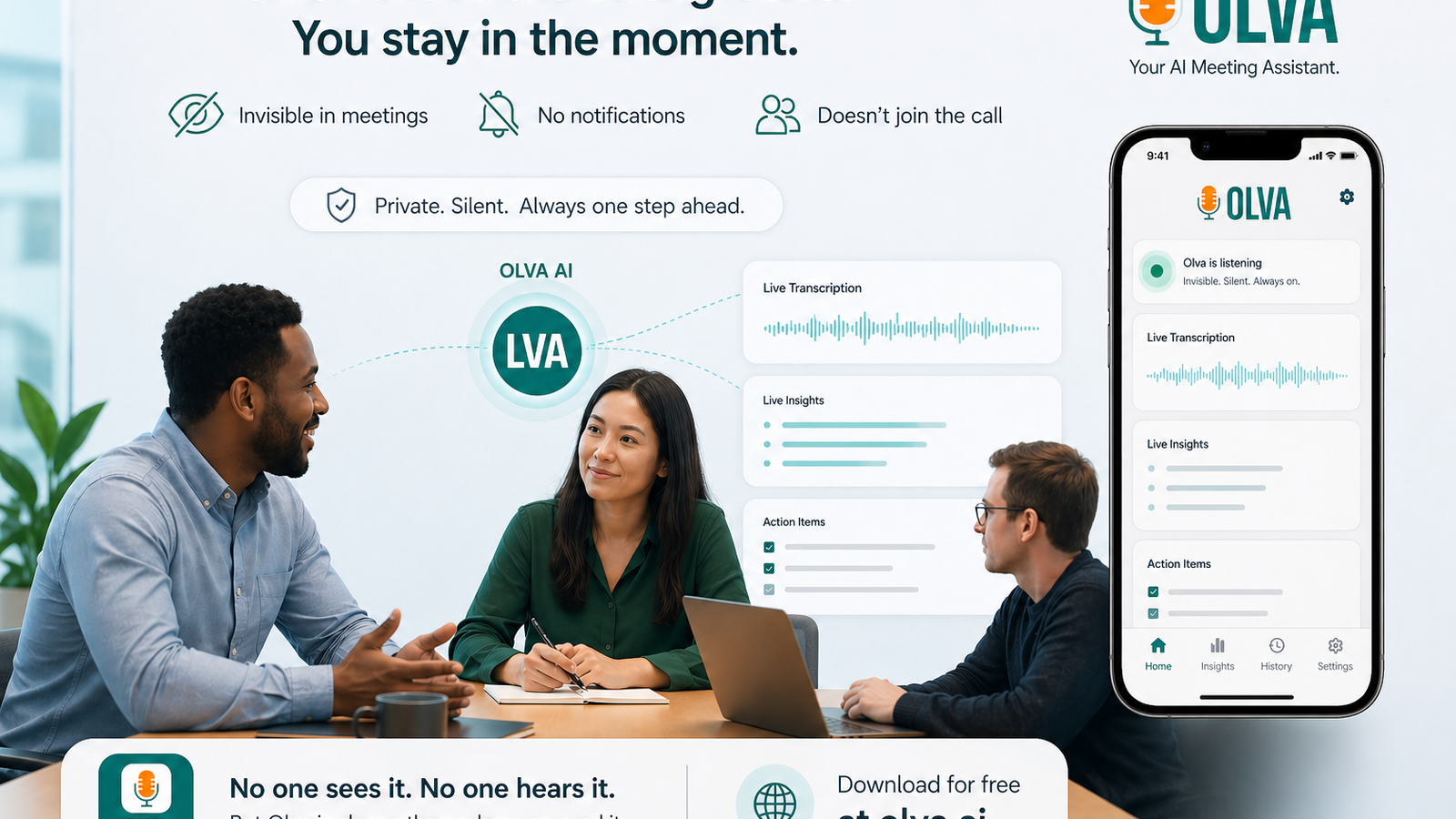
Olva is designed as an invisible AI meeting assistant focused on helping users during meetings—not just after. Key differentiators relevant to CS teams include:
- Invisible operation: no bot participants, no awkward notifications.
- Live transcription and multilingual support to reduce miscommunication.
- Automatic question detection that highlights pricing, technical, and legal concerns in real time.
- Instant answers and document-aware intelligence using uploaded contracts and product documentation.
- Live Q&A and private AI coaching that suggest phrasing and follow-ups on-the-fly.
- Ongoing live insights: fact checking, opportunity detection, and suggested next steps during the conversation.
For more detail on how Olva works and to explore product specifics, visit https://olva.ai.
Conclusion
Reducing churn requires more than better documentation—it requires better moments. CS teams win when they can identify and neutralize objections in real time, communicate clearly across languages, and cite the exact facts customers need to regain confidence.
Implementing live meeting intelligence—automatic question detection, instant document-aware answers, live Q&A, and multilingual transcription—gives teams the tools to act in the moment. Combine these capabilities with existing analytics platforms for a two-pronged approach: prevent churn during calls and continuously improve through post-call coaching.
Start small: pilot on renewals and high-risk accounts, measure the impact, and expand. When your team can answer tough questions confidently, in the customer’s language, and with the right contract clause at hand, churn becomes a preventable outcome rather than an inevitability.
Use technology that helps you perform during meetings—not just remember them. For teams evaluating live meeting intelligence, learn more at https://olva.ai and consider a pilot focused on multilingual renewals or technical onboarding to see immediate benefits.