How Sales Teams Close More Deals with Live Meeting Translation: A Playbook for Multilingual Calls
Selling across languages is no longer an edge — it’s a requirement. Global accounts, distributed prospects, and cross-border expansion mean sales teams routinely face multilingual conversations where nuance, speed, and trust determine whether a deal advances. This playbook explains practical tactics sales leaders, AEs, SDRs, and solutions consultants can use to win more deals by adding live meeting translation to their workflow.
Throughout the article we’ll reference concrete capabilities found in modern invisible meeting assistants like OLVA—real-time transcription, live translation, automatic question detection, context-aware answers, and post-meeting outputs. If you want to try these features yourself, see https://olva.ai for product details and responsible usage guidance.
Why live translation matters in sales
Multilingual sales conversations introduce friction at every stage:
- Listening overload: Reps juggle translation in their head while trying to interpret objections and capture next steps.
- Missed signals: Subtle cues—hesitation, qualifiers, tone—are easy to miss when following a non-native language.
- Slower responses: Pausing to translate or confirm creates awkward gaps and reduces momentum.
- Inaccurate notes: Poorly captured commitments or technical details lead to follow-up confusion.
Live meeting translation directly addresses these problems by turning spoken language into readable text and translated phrases in real time. That reduces cognitive load, preserves nuance through transcript review, and helps reps react faster with accurate, contextual replies.
Key live-translation capabilities sales teams need
Not all translation tools are created equal. For sales contexts, prioritize capabilities that preserve context, protect privacy, and support action after the call:
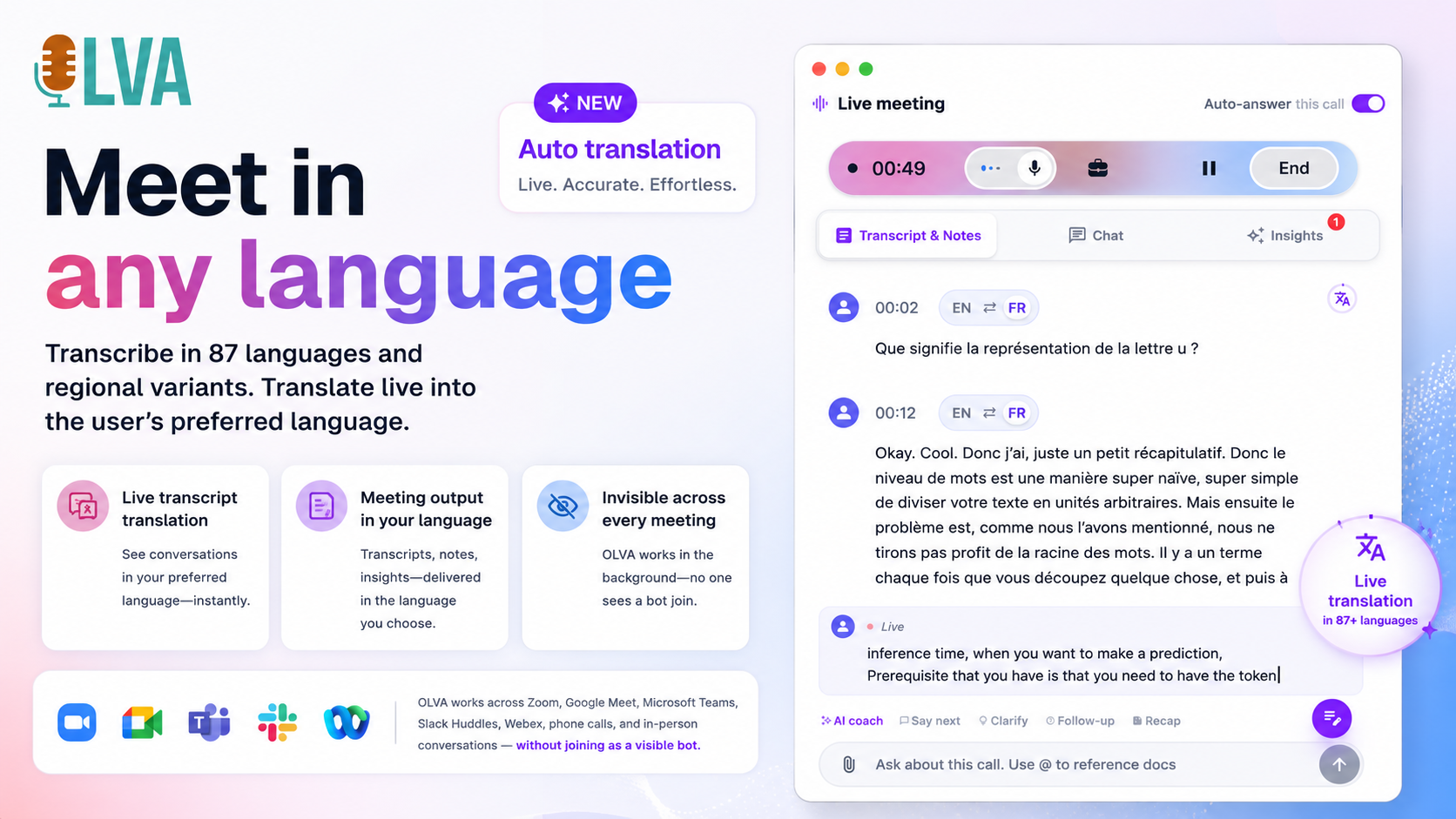
- Live transcription + translation: Side-by-side native-language transcript and translated text so participants and the rep can read along.
- Manual translation of segments: Ability to translate selected parts of the conversation when you need extra clarity—useful for pricing, legal language, or technical specs.
- Context-aware answers: The assistant can reference earlier parts of the meeting when answering a live question or summarizing a point.
- Automatic question detection: Detect customer questions even if phrased indirectly, surfacing them so reps don't miss opportunities.
- Document-aware intelligence: Use proposals or datasheets during the call and have the assistant reference relevant clauses in the meeting language.
- Post-meeting action capture: Convert translated transcripts into accurate summaries, action items, and follow-up emails.
OLVA bundles these capabilities in a botless, private assistant that runs alongside a meeting without appearing as a visible bot tile. That botless operation preserves natural meeting dynamics while giving reps real-time support. See OLVA at https://olva.ai for product specifics and privacy considerations.
Playbook: Before the call
- Prep the language plan
- Identify the primary spoken language(s). Confirm whether participants prefer simultaneous translation, a call transcript afterward, or on-demand translation for key passages.
- Share an agenda and relevant documents in the native language of your primary contact plus translated versions. Upload those documents into your meeting assistant if it supports document-aware intelligence.
- Enable live translation and transcription
- Configure your meeting assistant to translate into your default language automatically or enable manual translation for segments you’ll likely need clarified (technical specs, pricing, legal terms).
- Notify participants and obtain consent if required by local recording/transcription laws and workplace policy.
- Brief the internal team
- Assign roles: who will lead, who will demo, who will take notes/handle follow-ups.
- Designate a second-channel communicator (chat or internal call) to receive real-time insights or clarification prompts from the assistant so your front-line rep can stay focused on rapport.
Playbook: During the call
- Use live transcription to keep pace
Live transcription reduces cognitive load. For example, an AE listening to a German-speaking technical buyer can follow a synced English transcript to understand complex terminology while still engaging in conversation.
Tactics:
- Glance at the transcript to confirm details instead of asking the prospect to repeat.
- When accuracy matters, click to manually translate the exact sentence or paragraph into your language to avoid misinterpretation.
- Surface and act on questions instantly
Automatic question detection can highlight direct and indirect questions the prospect asks.
Tactics:
- If the assistant highlights an unaddressed question about integration timelines, acknowledge it quickly and propose a specific follow-up: "Great question—let me confirm the timeline and follow up by Wednesday."
- Use the assistant’s context-aware answers to prepare a concise response that references the earlier part of the discussion.
- Handle objections with contextual support
When a prospect raises a pricing or security objection in a language you’re less fluent in, use the assistant to translate the objection and then search the meeting transcript for prior signals (e.g., budget constraints) to craft a targeted reply.
Example:
- Prospect (Spanish): "Su precio parece alto comparado con lo que pagamos ahora." Translate, confirm the nuance, and respond: "I hear concerns about price vs current spend. Can you share how you measure value—TCO, time to value, or feature parity?" Use the assistant to pull earlier budget comments into the reply.
- Use document-aware intelligence live
If the prospect references a clause in your proposal or a technical spec, ask the assistant to pull that document excerpt into the conversation. This avoids screen sharing delays and ensures you reference the correct terms.
- Coach quietly with AI prompts
A discreet live assistant can suggest clarifying questions or rephrasings. Keep coaching tactical and short: "Ask: Can you describe the top priority for this quarter?" Use the prompt to guide the conversation without sounding scripted.
- Preserve tone and nuance
Translation can be literal and miss nuance. When the assistant provides a translation, treat it as an aid—confirm important points with the prospect using simple clarifying questions: "Do I understand correctly that X is your priority?"
Playbook: After the call
- Generate a multilingual meeting summary
Use the translated transcript to produce two outputs: a summary in your language for your internal team and a client-facing summary in the prospect’s language. This demonstrates respect for the prospect’s language and reduces miscommunication.
- Capture action items and owners
Automatically extract commitments and action items from the translated transcript. For instance: "AE to send revised SOW by Friday; Technical lead to provide integration checklist." Verify owners during the call and then publish the items in both languages.
- Send a bilingual follow-up
Early, clear follow-up increases conversion rates. Send a short, bilingual email that: restates the prospect’s top concerns (in their language), lists agreed next steps, and asks for confirmation.
Example follow-up structure:
- Greeting in prospect language
- One-sentence summary in prospect language
- Bullet list of action items (prospect language + translation)
- Closing and next meeting time (translated)
- Feed the CRM with accurate, translated notes
Export the translated transcript and summarized action items into your CRM. Tag the record with language, outcomes, and next-best actions to improve forecasting and account planning.
Practical examples and scripts
Example 1 — SDR discovery call with mixed languages
Scenario: Prospect speaks Portuguese primarily; the SDR is bilingual but not fluent.
Live tactics:
- SDR enables live Portuguese→English transcription.
- When the prospect mentions a compliance requirement, the SDR clicks manual translation for that sentence and asks a targeted follow-up question suggested by the assistant: "Which regulation requires that data stay in-country?"
- SDR records action: "Send country-specific compliance doc" and assigns it during the call.
Result: Faster clarification, fewer misinterpretations, immediate assignment of follow-up tasks.
Example 2 — AE demo with technical Q&A in Japanese
Scenario: Technical buyer asks detailed integration questions in Japanese.
Live tactics:
- AE uses document-aware intelligence to fetch the integration section of the product datasheet and asks the assistant to translate the exact paragraph for clarity.
- Assistant flags an earlier comment about the buyer’s deployment timeline; AE incorporates that into the response: "Given your target date in June, we recommend..."
- After the call, the AE generates a bilingual summary and the integration checklist as an attachment.
Result: Technical confidence is preserved, the buyer’s timeline is acknowledged, and needed documents are delivered in the buyer’s language.
Example 3 — Negotiation with multilingual stakeholders
Scenario: Deal negotiation includes a French CFO and an English procurement lead.
Live tactics:
- AE enables simultaneous translation into both English and French for private internal view.
- Use manual translation for contract terms to avoid legal ambiguity and ask the assistant to pull relevant contract clauses.
- After verbal agreement, AE records the exact terms as action items in both languages and shares a bilingual confirmation email.
Result: Reduced legal back-and-forth, clarity on commitments, faster contract progression.
Measuring impact: KPIs to track
To justify the investment in live translation, measure:
- Deal cycle time: Compare average days-to-close for multilingual deals before and after adopting live translation.
- Conversion rate by language: Track conversion changes for meetings conducted in non-native languages.
- Demo to proposal ratio: Faster understanding often means more proposals issued after demos.
- Follow-up response time: Measure time between meeting end and follow-up sent (bilingual follow-ups tend to get faster replies).
- Customer satisfaction and meeting NPS: Short post-call surveys in the prospect’s language can reveal improved comprehension and trust.
Privacy, consent, and responsible use
Live translation and transcription have legal and ethical implications. Best practices:
- Notify participants and obtain consent when required by law or company policy.
- Use transcription/transmission features only where allowed by the prospect and your legal team.
- Treat AI-generated outputs as decision-support—verify legal or compliance-critical statements with appropriate stakeholders.
OLVA operates as a botless assistant that captures device audio and runs privately for the user. That helps keep meetings natural, but it doesn’t remove the user’s responsibility for complying with local recording laws and organizational policies. See OLVA’s privacy guidance at https://olva.ai for details and to confirm correct usage.
Implementation checklist for sales leaders
- Select a meeting assistant that supports live translation, manual segment translation, and document-aware intelligence.
- Pilot with a subset of multilingual accounts and define KPIs (cycle time, conversion rate, follow-up tempo).
- Train reps on when to use automatic vs manual translation, how to confirm nuance, and how to use generated follow-ups.
- Create templates for bilingual follow-ups, meeting summaries, and CRM notes.
- Define consent and recording policy; update call scripts to include clear participant notification.
- Scale based on pilot results and continuously refine coaching prompts and templates.
Conclusion
Live meeting translation turns linguistic friction into a competitive advantage. Sales teams that integrate real-time transcription, selective manual translation, context-aware answers, and document-aware intelligence can respond faster, avoid misunderstandings, and demonstrate respect for the prospect’s language—factors that measurably increase trust and improve conversion.
This playbook offers practical steps you can apply immediately: prepare language plans, enable live translation, use question detection and document-aware features during calls, publish bilingual follow-ups, and measure outcomes. Combined with responsible use and clear consent practices, live translation helps sales teams close more deals with confidence.
If you want to explore real-time, botless meeting assistance that supports translation, transcription, and contextual meeting intelligence, learn more at https://olva.ai.
End of playbook.