Inclusive Hiring Conversations: How AI Assistants Improve Interviews
Inclusive hiring starts with clear, fair conversations. For recruiters and hiring managers, interviews are where candidate potential is most visible — and where misunderstandings, unconscious bias, and communication gaps can silently exclude talented people. Non-native speakers are particularly vulnerable: accents, unfamiliar vocabulary, and cultural differences can distort a candidate’s true fit.
This article explains practical ways modern AI meeting assistants can help recruiters run more inclusive, effective interviews in real time. It discusses strengths and limits of earlier meeting tools, then focuses on features that matter during the conversation — not just after it — and shows concrete examples you can apply today. Learn more about Olva at https://olva.ai.
Why live support matters for inclusive interviewing
Post-interview transcriptions and notes are helpful for record-keeping, but they don’t prevent miscommunication in the moment. Two things happen in a typical interview that undermine inclusion:
- A fast pace or overlapping speech leaves non-native speakers behind.
- Subtle phrasing or jargon creates confusion that goes unaddressed.
In both cases, the damage is done during the conversation. Tools that only record or summarize later can’t undo a missed clarification or a lost candidate opportunity. That’s why live meeting intelligence — assistance that works while the interview is happening — is a game changer for inclusive hiring.
Common communication gaps that harm inclusivity
Recruiters and hiring teams repeatedly encounter the same issues:
- Accent and speed: Candidate or interviewer speaks quickly; the other party misses nuance.
- Jargon and abbreviations: Industry terms (or company-specific acronyms) confuse candidates.
- Cultural phrasing: Indirect answers or culturally influenced modesty are misread as evasiveness.
- Ambiguous questions: Interviewers ask compound or leading questions that non-native speakers find hard to parse.
- Compensation and benefits clarity: Candidates ask nuanced questions that require referencing policy documents.
Addressing these in real time—not just documenting them after—improves fairness and candidate experience.
What traditional meeting tools do well (and where they fall short)
Tools like Otter, Gong, and Fireflies have advanced the space by offering strong automated transcription, searchable recordings, and post-call summaries. Those features help hiring teams review conversations and calibrate later.
Strengths:
- Accurate transcripts for documentation
- Searchable meeting history for hiring committees
- Post-interview summaries and action items
Limits for inclusive interviewing:
- Mostly after-the-fact: They help remember what happened, not what to do during the conversation.
- Visible bots and recordings can make candidates uncomfortable or trigger compliance concerns.
- Few solutions proactively detect unclear questions, candidate confusion, or real-time opportunities to clarify.
This gap is where live meeting intelligence matters most.
How live AI meeting assistants help during interviews
Modern assistants designed for in-meeting support provide capabilities that directly improve inclusivity. Below are the features recruiters find most useful, with simple explanations of how each helps in real interviews.
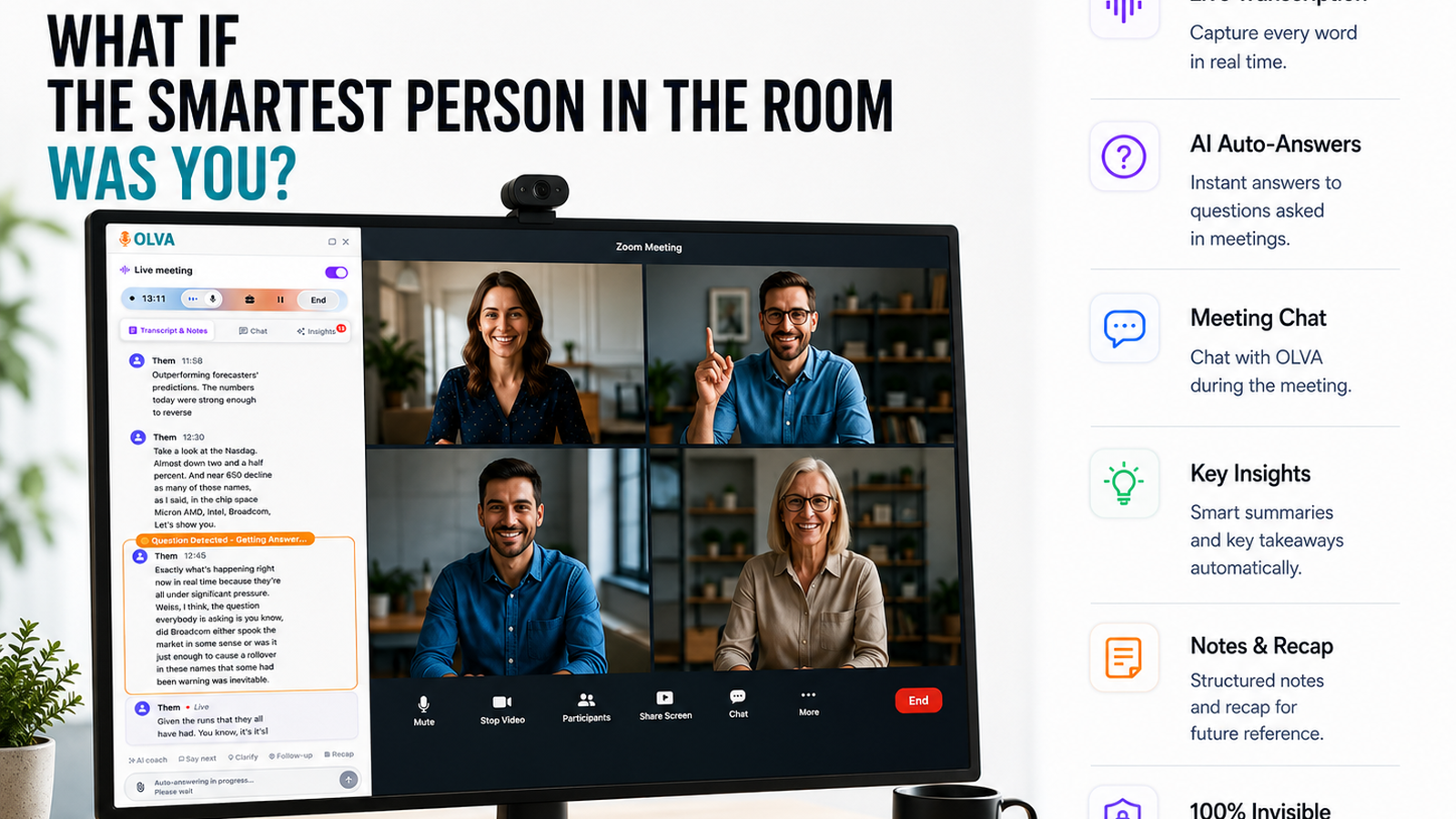
- Invisible AI Assistant
- Works quietly in the background without joining as a visible bot, keeping the interview atmosphere natural and avoiding awkward notifications.
- Live Transcription
- Real-time captions help non-native speakers follow the conversation and allow interviewers to slow down, rephrase, or highlight key points.
- Automatic Question Detection
- Detects when a candidate asks for clarification or when a sensitive topic (like compensation or visa status) arises, prompting the interviewer to respond more thoughtfully.
- Instant Answers & Document-Aware Intelligence
- Pulls answers from uploaded documents (job descriptions, benefits guides, salary bands) so recruiters can respond accurately in the moment.
- Live Q&A & AI Coaching
- Suggests phrasing, clarifying questions, and follow-up probes to help interviewers get better evidence and help candidates articulate examples.
- Live Insights, Fact Checking & Opportunity Detection
- Flags potential red flags (e.g., inconsistent statements vs. the resume) and detects signals of high candidate enthusiasm or uncertainty that merit deeper probing.
- Post-Meeting Memory
- Stores decisions, open questions, and next steps in a searchable history for fair evaluation by the hiring committee.
Together, these capabilities help hiring teams not only capture the interview but actively improve the conversation as it happens.
Practical scenarios and examples
Below are real-world situations and how a live AI assistant improves the outcome.
Scenario 1: Clarifying a technical question
- Problem: A candidate answers a systems-design prompt using terminology your company doesn’t use. The interviewer misinterprets the answer.
- Live AI help: The assistant defines the unfamiliar term in context, suggests a clarifying question (e.g., “Can you describe how you would scale this component?”), and offers a brief paraphrase to check for understanding.
- Outcome: The candidate gets a fair chance to explain, and the interviewer evaluates the substance instead of stumbling over vocabulary.
Scenario 2: Compensation and policy questions
- Problem: A candidate asks about a specific benefit. The recruiter isn’t sure about the exact policy.
- Live AI help: With document-aware intelligence, the assistant pulls the correct line from the benefits PDF or salary band sheet and surfaces an accurate, concise response.
- Outcome: The recruiter answers confidently and transparently, reducing candidate anxiety and the risk of misrepresenting policy.
Scenario 3: Supporting non-native speakers during behaviorals
- Problem: A candidate from a different cultural background gives a brief, modest answer that sounds underwhelming.
- Live AI help: The assistant suggests follow-up prompts to elicit a concrete example (e.g., “Tell me about a time you led a project. What was your role, and what measurable result did you achieve?”) and offers coaching tips for the interviewer to avoid culturally biased interpretations.
- Outcome: The interviewer collects the evidence needed to assess competency fairly.
Scenario 4: Group interview dynamics
- Problem: Multiple interviewers speak over one another, making it hard for a non-native speaker to follow.
- Live AI help: Real-time captions and suggested moderation prompts (e.g., “Let’s pause; [Candidate] had a question”) help the panel slow the pace and keep the conversation accessible.
- Outcome: The candidate remains engaged, and the panel maintains a professional, inclusive atmosphere.
Implementation tips for hiring teams
Use these practical steps to integrate live AI assistance into your recruiting workflow while protecting candidate trust and complying with policy.
- Prepare core documents in advance
- Upload JD, benefits guide, and salary bands to the assistant so it can provide accurate answers.
- Set expectations with candidates
- Mention the use of real-time captioning or AI assistance as part of your accessibility and inclusivity efforts. Transparency builds trust.
- Train interviewers on live coaching suggestions
- Practice using suggested follow-up prompts and paraphrases so the assistance feels natural, not intrusive.
- Prioritize privacy
- Use solutions that avoid joining meetings as visible bots and allow transcripts to be deleted or restricted. Candidates often respond better when they know data is private.
- Use AI suggestions judiciously
- Treat recommendations as prompts, not final judgments. Preserve human evaluation and avoid over-reliance on AI for hiring decisions.
- Capture action items immediately
- Use post-meeting memory to record open questions, candidate accommodations, and agreed next steps for fair committee review.
A fair note on other meeting tools
Several established vendors provide excellent transcription, analytics, and CRM integrations. These platforms strengthen hiring programs by creating searchable records and performance coaching after interviews. They’re particularly strong at post-call analysis, team debriefs, and pipeline analytics.
Where many of them fall short for inclusive hiring is the real-time, invisible support that helps the conversation itself. If your priority is to improve how interviews happen — to reduce misunderstandings in the moment and help interviewers ask clearer, fairer questions — prioritize solutions engineered for live assistance, automatic question detection, and document-aware instant answers.
Ethics, consent, and fairness
AI can improve inclusivity, but only when used responsibly:
- Obtain consent: Tell candidates if you’re using live captions or AI assistance, and explain how data is used.
- Avoid replacing human judgment: AI should augment, not replace, interviewer decisions.
- Monitor for bias: Regularly audit AI suggestions to ensure they don’t introduce cultural or linguistic bias.
- Preserve privacy: Use tools that minimize visible bots and give users control over transcripts and stored data.
These practices keep AI aligned with ethical hiring goals.
How this changes outcomes for recruiters
When applied thoughtfully, live AI meeting assistance reduces missed signals, shortens the time to clear answers, and helps interviewers gather better evidence. Recruiting teams report:
- Higher candidate satisfaction, especially among non-native speakers
- Fewer misinterpretations of technical or behavioral answers
- More consistent interview evaluation across panels
- Faster, more accurate responses to policy questions
These improvements lead to a fairer, more competitive hiring process and help companies access a broader talent pool.
Conclusion
Inclusive interviews require more than good intentions — they need tools that support clarity, fairness, and real-time understanding. Live AI meeting assistants that work invisibly, transcribe in real time, detect questions, and deliver instant, document-backed answers help recruiters do exactly that. They don’t replace human judgment; they make conversation better while it’s happening.
For teams looking to modernize interviewing with privacy-first, in-meeting intelligence, explore solutions built specifically for live assistance — including the capabilities available at https://olva.ai.
By bringing thoughtful AI into the interview room, hiring teams can reduce miscommunication, strengthen candidate experience, and make inclusion a measurable part of every conversation.
References and further reading
- Practical interview scripts for cross-cultural conversations
- Accessibility and privacy considerations for captions and AI tools
- Best practices for bias mitigation in hiring
(Links and templates available from your internal TA resources and industry guides.)