From Demo to Decision: How Document-Aware AI Helps Sales Reps During Product Demos
Product demos are high-stakes moments. A single technical question, pricing objection, or missed follow-up can turn momentum into hesitation. For sales engineers, account executives, and product teams, the difference between a strong demo and a closed deal often comes down to how quickly and confidently the team answers customer questions and steers the conversation.
This article explains how document-aware AI, used in the moment, transforms demos into decision-making engines. It covers practical workflows, real-world examples, and fair comparisons to existing tools so you can see how to apply live AI assistance to accelerate deals.
- Target audience: sales engineers, account executives, product managers, technical teams
- Core topic: using document-aware, real-time AI during demos to answer questions, coach reps, and capture opportunities
Visit https://olva.ai to explore a meeting assistant built for live support during demos.
Why demos need real-time, document-aware intelligence
Traditional meeting tech focuses on recording, transcription, and post-demo analysis. Those capabilities are useful for retrospective coaching, but they miss the most valuable window: the demo itself. When a customer asks a critical question, the deal moves in minutes, not days. Waiting for a transcript or a postmortem to find the right answer is often too late.
Document-aware AI that operates during the demo does three things differently:
- It uses the actual materials you rely on — spec sheets, pricing guides, contracts, and technical docs — to provide precise answers in real time.
- It listens and detects the kinds of questions that matter: objections, technical gaps, and buying signals.
- It coaches the rep on next steps and phrasing, helping the team steer the conversation toward a decision.
Those differences are what turn a demo from an informative session into a decisive moment.
What other tools do well, and where live document-aware AI adds value
Competitors and common tools generally fall into two camps:
- Meeting platforms like Zoom and Microsoft Teams provide reliable audio, video, and sometimes live transcription. They are excellent for connecting remote teams and customers.
- Conversation intelligence platforms like Gong and Chorus focus on capturing meetings and surfacing analytics after the fact. Their post-meeting insights are invaluable for coaching and pipeline analysis.
Both approaches have strengths: reliable recording, high-quality transcripts, and useful post-demo analytics. But they typically operate after the conversation is finished.
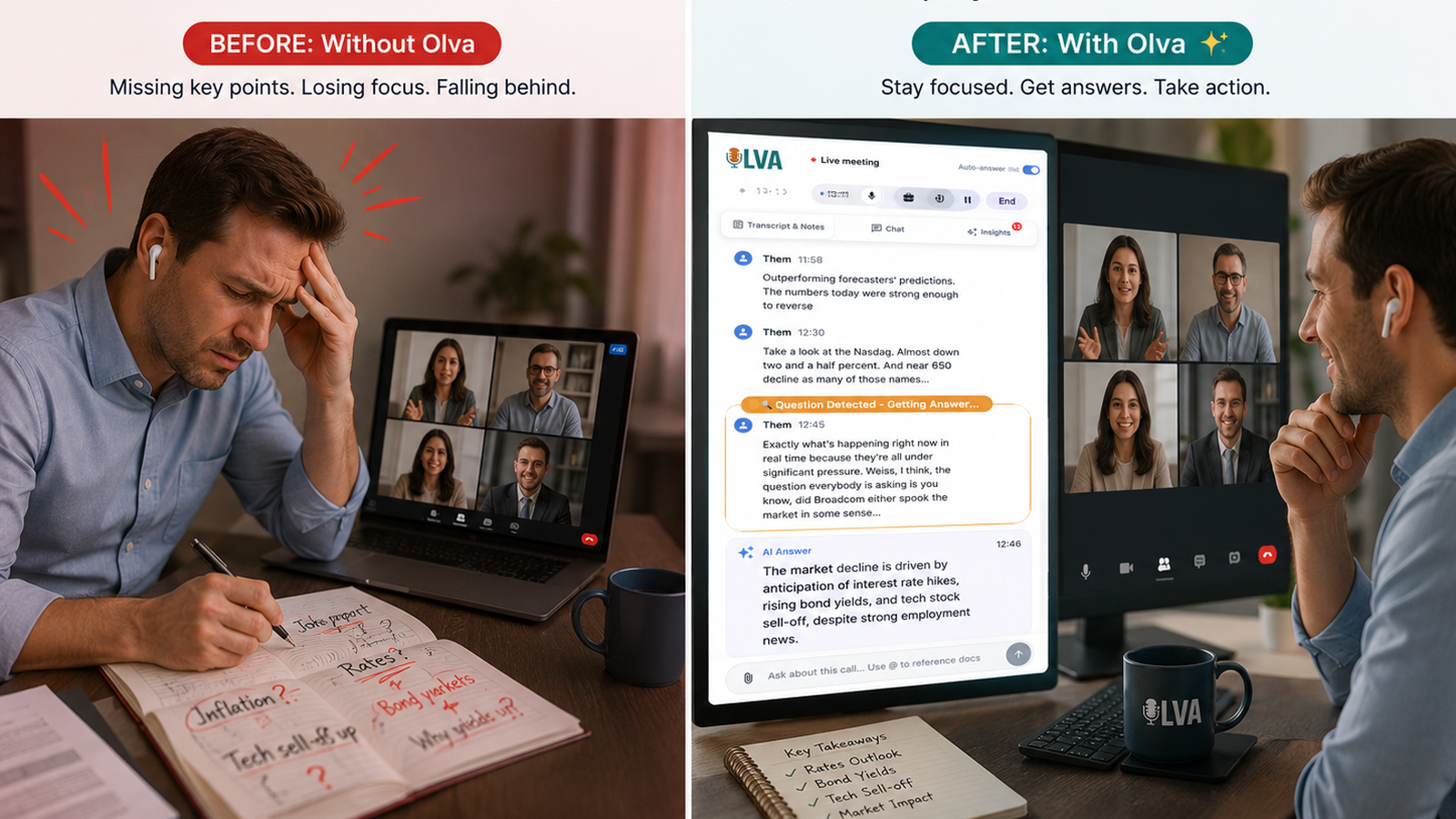
Document-aware, live AI fills the gap by helping the rep in the moment. Instead of waiting for a transcript or post-call playbook, reps get context-aware answers, suggested phrasing, and real-time fact checks that are grounded in uploaded documents and prior meeting history.
Key live capabilities that matter during demos
Here are the capabilities sales and technical teams should expect from a document-aware AI assistant during demos, with practical examples.
Invisible AI assistant
Why it matters: the customer stays focused on the presenter, not a visible bot. The rep retains control and confidentiality is preserved.
Example: Share your screen to walk through a product flow while the assistant remains hidden from the meeting participant list and provides private prompts to the rep.
Live transcription
Why it matters: accurate live transcriptions reduce note taking and let the rep focus on the conversation while the AI maintains context.
Example: When a customer references a clause in a contract, the live transcript helps the AI identify the moment and match it to the uploaded contract.
Automatic question detection
Why it matters: not every sentence is equally important. The AI detects clarifications, objections, pricing questions, and technical probes in real time.
Example: The AI flags a customer comment like, 'How do you handle single sign on with our IdP?' as a technical question and prioritizes relevant documentation.
Document-aware instant answers
Why it matters: answers are grounded in the exact product documentation, pricing guides, or contract language you provide.
Example: During a demo, a customer asks about throughput limits. The assistant searches the uploaded technical spec, surfaces the precise limit, and suggests a short script the rep can use to explain tradeoffs.
Live Q&A and AI coaching
Why it matters: reps can privately ask the assistant what to say next, how to position a feature, or which follow-up question will uncover buying intent.
Example: The rep privately asks, 'How should I respond to a pricing pushback tied to integration costs?' The assistant suggests a two-part response: acknowledge the concern, then propose a trial integration plan plus a discount framework tied to usage milestones.
Live insights, fact checking, and opportunity detection
Why it matters: the AI continuously analyzes the conversation for risks, inaccuracies, and buying signals.
Example: The assistant notices repeated mentions of compliance and suggests emphasizing certifications present in the uploaded compliance PDF. It also detects language indicating interest in expansion and recommends an upsell question.
Post-meeting memory and follow-up
Why it matters: while the focus is on live help, you still need accurate records and a follow-up plan.
Example: After the demo, the assistant generates a structured recap with decisions, action items, open technical questions, and links to the exact passages in documents that were referenced.
Practical demo scenarios and scripts
These short scenarios show how document-aware AI improves outcomes in common demo moments.
Scenario 1: Technical deep dive
- Situation: A product manager asks about API rate limits during an integration demo.
- Without live AI: The rep guesses, asks to follow up, or pulls in an engineer later.
- With document-aware AI: The assistant locates the API doc, pulls the exact rate limits, suggests a concise explanation, and recommends asking a follow-up question to gauge integration timeline.
Suggested rep script from AI: 'Our APIs support up to X requests per minute by default. For high-volume integrations we offer a quota increase process and a dedicated onboarding plan. When do you plan to begin integration so we can align the support window?'
Scenario 2: Pricing objection
- Situation: Prospect says price is higher than expected.
- Without live AI: The rep apologizes and promises to research discounts.
- With document-aware AI: The assistant finds the relevant pricing tiers in the uploaded guide, surfaces available discount rules, and suggests a negotiation framework tied to contract length and usage.
Suggested rep script from AI: 'We can explore both volume-based discounts and a pilot-priced rollout. If you commit to a 12-month term with X seats, we can apply a Y% discount and include migration support at no extra cost.'
Scenario 3: Competitive claim or fact check
- Situation: A prospect claims a competitor supports an integration or feature that may not exist.
- Without live AI: The rep risks arguing without evidence or deferring the point.
- With document-aware AI: The assistant runs a private fact check against uploaded docs and prior meeting notes and suggests a calibrated response that highlights your product strengths without overclaiming.
Suggested rep script from AI: 'I want to make sure I don't misrepresent capabilities. Our product handles integrations via our connector framework, which we documented in the integration guide. If you share the competitor example, I can map the differences for you.'
How to integrate document-aware AI into demo workflows
- Pre-demo prep
- Upload key documents: product specs, API docs, pricing guides, contracts, and recent RFPs.
- Flag sections you expect to discuss, such as SLAs and pricing tiers.
- Review suggested answers and scripts the assistant prepares from the documents.
- During the demo
- Enable invisible assistant mode so the AI supports the rep privately.
- Rely on live transcription and automatic question detection to surface critical moments.
- Use private live Q&A to ask for phrasing, quick data, or a suggested follow-up question.
- Post-demo
- Accept the AI-generated recap that lists decisions, action items, open questions, and references to the exact document passages.
- Share only the parts of the transcript you need; transcripts are private by default and deletable when required.
Privacy and collaboration considerations
Real-time AI assistance must respect confidentiality and user control. Best practices include:
- No visible bot participants in the meeting roster.
- Private-by-design operation so only the rep sees AI cues and answers.
- User control to delete transcripts and meeting memory when necessary.
These safeguards let technical teams and customers stay comfortable during sensitive discussions.
Measuring impact: metrics to watch
To evaluate how document-aware AI is improving demos, track these metrics:
- Demo-to-opportunity conversion rate
- Time to decision after demo
- Number of questions answered live vs answered in follow-ups
- Length of sales cycle for deals where AI was used
- Rep confidence and ramp time for new hires
Teams that adopt live, document-aware AI consistently report faster answers and higher demo effectiveness, driven by fewer follow-up loops and more on-the-spot decision making.
Why this matters for sales engineers and technical teams
Sales engineers and product experts are the bridge between technical correctness and commercial outcomes. Document-aware AI acts as a silent partner that preserves the accuracy of technical answers while improving speed and clarity. It empowers reps to keep the conversation moving and reduces the friction of scheduling additional follow-ups.
By combining live transcription, automatic question detection, instant document-aware answers, and AI coaching, teams can focus less on searching for facts and more on building trust and closing business.
Fair runway: when competitors still make sense
If your priority is enterprise-wide recording, downstream analytics, or detailed post-call coaching at scale, platforms like Gong and Chorus remain strong choices. Video-first platforms and native meeting apps are also essential for connectivity and reliability.
The point is not to replace those systems, but to add a layer of live intelligence that helps reps respond in the moment. When you need to perform during a single demo and reduce friction in the decision-making window, document-aware, real-time AI provides the missing capability.
Getting started with live document-aware assistance
A practical rollout looks like this:
- Start with a pilot group of sales engineers and high-velocity AEs.
- Upload the documentation they use most frequently.
- Run demos with invisible mode enabled and capture usage patterns: which questions are detected, what templates are used, and what follow-ups are suggested.
- Iterate on the document library and coaching prompts to refine live answers.
For teams that want a modern assistant focused on helping during meetings, learn how Olva brings document-aware, live intelligence to demos at https://olva.ai.
Conclusion
Demos are decision-making moments. The faster and more accurately you answer technical questions, address objections, and propose next steps, the more likely a prospect will move from evaluation to commitment.
Document-aware AI shifts the advantage from post-demo analysis to live performance. By using uploaded documents, live transcription, automatic question detection, instant answers, and private AI coaching, sales engineers and account teams can handle complex questions on the spot, reduce follow-up friction, and accelerate deals.
Implementing live, document-aware intelligence does not replace existing analytics tools. Instead, it complements them by ensuring your reps have the right answers at the right time. That capability is what turns a product demo from a presentation into a decisive conversation.
Learn more about applying live, document-aware intelligence to your demos at https://olva.ai.