Supporting Neurodivergent Colleagues with Live AI Coaching and Instant Answers
Neurodiversity is increasingly recognized as a strength in modern teams. People who are neurodivergent—those with autism, ADHD, dyslexia, or other cognitive differences—bring exceptional perspectives, pattern recognition, and creativity. At the same time, meetings and real-time collaboration can present practical challenges: fast-paced conversations, unclear jargon, shifting priorities, and social signals that are hard to parse.
This article explains concrete use cases for sales, customer success, and product teams to support neurodivergent colleagues and clients using live AI coaching, instant answers, and document-aware insights. The focus is specifically on tools that help during meetings, not just after them. When applied thoughtfully, these capabilities reduce anxiety, increase clarity, and help teams capitalize on neurodivergent strengths in real time.
Learn more about the approach and product capabilities at https://olva.ai.
Why real-time support matters for neurodivergent people
Many existing meeting tools emphasize recording, transcription, and post-meeting summaries. Those are valuable—but they don't remove the friction a neurodivergent person experiences in the moment. Common in-meeting pain points include:
- Overlapping speech and rapid topic changes that make it hard to follow.
- Difficulty decoding implied social cues or when to interject.
- Trouble recalling specific product or contract details on the fly.
- Sensory overload from long video meetings or many participants.
- Anxiety about responding quickly to objections or technical questions.
Real-time assistance addresses these issues by providing scaffolding while the conversation is happening: clarifying terms instantly, suggesting phrasing, surfacing referenced documents, and detecting questions or concerns that warrant attention.
Core live capabilities teams should look for
When evaluating solutions, prioritize capabilities that directly help people in the moment:
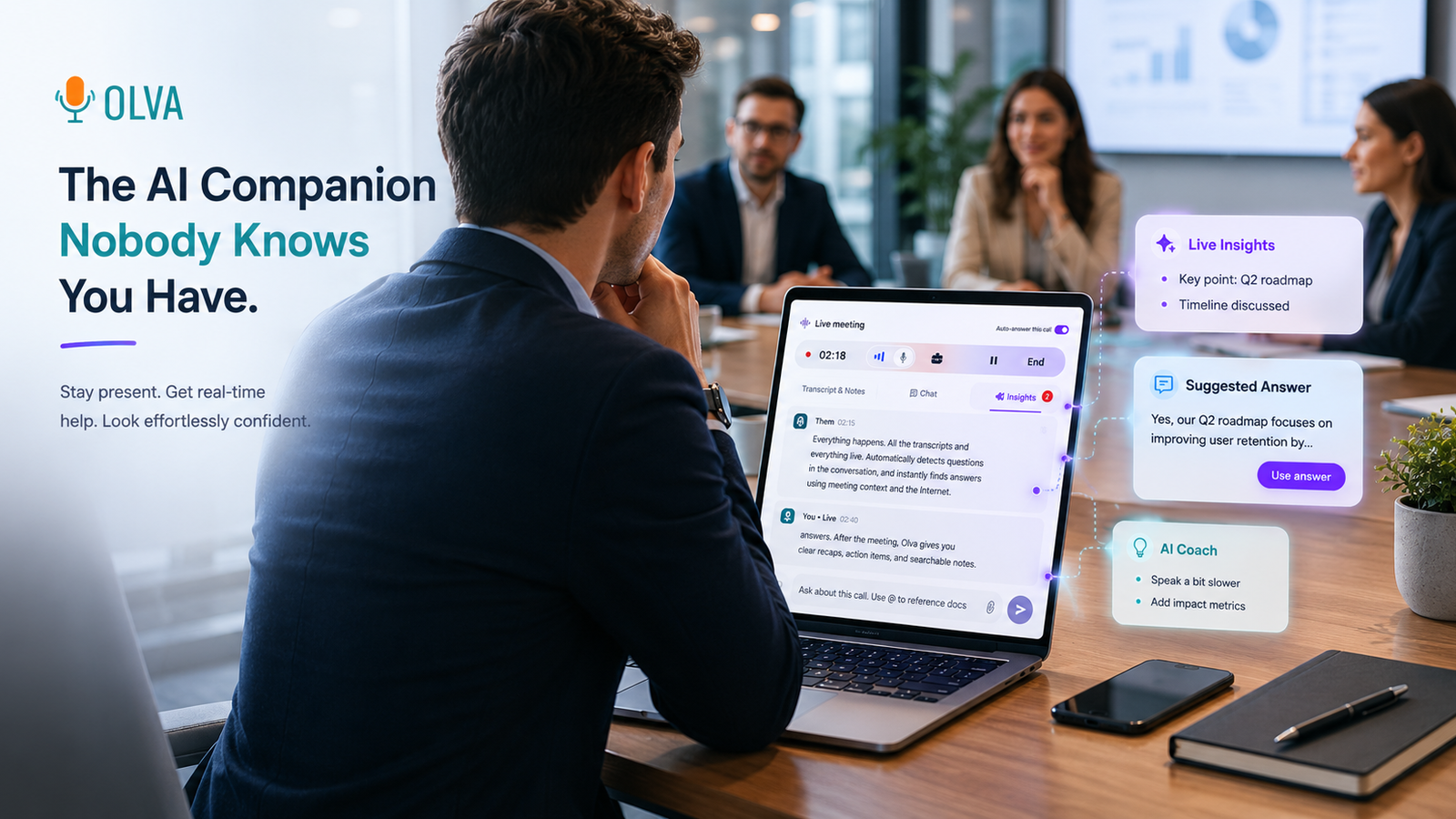
- Invisible AI assistance: private, background support that doesn't add bot participants or notifications.
- Live transcription: real-time capture of what’s being said improves focus and reduces cognitive load.
- Automatic question detection: flags customer objections, clarification requests, and technical questions as they arise.
- Instant answers and document-aware intelligence: use meeting context plus uploaded documents to generate accurate responses instantly.
- Live Q&A and coaching: private prompts on what to say next, how to reframe answers, or when to pause for a colleague.
- Live insights: fact-checking, jargon definitions, opportunity signals, and suggested follow-ups surfaced during the conversation.
These features let teams support neurodivergent colleagues without making them feel exposed or singled out.
Use cases for Sales teams
Sales conversations often demand quick judgement calls. For neurodivergent sales reps, that can be stressful. Live AI coaching and instant answers reduce cognitive load while increasing close rates.
Practical examples:
- Handling objections: automatic question detection identifies pricing objections and suggests a short, scripted response grounded in product facts and uploaded pricing docs. The rep can paraphrase the suggestion or read it silently to reduce anxiety.
- Managing pace and turn-taking: live transcription provides a visible, scrolling transcript that helps a rep follow the flow when multiple stakeholders speak at once.
- Document-aware answers during demos: when a prospect asks about SLAs or integrations, the assistant pulls precise contract or technical details from uploaded PDFs in real time so the rep can answer accurately.
Scenario:
- A lead asks, "Can you guarantee uptime for our API during seasonality spikes?"
- The assistant detects this as a technical/contract question and surfaces the SLA clause from an uploaded document plus a suggested reply: "Our standard SLA provides 99.9% uptime; for high-volume seasons we offer an enhanced plan with dedicated support—I can send the exact terms." The sales rep adapts that language and sends a follow-up email created by the assistant.
How this supports neurodivergent reps:
- Reduces pressure to recall specifics under stress.
- Provides structured responses that can be practiced before speaking.
- Prevents overcommitment by showing exact contract language.
Use cases for Customer Success teams
Customer success teams need to build trust while resolving problems—often under time pressure. Neurodivergent CSMs and customers both benefit from transparent, factual, and paced interactions.
Practical examples:
- Clarification prompts for clients: if a client uses ambiguous language or jargon, the assistant suggests clarifying questions to help the CSM get to the root cause without making assumptions.
- Live opportunity detection: the assistant flags buying signals from a conversation and suggests low-effort expansion or next-step questions the CSM can ask.
- Accessibility and pacing: invisible screen-share mode allows a CSM to share visuals while the assistant privately highlights key bullets or captions so customers who process information visually can follow at their own pace.
Scenario:
- During a support call, a client repeatedly says, "It's just slow," without clear context. The assistant suggests three targeted diagnostics to ask next and offers a one-sentence summary the CSM can send to capture the shared understanding.
How this supports neurodivergent colleagues and clients:
- Reduces ambiguous social exchange by producing clear, written phrasing.
- Helps clients who prefer written confirmation or step-by-step instructions.
- Gives neurodivergent CSMs a private coach that recommends what to ask next and how to summarize complex information.
Use cases for Product teams and Technical teams
Product and engineering discussions can be dense with jargon and implicit assumptions. Real-time assistance helps keep everyone aligned and prevents miscommunication from cascading into design or roadmap errors.
Practical examples:
- Defining terms and acronyms: live insights automatically define unfamiliar concepts or acronyms during a meeting so no one is left guessing.
- Fact-checking and requirements capture: the assistant calls out potential contradictions in real time and suggests clarifying questions or action items.
- Document-aware context for decisions: when a customer requirement references a contract, the assistant pulls the exact phrasing so product decisions are made from accurate information.
Scenario:
- In a planning meeting, someone says, "We can deprioritize the OAuth flow for now." The assistant notes this as a decision, checks it against the product roadmap and prior meeting memory, and flags a possible dependency with a live prompt: "OAuth is required for customer X—confirm impact before deprioritizing." This prevents an expensive rework later.
How this supports neurodivergent colleagues:
- Reduces ambiguity in technical discussions.
- Provides written anchors and definitions on demand.
- Acts as a private validator for alternate thinking styles, decreasing the social cost of challenging assumptions.
Supporting neurodivergent clients in external meetings
Neurodivergent customers often appreciate clear agendas, slower pacing, and written confirmation. Tools with live assistance make meetings more inclusive:
- Shared, live transcripts act as a real-time anchor for people who process information better when they can read along.
- When a client asks a complex question, automatic question detection plus document-aware answers let you respond precisely and calmly.
- Follow-up summaries created during the meeting ensure next steps are concrete and accessible.
Example email created automatically during the meeting:
- Summary of what was agreed, three next steps, and the exact timeline mentioned, all pulled from the meeting transcript and documents.
This reduces rework and the number of clarifying exchanges after the meeting.
Competitors: fair context and where real-time differs
Many established tools—recording platforms, transcription services, and conversation intelligence products—do a great job at capturing meetings and generating post-meeting analytics. Tools like Gong, Otter, and common conferencing platforms provide useful transcripts, call analytics, and playback.
Where those tools excel:
- Accurate transcriptions and searchable meeting histories.
- Post-hoc coaching and analytics that surface trends over time.
Where real-time assistants add complementary value:
- Live assistance helps people perform during the meeting, not just review it later. For neurodivergent individuals who need immediate scaffolding, that matters.
- Invisible AI assistance avoids adding bot participants or interrupting the meeting flow while still providing private, actionable suggestions to the user.
- Document-aware instant answers reduce the risk of inaccurate or misleading responses when a question requires consulting contracts or specs.
The best approach often combines both: use robust post-meeting analytics to learn trends and a live assistant to improve performance and inclusivity during conversations.
Privacy and inclusivity considerations
Supporting neurodivergent colleagues requires sensitivity. When adopting live AI tools, teams should ensure:
- Transparent policies about when AI assistance is active and how transcripts are stored.
- Options for private use so the individual gets support without being singled out or broadcast to participants.
- Fine-grained control over transcript retention and deletion.
A useful model is a private, invisible assistant that transcribes locally or stores data only for the user and allows deletion of transcripts—this protects privacy while still delivering in-meeting benefits.
Implementation tips for teams
- Start small: pilot live assistance with a subset of users in sales, CS, and product teams who can give feedback.
- Share inclusive meeting norms: encourage concise turn-taking, use of agendas, and written follow-ups. Live AI makes it easier to enforce these norms without policing behavior.
- Upload key documents: contracts, SLAs, technical specs, and product sheets are most valuable when the assistant can reference them during a call.
- Train managers on neurodiversity: combine AI enablement with human coaching and accommodations.
Measured benefits
Teams using live AI coaching and document-aware instant answers report:
- Reduced meeting stress for neurodivergent and neurotypical colleagues.
- Faster, more accurate responses to customer questions.
- Fewer follow-up clarifications and escalations.
- Improved capture of decisions and action items in real time.
These outcomes translate into higher productivity, better customer satisfaction, and fewer costly reworks.
Conclusion
Neurodiversity is an asset—when teams provide the right supports. Live AI coaching, instant answers, and document-aware insights help sales, customer success, and product teams remove friction during meetings, enabling neurodivergent colleagues and clients to contribute confidently.
Look for tools that emphasize invisible assistance, live transcription, automatic question detection, and document-aware intelligence so support happens in the moment without creating additional spotlight or interruptions. Combining these capabilities with inclusive meeting norms and clear privacy controls helps teams become both more effective and more equitable.
For an example of how these principles come together in a real product, see https://olva.ai.