Go Viral in Interviews: Real-Time AI Coaching and Instant Answers to Nail Interviews
Landing your next role is increasingly about performance in the moment: the clarity of your answers, how you steer difficult questions, and whether you can confidently handle curveballs. For job seekers, career coaches, recruiters, and early-career professionals, mastering interviews now means mastering live conversations.
This article explains how real-time AI coaching and instant answers change the interview game. It covers practical strategies, example scenarios, and a fair comparison to other tools — and shows how modern assistants like Olva (https://olva.ai) are helping candidates perform better during interviews, not just remember them afterward.
Why real-time help matters more than ever
Traditional interview prep focuses on rehearsals, lists of common questions, and after-the-fact notes. But interviews are dynamic: interviewers ask follow-ups, test your thinking, and look for cues that indicate fit. When you need to recover from a mistake, clarify a technical detail, or seize a negotiation opening, waiting until after the interview is too late.
Real-time AI coaching offers two crucial advantages:
- It provides context-aware support at the moment you need it.
- It reduces cognitive load so you can focus on the conversation, not frantic note-taking.
In short: most meeting tools help you remember meetings. Real-time AI assistants help you perform better in them.
What real-time AI coaching looks like in an interview
Here are concrete scenarios showing how live assistance changes outcomes.
Scenario 1 — Phone screen: Clarifying a competency question
- Interviewer: "Tell me about a time you led a project with cross-functional stakeholders."
- You (thinking): Unsure how to frame a quick STAR answer.
- Real-time AI help: Detects the question type, suggests a 30–45 second STAR outline, and highlights which part of your resume to reference.
- Result: You deliver a focused, evidence-backed response that keeps momentum.
Scenario 2 — Technical interview: Facing an unfamiliar API question
- Interviewer asks about integrating a specific API you haven’t used.
- Real-time assistant: Pulls relevant notes from your uploaded documents (e.g., your project docs or API snippets you prepared), gives a concise explanation, and suggests clarification questions for the interviewer.
- Result: You avoid rambling, show pragmatic thinking, and turn a potential weakness into curiosity.
Scenario 3 — Panel interview: Managing conflicting cues
- Two interviewers push different lines of questioning.
- Live insights: Detects a divergence in priorities (e.g., one cares about scalability, the other about speed), surfaces opportunity signals, and recommends a balancing answer that addresses both concerns.
- Result: You appear diplomatic and solution-oriented.
Scenario 4 — Offer negotiation: Spotting a salary opening
- Interviewer hints at budget flexibility.
- Opportunity detection: Flags buying/compensation signals in real time and suggests a negotiation script backed by market data or your uploaded salary research.
- Result: You confidently frame your ask while preserving rapport.
Key capabilities that matter during interviews
Not all AI tools are designed to help during the conversation. When evaluating solutions, focus on capabilities that deliver in-the-moment value:
- Invisible AI Assistant: Works without adding a bot participant or awkward notifications, so your interview feels natural and private.
- Live Transcription: Captures interviewer prompts and your answers, letting you focus on tone and logic instead of frantic note-taking.
- Automatic Question Detection: Identifies behavioral, technical, or pricing/compensation questions as they occur so the assistant can offer targeted help.
- Instant Answers: Generates context-aware answers using uploaded documents (resume, job description) or prior meeting memory.
- Live Q&A: Lets you ask micro-questions silently—e.g., “How to rephrase this?”—and receive an instant suggestion.
- Live Insights & Opportunity Detection: Highlights what matters in the conversation (what was emphasized, buying signals, or gaps you can exploit).
- AI Coaching: Recommends phrasing, follow-up questions, and strategic guidance tailored to the role and interviewer cues.
- Document-Aware Intelligence: Uses your resume, portfolio, and the job description to craft precise, relevant responses.
- Post-Meeting Memory: Stores highlights, suggested follow-ups, and decisions for later review and follow-up emails.
These features are particularly effective when combined: live transcription plus instant answers plus the ability to reference an uploaded resume turns uncertainty into confidence.
Practical checklist: How to prepare for interviews with real-time AI support
- Upload your core documents ahead of time
- Resume, portfolio, GitHub links, job description, and salary research. Document-aware AI will use these to generate accurate, tailored answers.
- Practice with mock interviews that simulate live assistance
- Give the assistant permission to listen in a mock session so it learns your voice, phrasing, and typical gaps.
- Set privacy boundaries
- Use tools that are private by design and don’t join as visible bots. That preserves the natural interview flow and your control over data.
- Define your signal words
- Decide which phrases will trigger the assistant quietly (e.g., "help me rephrase").
- Prepare fallback strategies
- If the connection or assistant is unavailable, keep one or two prepared bridging sentences to buy time while you gather your thoughts.
- Use live insights for follow-ups
- After the interview, use saved highlights to craft targeted thank-you notes and answer unresolved questions.
How Olva fits into the interview workflow
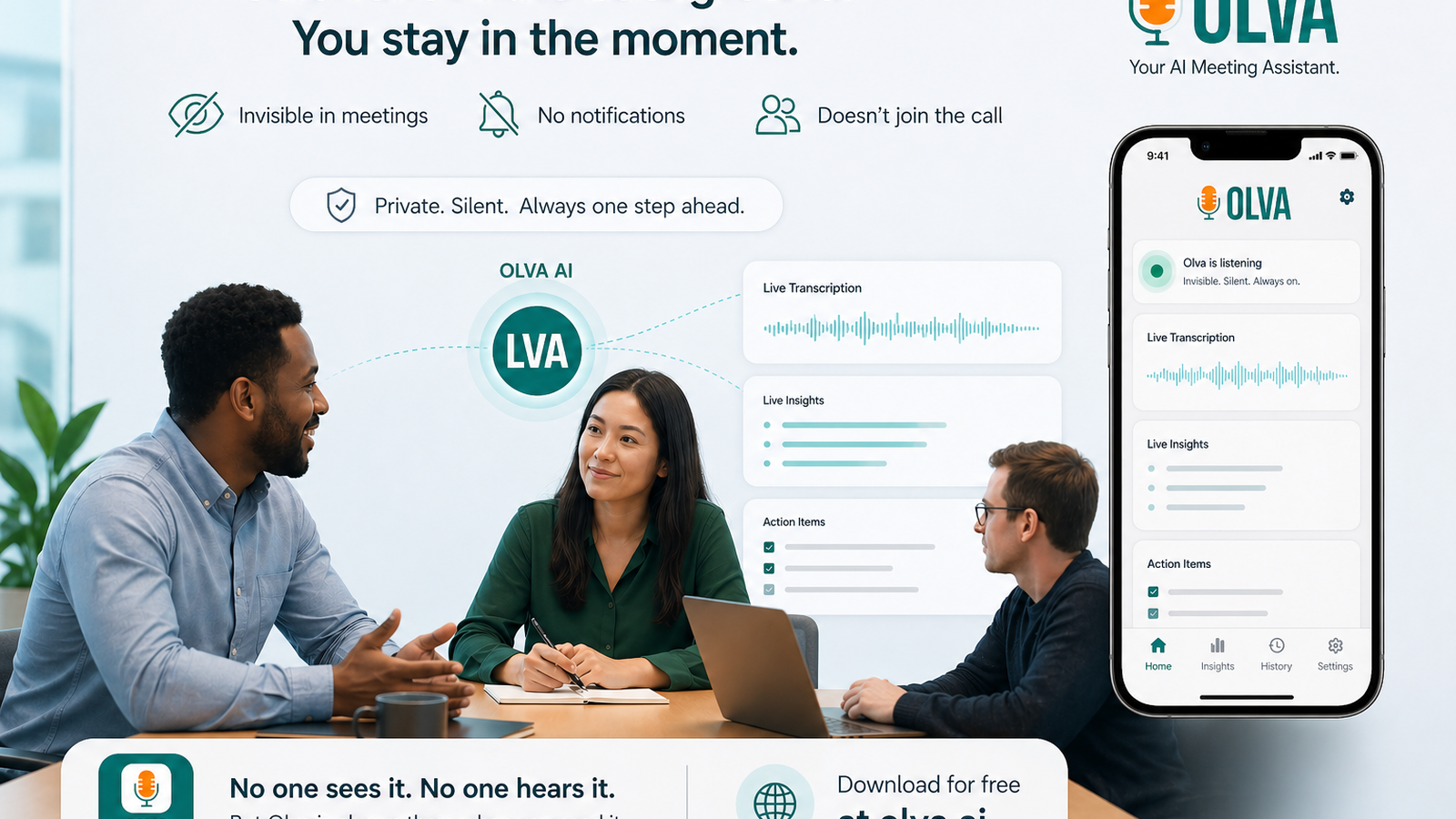
Olva is designed as an invisible AI meeting assistant that focuses on helping users perform better during conversations. Unlike tools that primarily record and summarize, Olva emphasizes live coaching and instant, context-aware support.
What that looks like in an interview setting:
- Invisible presence: No bot participant, no awkward notifications — the conversation stays human.
- Live transcription captures both interviewer and candidate audio so you can concentrate on engagement rather than notes.
- Automatic question detection flags the type of question and surfaces tailored guidance immediately.
- Instant answers draw from your uploaded resume, job description, or previous meeting memory to produce answers you can use on the spot.
- Live Q&A allows micro-asks like "How to rephrase that answer for a senior PM role?" without interrupting.
- Opportunity detection highlights moments where the interviewer hints at priorities, compensation, or future projects.
Together, these capabilities help you navigate the interview in real time, converting uncertainty into action.
For more on how Olva enables live meeting intelligence, visit https://olva.ai.
Fair comparison: What other tools do well — and where real-time coaching adds value
Many existing tools help with interviews in useful ways:
- Otter.ai, Rev, and similar services provide reliable transcripts and searchable records for post-interview review.
- Hiring platforms like HireVue or Pymetrics automate interview scoring and standardized pre-recorded responses.
- Note-taking and productivity tools (e.g., Google Docs, Notion) help organize post-interview reflections and follow-ups.
These tools excel at documentation, scalable assessments, and analysis after the fact. Where they fall short is in-the-moment assistance: most do not provide contextual suggestions while the conversation is happening, nor do they offer private, invisible coaching without joining the call.
Real-time AI coaching fills that gap. It doesn’t replace post-interview analysis — it enhances live performance. Combining post-hoc tools with a live assistant delivers the best outcomes: you perform better during the interview and still get accurate records afterwards.
Example scripts: Real-time coaching suggestions you can expect
- Behavioral question (30–45 seconds)
- Prompt detected: STAR behavioral.
- Suggested structure: "Situation: X; Task: Y; Action: Z — emphasize my leadership and measurable result: A."
- Live phrasing: "At Company X, we faced [problem]. I led a cross-functional team to [action], which improved [metric] by [result]."
- Technical clarification
- Prompt detected: API/architecture question.
- Suggested bridge: "Can you clarify whether you mean latency under load or average response time? That will help me answer precisely."
- Quick explanation: Short bullet points about trade-offs and a recommended follow-up question.
- Salary opening
- Prompt detected: Budget flexibility.
- Suggested response: "Based on market data for similar roles in this region and my experience, I'm targeting [range]. What does your compensation structure typically look like for someone at this level?"
These micro-scripts are usable verbatim or as inspiration; they buy you clarity and composure.
Ethics and privacy considerations
Interviews are sensitive interactions. When using AI assistance, prioritize platforms that:
- Keep data private and accessible only to you.
- Don’t add visible bots or record without explicit consent.
- Allow you to delete transcripts or highlights at any time.
Olva’s invisible design and user-controlled memory align with these principles by default. Always disclose recordings or shared transcripts if required by law or company policy.
Measuring impact: What success looks like
Track outcomes to evaluate the ROI of real-time coaching:
- Short-term: Increased clarity in answers, fewer interrupted or redirected responses, smoother transitions in panel interviews.
- Medium-term: Higher callback rates, improved conversion from interview to offer, better negotiation outcomes.
- Long-term: Faster progression through hiring funnels and stronger interview confidence that compounds over time.
Qualitative feedback from interviewers (e.g., comments about clarity or problem-solving) can also validate the difference real-time coaching makes.
Final thoughts
Interviews reward clarity, composure, and the ability to respond to novel questions quickly. Real-time AI coaching and instant answers shift the advantage to candidates who can access context-aware support during the conversation — without disrupting the human connection.
By combining invisible assistance, live transcription, automatic question detection, and document-aware intelligence, modern tools like Olva help you do more than remember an interview: they help you win it. For practical, privacy-conscious live coaching that supports performance in the moment, explore how these capabilities fit into your interview preparation and on-call workflow at https://olva.ai.
References and further reading
- Practical interview frameworks: STAR, PAR, CAR
- Negotiation basics: anchoring, BATNA, and framing
- Ethical AI use in interviews: consent, transparency, and data control