How Recruiters & Hiring Managers Use Olva’s Real-Time Question Detection to Run Faster, Fairer Interviews
Hiring at scale means balancing speed, fairness, and accuracy. Recruiters and hiring managers often rely on notes, recordings, and manual checklists — tools that help remember what happened but rarely improve what happens during the interview itself. That gap is where Olva was built to help.
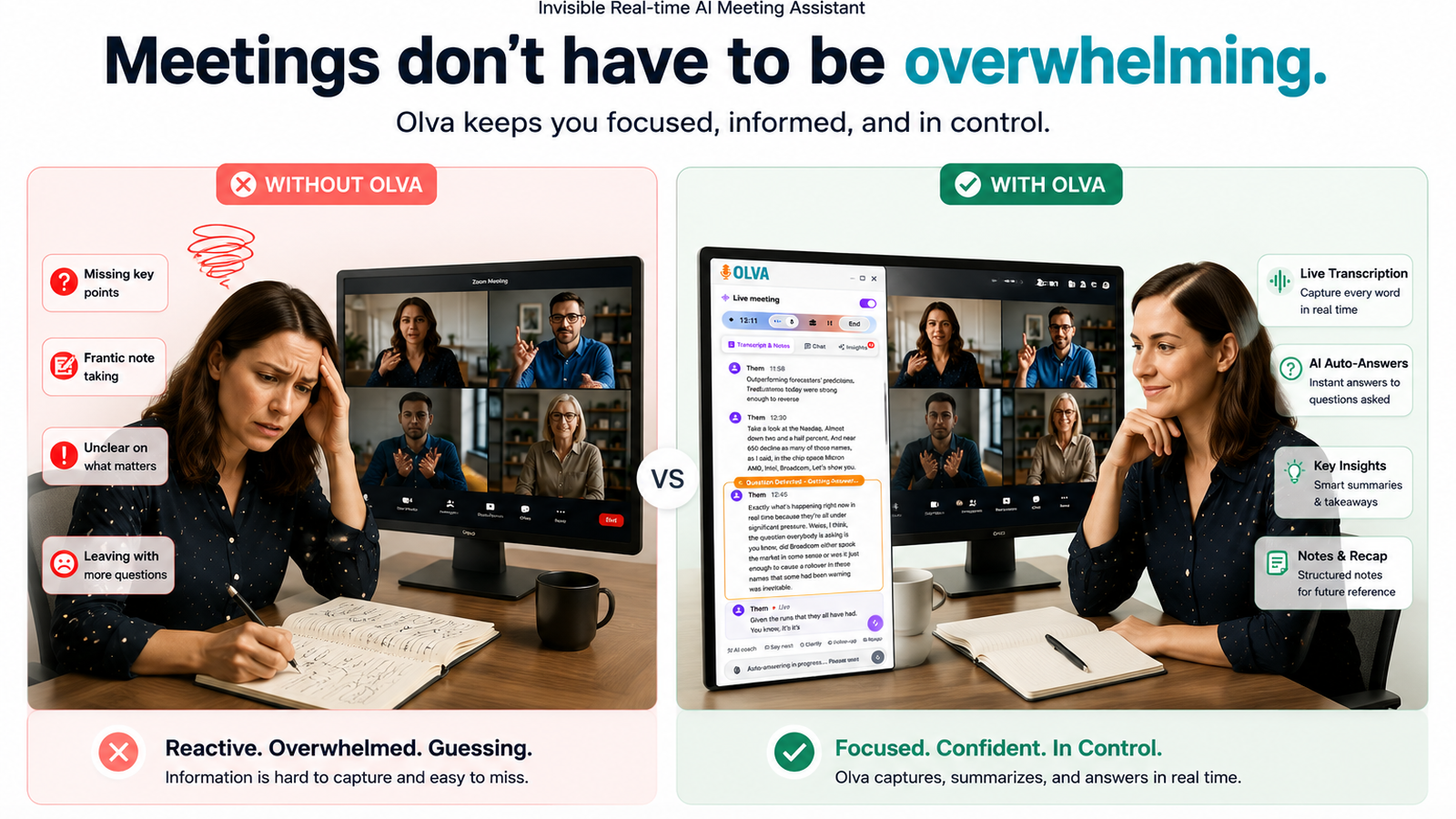
Olva is an invisible AI meeting assistant that focuses on real-time meeting intelligence: automatic question detection, document-aware answers, live coaching, and continuous insights. Instead of only creating transcripts and summaries after an interview, Olva helps you perform better during the conversation — ask better follow-ups, verify claims instantly, and keep interviews consistent and bias-resistant.
In this post we’ll cover:
- Why real-time assistance matters for recruiting
- Concrete ways recruiters and hiring managers use Olva in interviews
- Practical examples (screening, technical, and panel interviews)
- How Olva supports fairness and reduces bias
- How Olva compares to transcription-heavy tools
- A short checklist for getting started
If you want to explore Olva further, visit https://olva.ai for demos and examples.
Why real-time assistance matters for recruiting
Interviews are high-stakes, fast-moving conversations. Small mistakes — missed clarifications, forgotten follow-ups, or misinterpreted answers — compound into bad hiring decisions. Traditional meeting tools solve the memory problem: they record, transcribe, and summarize. Those workflows are valuable, but they act after the interview has already shaped a hiring outcome.
Real-time assistance changes that timeline. Helping a recruiter during the conversation improves the quality of information collected and the candidate experience. It also reduces interviewer cognitive load so humans can focus on evaluating instead of note-taking.
Key benefits of real-time help in interviews:
- Ask the right follow-ups in the moment
- Verify candidate claims instantly against documents and prior notes
- Maintain consistent question sets across candidates
- Surface concerns and buying signals directly during the conversation
- Remove distractions so interviewers can stay present
Olva is designed to deliver all of these, privately and invisibly, while you conduct interviews.
Core Olva capabilities that matter for hiring
- Invisible AI Assistant: Olva works without joining the interview as a visible bot. No awkward bot names in calls, no distractions for candidates, and full privacy by design.
- Live Transcription: Real-time transcripts let you track answers without note-taking.
- Automatic Question Detection: Olva detects candidate questions (and interviewer prompts) and flags important moments like objections, clarification requests, or commitments.
- Document-Aware Intelligence: Upload resumes, job descriptions, assessments, and offer letters so Olva can reference them live.
- Instant Answers & Live Q&A: Ask Olva what to say next or request an answer based on the job description and candidate resume.
- Live Insights & Fact Checking: Verify dates, role titles, or claimed skills against uploaded documents or past interview notes.
- AI Coaching: Receive suggested follow-ups, phrasing tips, and objection-handling scripts in real time.
- Post-Meeting Memory: Action items, decisions, and searchable interview history are captured for future reference.
Practical scenarios: how Olva improves real interviews
Below are concrete examples that show how these capabilities work together during typical recruiting workflows.
1) First screening: stay efficient and consistent
Challenge: Screening calls are high volume. Interviewers must capture qualifications and cultural fit while remaining consistent across dozens of candidates.
How Olva helps:
- Use Document-Aware Intelligence to load the job description and scorecard.
- Live Transcription captures candidate answers so you don’t have to type.
- Automatic Question Detection highlights when a candidate asks about compensation, visa status, or remote policy — critical screening topics that can be missed otherwise.
- AI Coaching suggests a standard follow-up for behavioral answers (e.g., “Can you walk me through the specific outcome and your role?”).
Example flow:
- Before the call, upload the JD and screening rubric to Olva.
- During the call, Olva flags the candidate asking about salary expectations and shows a suggested reply: a short, transparent statement about timeline and range.
- After the call, Olva auto-generates a scorecard entry populated with the transcript snippets and suggested highlights.
Result: Faster calls, standardized notes, and fewer missed disqualifiers.
2) Technical interviews: verify claims and focus on assessment
Challenge: Technical interviews require verifying skill claims (framework experience, years of leadership, published work) without pulling the interviewer out of the problem-solving flow.
How Olva helps:
- Load candidate GitHub, portfolios, and assigned take-home tests into Olva ahead of time.
- As the candidate references a project, Olva can instantly surface relevant lines from the uploaded materials and provide context.
- Live Insights detect potential inconsistencies (e.g., candidate states 5 years of React experience but portfolio shows recent projects in Vue) and flag them privately.
- Instant Answers can suggest a probing question to validate depth: “Can you explain a trade-off you made in Project X and why you chose that approach?”
Example flow:
- An interviewer asks a system design question and the candidate references an architecture they worked on. Olva silently pulls the candidate’s architecture diagram (uploaded PDF) and surfaces a concise summary and follow-up ideas.
Result: Interviewers verify claims without interrupting the flow, so they can focus on evaluating problem-solving rather than hunting for evidence.
3) Panel interviews and structured fairness
Challenge: Panels can be inconsistent — different interviewers may ask different questions or interpret answers differently.
How Olva helps:
- Share a common question set and scoring rubric via Document-Aware Intelligence.
- Olva’s Automatic Question Detection ensures all panelists’ key items are asked and captured.
- Real-time suggested follow-ups keep the panel aligned on probing the same competencies.
- Post-Meeting Memory stores the combined notes and recommended next steps.
Example flow:
- During a panel interview for a PM role, Olva monitors coverage of core competencies (product sense, prioritization, stakeholder management) and privately alerts the panel host if a competency hasn’t been sufficiently probed.
Result: More consistent data across candidates and fairer comparisons.
4) Offer negotiation and closing
Challenge: Negotiations are nuanced, time-sensitive, and often require quick access to offer details and equity plans.
How Olva helps:
- Load offer templates, comp bands, and pre-approved negotiation boundaries.
- When a candidate asks about equity, salary, or benefits, Olva instantly summarizes what’s on record and suggests next phrases to maintain alignment with compensation policy.
- Opportunity Detection identifies signs of high interest (e.g., candidate asks about start date and team structure) and suggests prioritized closing steps.
Result: Faster, compliant, and more confident negotiations.
Improving fairness and reducing bias
Real-time interview intelligence can directly help with fairness — when used intentionally.
Ways Olva supports equitable hiring:
- Standardization: Load structured interview guides and rubrics so every interviewer has the same reference during the conversation.
- Consistent follow-ups: AI Coaching suggests neutral, competency-focused questions rather than ad-hoc personal probes that invite bias.
- Fact Checking: Verify credentials and dates against resumes and uploaded files to reduce reliance on memory or first impressions.
- Silent prompts: Olva’s invisible mode prevents candidates from feeling monitored by a visible bot, preserving a natural interview atmosphere.
A cautionary note: technology itself isn’t a silver bullet. Use Olva to enforce structured processes and train interviewers on equitable evaluation to get the best results.
How Olva compares to transcription-first tools
Many popular products in the market excel at capturing and analyzing post-interview data. Services like Otter, Gong, or Chorus provide excellent transcripts, playback, and review workflows. Those tools are strong when you want deep post-hire analytics and team-wide coaching using recorded data.
Where Olva is different:
- Live-first, not just post-analysis: Olva focuses on helping interviewers during the conversation — not only after.
- Automatic Question Detection: Rather than simply surfacing everything, Olva identifies and categorizes questions and candidate signals in real time.
- Document-Aware Intelligence: Olva uses uploaded resumes, job descriptions, code samples, and offer docs actively during the interview to provide contextual answers.
- Invisible Assistant: Olva operates without joining your meeting as a visible bot, maintaining privacy and a natural candidate experience.
That said, transcription and post-meeting summaries remain valuable. Olva includes live transcription and post-meeting memory so you get the best of both worlds: in-the-moment guidance and reliable records after the interview.
Practical tips for getting started with Olva in hiring
- Prepare documents: Upload the job description, scorecard, candidate resume(s), and any portfolio or test artifacts before the interview.
- Define what matters: Create a short rubric for the interview — 3–5 core competencies — and upload it so Olva can align prompts and follow-ups.
- Train your panel: Show interviewers how Olva’s private suggestions appear and practice using Live Q&A to request instant coaching.
- Use invisible mode: Keep Olva hidden to maintain a natural candidate experience.
- Review post-meeting memory: After the interview, use Olva’s auto-generated recaps and action items to sync with hiring teams.
Checklist to try on your next interview:
- Job description uploaded
- Scorecard uploaded
- Candidate resume(s) uploaded
- Panel informed about Olva’s role
- Interviewer practices one live coaching prompt (e.g., “How to probe leadership in this example?”)
Example transcript snippet (fictional)
Interviewer (live): "Can you describe a time you owned a product from ideation to launch?"
Olva (private suggestion): "Follow-up: Ask about metrics for success and the candidate’s specific role in trade-offs. Suggested phrasing: 'What metric did you own, and how did you decide trade-offs between speed and reliability?'"
Candidate: "We shipped monthly and increased retention by 8%."
Olva (fact check): "Resume lists Project X at Company Y with launch date March 2022. Uploaded case study shows retention improved by 7% — consider asking for measurement methodology."
Interviewer: "Can you walk me through how you measured retention and which cohort you used?"
This streamlined flow shows how Olva helps interviewers probe deeper and verify claims without disrupting the candidate.
Privacy and compliance
Olva emphasizes privacy: it does not join meetings as a visible bot, transcripts are private to the user and can be deleted, and data visibility is user-controlled. These design choices make Olva suitable for sensitive hiring conversations while helping teams stay compliant with internal privacy policies.
Conclusion: Run faster, fairer, and smarter interviews
Recruiting teams need tools that do more than remember what happened — they need tools that improve what happens. Olva brings real-time question detection, document-aware intelligence, and private AI coaching to interviews so recruiters and hiring managers can be more consistent, confident, and equitable.
Whether you’re screening dozens of candidates a week, running deep technical assessments, or negotiating offers, Olva helps you act in the moment: ask better questions, verify claims instantly, and surface opportunities and risks as they happen.
To see live examples and learn how to apply these workflows in your hiring process, visit https://olva.ai and explore demos tailored for recruiting teams.