How Job Seekers Use Olva for Live Interview Coaching and Resume-Aware Practice
Job interviews are high-pressure conversations where clarity, timing, and relevance matter more than a perfect transcript afterward. For job seekers, practicing answers, responding to unexpected questions, and aligning responses to your resume and the job description are the difference between a good interview and a successful one.
Olva is an invisible AI meeting assistant designed to help you perform better in the moment — not just remember what happened later. This post explains practical ways job seekers use Olva for live interview coaching, automatic question detection, and resume-aware practice, with examples you can apply right away.
Visit https://olva.ai to learn more about Olva’s capabilities.
Why live coaching beats after-the-fact feedback
Most tools focus on transcripts, summaries, and notes. Those are useful, but they only help you learn after the interview is over. Job interviews demand on-the-spot thinking, instant reframing, and the ability to pivot based on the interviewer’s signals.
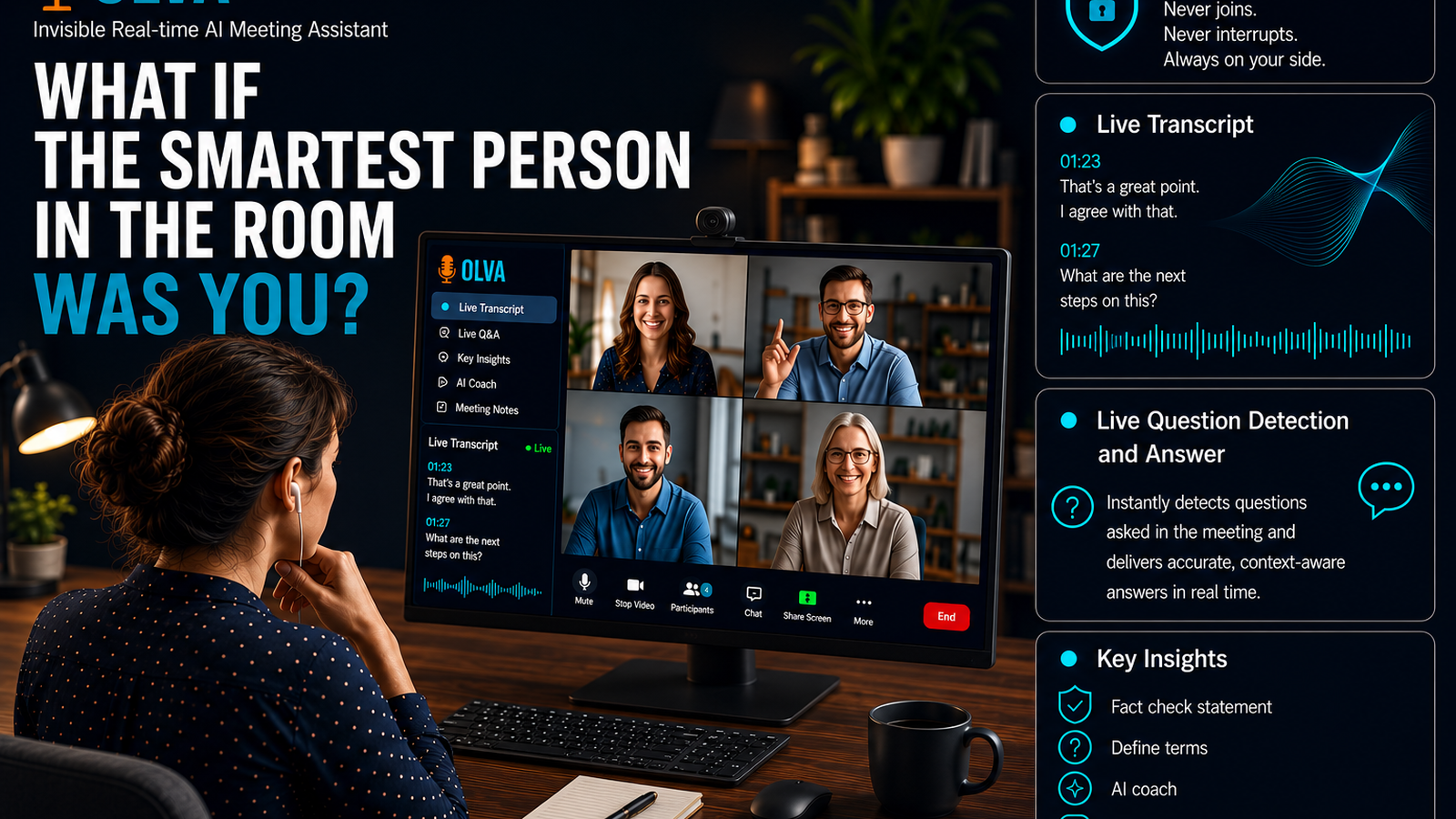
Olva fills that gap. It works quietly in the background (no bot participant announcing itself), transcribes in real time, detects questions and conversational opportunities, and gives you instant, private guidance while the interview is happening.
Benefits for job seekers:
- Respond faster and more precisely to technical or behavioral prompts.
- Avoid awkward pauses by getting suggested phrasing and follow-ups in real time.
- Tailor answers to your uploaded resume and the job description rather than generic scripts.
Core Olva capabilities for interviews (brief)
- Invisible AI Assistant: Olva supports you without joining as a visible bot—no interruptions.
- Live Transcription: Follow and search what’s said without taking notes.
- Automatic Question Detection: Olva flags direct questions, clarifications, and objections the moment they occur.
- Instant Answers & Live Q&A: Ask Olva “How should I frame my response?” or get suggested answers immediately.
- Document-Aware Intelligence: Upload your resume, portfolio, and the job description so Olva answers using that context.
- Live Insights & AI Coaching: Get phrasing suggestions, follow-up questions, and opportunity detection in real time.
- Post-Meeting Memory: Review key moments, action items, and suggested improvements after the interview.
Before the interview: resume-aware practice that actually helps
Preparation with Olva starts by feeding it the documents that matter: your resume, cover letter, portfolio links, and the job description.
How resume-aware practice works in a mock interview session:
- Upload your resume and the target job description to Olva.
- Start a mock interview meeting (Olva can run in your practice calls or local recordings).
- Ask Olva to role-play the recruiter or simulate common interview tracks: behavioral (STAR questions), technical, or case questions.
- Olva generates targeted prompts and scores your responses on relevance, clarity, and alignment with your resume.
Practical example:
- Scenario: You’re preparing for a product manager interview. Your resume highlights “roadmap prioritization” and “A/B testing.”
- Olva prompt: "Ask me a behavioral question about a time I prioritized competing roadmaps."
- You answer; Olva instantly shows you where your answer didn’t reference an impact metric, suggests a tighter STAR structure, and gives a 30-second alternative phrasing that ties your example back to a measurable result.
Why this is better than generic practice:
- Olva’s feedback uses your actual resume and the job description, so suggested language reflects your real experience.
- You practice phrasing that’s honest, concise, and tailored to the role — not generic interview platitudes.
During the interview: automatic question detection and instant coaching
Live interviews are unpredictable. You might get a technical deep-dive, an unexpected behavioral question, or a request to explain a gap in your resume. Olva helps while the conversation is live.
Key live scenarios and Olva’s responses:
- Automatic Question Detection
- What happens: Olva flags when an interviewer asks a direct question, raises a clarification request, or expresses concern (e.g., "How do you handle tight deadlines?").
- Why it matters: You get subtle, private prompts that help you decide whether to answer concisely, ask for clarification, or give a detailed example.
- Instant Answers and Suggested Phrasing
- What happens: When a question is detected, Olva can surface suggested responses built from your resume, past meeting memory, and the job description.
- Practical example:
- Interviewer: "Can you explain your role in the migration project?"
- Olva (private): "Start with the scale (1.2M users), your role (technical lead), one metric improved (30% latency reduction), then end with a short lesson learned. Example phrasing: ‘I led the migration for 1.2M users, which reduced latency by 30% by…’"
- Live Q&A — Ask Olva in the moment
- If you’re unsure about an answer, privately ask Olva: "How should I explain this technical term to a non-technical PM?" or "What follow-up question shows curiosity here?"
- Olva replies instantly with simple analogies or suggested follow-ups.
- Fact Checking and Clarifying Claims
- Olva checks claims you make against uploaded documents (e.g., project reports) and your own meeting memory, helping ensure accuracy when you cite figures or timelines.
- Opportunity Detection
- Olva can detect buying signals or interviewer interest (e.g., repeated questions about a skill) and prompt you to emphasize that strength or offer deeper examples.
Why this live help changes outcomes
- It reduces fumbling: you get strategic guidance exactly when you need it.
- It keeps your answers aligned to your resume and the role, improving perceived relevance.
- It helps you ask better questions back, which is often a key differentiator in interviews.
Example interview flow (full scenario)
Candidate: Jane applying for a Customer Success role.
Before interview:
- Jane uploads her resume and the job description into Olva.
- She runs a 30-minute mock session focusing on handling objections.
During interview (selected moments):
- Interviewer: "Tell me about a time a customer almost churned."
- Olva detects the behavioral question and privately suggests a STAR-structured response that references Jane’s resume example about "Account X".
- Jane answers but misses the impact metric. Olva privately suggests: "Add the retention rate improvement (from 72% to 91%) and mention the three-step playbook you used."
- Interviewer later asks a technical question about API integrations. Jane isn’t 100% sure of the detail.
- She privately asks Olva: "How do I summarize OAuth flow in 30 seconds?"
- Olva provides a concise analogy and a 30-second script tailored to non-technical stakeholders.
- At the end, Olva notices repeated interest in contract negotiation topics and prompts Jane to offer a small case example about successful contract upsells — which she then uses to close strongly.
After the interview:
- Olva’s post-meeting summary highlights the moments where Jane could have added metrics, includes the exact phrasing she used, and offers practice prompts for her next round.
Competitor landscape — what others do well (and where Olva differs)
There are several popular meeting and interview practice tools (Otter.ai, Fireflies, Rehearsal, HireVue). Many perform well at transcription, recording, and offering post-hoc summaries or practice environments.
What competitors often do well:
- Accurate transcription and searchable recordings.
- Structured mock interviews and assessment scoring.
- Candidate playback for self-review.
Where Olva provides different value:
- Real-time, private coaching during the live conversation rather than primarily after the fact.
- Automatic question detection that not only marks questions but suggests immediate responses and follow-ups.
- Document-aware intelligence that uses your actual resume, portfolio, and job description to craft answers — not just generic templates.
- Invisible operation: Olva doesn’t join as a visible bot participant, preserving interview dynamics and privacy.
We acknowledge these other tools are strong for post-interview analysis and structured practice. If your primary goal is transcription-only or asynchronous feedback, those tools can be useful. But for job seekers who want in-the-moment assistance and resume-aligned live coaching, Olva is purpose-built for that need.
Privacy and etiquette — showing up confident and discreet
Interviews require trust. Olva’s design respects that:
- No visible bot participants: Olva works in the background, avoiding awkward notifications or signals.
- Private by design: Only you see Olva’s prompts and insights.
- Control over data: Transcripts can be deleted; Olva is not positioned as a recording platform.
This means you can use Olva to gain an edge without changing the natural flow of the interview or making interviewers uncomfortable.
After the interview: review, learn, and iterate
Olva’s post-meeting memory and recaps help turn each interview into a focused coaching session:
- Review key moments: See detected questions, your answers, and Olva’s suggestions.
- Track improvement: Compare how your phrasing changed across interviews and where you consistently lose impact.
- Follow-up guidance: Olva will suggest concise follow-up emails or clarifying responses based on the conversation and uploaded documents.
Practical follow-up example:
Olva draft for a thank-you note: "Thanks for your time today — I appreciated our conversation about X. To follow up on the integration example I mentioned, I led a migration that improved latency by 30% and would be happy to share the playbook if useful."
How to get started (simple workflow)
- Upload your resume, job description, and any relevant project docs to Olva.
- Use a 20–30 minute mock interview to warm up and tune Olva’s suggestions to your voice.
- Join live interviews with Olva running invisibly in the background.
- Use private prompts for instant help when questions feel tricky.
- Review Olva’s post-interview recap to practice and iterate quickly.
This workflow transforms each interview into a data point you can learn from in real time — accelerating improvement more than passive review alone.
Conclusion
Landing the right job is about more than rehearsed answers — it’s about responding clearly, staying relevant to your resume, and seizing opportunities during the conversation. Olva’s live interview coaching, automatic question detection, and document-aware practice help job seekers perform better when it matters most.
If you want to move beyond traditional post-interview feedback and get private, real-time help tailored to your resume and the role, explore Olva at https://olva.ai and start practicing the way interviews actually happen: live.