
Monetize Podcasts & Webinars: Detect Sponsorship Opportunities and Audience Pain Points with Live Meeting Intelligence
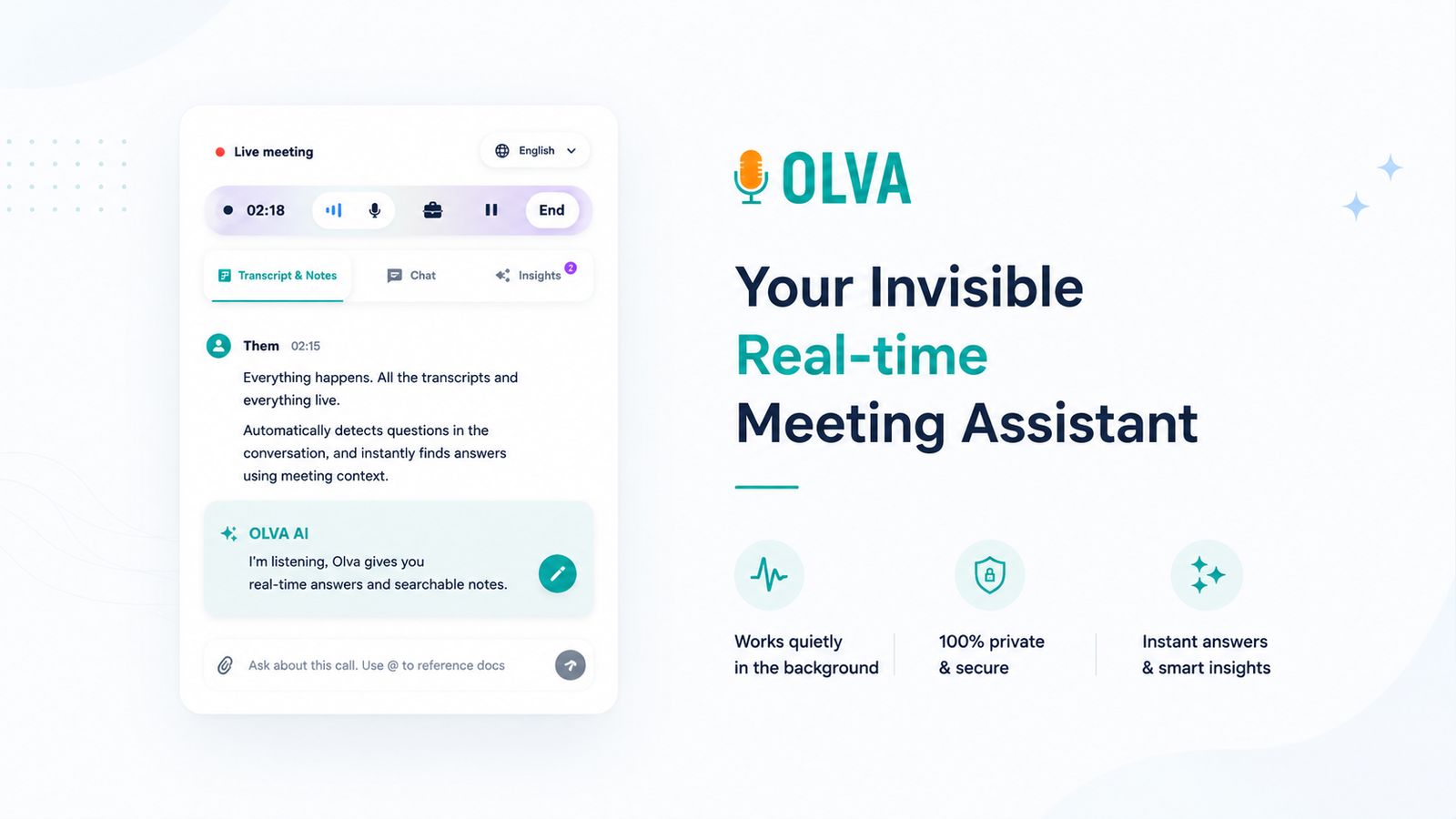
Monetizing audio and live events has moved beyond advertising marketplaces and post‑event analytics. For podcasters, webinar hosts, content creators, and community managers, the most valuable signals—audience pain points, buying intent, and sponsor fit—often emerge in real time. The challenge is hearing them and acting on them while the conversation is still happening.
This article explains how to detect sponsorship opportunities and audience pain points during shows, why live meeting intelligence changes the game, and practical workflows you can use today. Examples are tailored to podcasters, webinar hosts, and community managers, and highlight how modern tools (including invisible, real‑time assistants) help creators convert moments into revenue.
Visit https://olva.ai to learn more about live meeting intelligence built for in‑meeting support.
Why real-time intelligence matters for monetization
Traditional approaches to monetization rely on post‑event analytics: download numbers, engagement graphs, and manual review of transcripts. Those are necessary, but they miss two things:
- Timing: Sponsorship conversations and purchase intent are fleeting. If you don’t capture and act while the moment is hot, you miss higher conversion rates.
- Context: A transcript shows words. It doesn’t always highlight whether that comment represents a genuine pain point, a passing mention, or a strategic opportunity.
Live meeting intelligence solves both problems by listening, interpreting, and surfacing actionable signals while the conversation is still happening. That changes monetization from reactive (analyzing after the fact) to proactive (responding in the moment).
Key signals that lead to sponsorships and revenue
When monetizing shows, focus on these high-value signals:
- Explicit sponsorship cues: Audience members or guests asking about products, tools, or services repeatedly.
- Pain points: Recurrent frustrations, unmet needs, and expressed budgets—especially when multiple participants bring up the same issue.
- Buying intent: Questions like “Where can I buy this?” or “How much would that cost?” are direct signals.
- Influencer mentions: Guests who have influence in a niche can be co‑sponsors or referrers.
- Researchable quotes: Strong, quotable statements that sponsors can use in assets.
Detecting these in real time turns casual conversation into monetization opportunities.
Common tools creators use — and where they fall short
Many creators already use tools such as Otter.ai, Descript, Fireflies, and Rev for transcription and editing. These tools are excellent at producing high‑quality transcripts, searchable archives, and editing workflows for repurposing content.
What they do well:
- Accurate post‑meeting transcripts and captions.
- Editing and publishing workflows for repurposed clips.
- Integrations with podcast hosting platforms and video editors.
Where they often fall short for live monetization:
- Passive insights: Most tools focus on recording and summarizing rather than surfacing opportunistic moments while live.
- No in‑meeting coaching: They don’t suggest how to respond to questions or how to frame sponsorship asks.
- Visible bot participants: Tools that join meetings as a bot can be awkward for sensitive conversations and may affect participant behavior.
Acknowledging these strengths helps place the next wave of tools in context: creators still need transcripts and editability, but to monetize more effectively they also need live, contextual assistance.
How live meeting intelligence works (simple overview)
Live meeting intelligence systems combine several capabilities:
- Live transcription: Convert spoken words into text instantly.
- Automatic question and signal detection: Flag objections, product mentions, pricing questions, and emotional cues.
- Opportunity detection: Use conversation context and pattern recognition to classify sponsorship fit and buying intent.
- Instant answers and coaching: Provide suggested replies, follow‑up questions, or sponsor matches in real time.
- Document awareness: Use sponsor briefs, product catalogs, or past episode data to ground recommendations.
Together these capabilities let creators identify and act on the most monetizable moments.
Practical workflows for podcasters and webinar hosts
Below are concrete workflows showing how to use live intelligence to monetize shows, with examples that require minimal setup.
- Capture sponsor fit during a live guest interview
- Setup: Upload sponsor one‑pagers or brand guidelines into your assistant’s document store before the interview.
- During the interview: Live transcription and automatic detection flag when the guest mentions problems that match sponsor solutions (e.g., “We struggle with onboarding new users” for a SaaS sponsor that sells onboarding tooling).
- In‑moment action: The assistant surfaces a discreet on‑screen suggestion: “Guest mentions onboarding friction—this matches SponsorX’s product. Suggested phrasing to introduce SponsorX after the segment.”
- Result: You offer a tailored, natural sponsorship pitch near the point of relevance, increasing conversions.
Example: A SaaS founder says, “We don’t have a reliable churn prediction tool.” Your assistant shows: “Sponsor Recommendation: PredictAI—offers churn prediction. Suggest: ‘Before the break, a quick word about PredictAI…’” You pivot and include a brief, relevant ad, which resonates with listeners.
- Turn audience Q&A into paid offers
- Setup: For live webinars with Q&A, set the assistant to detect buying intent and rank questions by intent.
- During the webinar: When multiple attendees ask similar questions about pricing or integrations, the assistant highlights a pattern and suggests upsell or sponsor options.
- In‑moment action: Offer a limited‑time discount code from a sponsor or an immediate call‑to‑action that converts higher because it’s contextual.
Example: Three attendees ask about advanced analytics. The assistant surfaces this as an opportunity and suggests: “Offer sponsor discount code for AnalyticsPro; announce now during Q&A.”
- Community rooms and recurring shows: spot recurring pain points
- Setup: Connect your assistant to your recurring community sessions and upload product roadmaps or sponsor catalogs.
- During sessions: Automatic opportunity detection finds repeated pain points across episodes, flagging trends such as “billing issues” or “user onboarding.”
- In‑moment action: Prompt hosts with follow‑up questions to probe budget and decision timelines, creating qualifying leads to pass to sponsors or partners.
Result: Sponsors receive pre‑qualified leads and creators can negotiate higher CPMs or affiliate deals because they bring verified intent.
Live Q&A and AI coaching: say the right thing at the right moment
The words you use to introduce sponsorships matter. Live Q&A and AI coaching provide suggested phrasing, objection handling, and timing cues.
- Suggested phrasing: Short, contextual ad copy that feels organic to the conversation.
- Objection handling: If a listener or guest questions sponsor credibility, AI coaching offers facts or brief case studies to counter concerns.
- Timing cues: The assistant recommends when to introduce a sponsorship based on attention cycles (e.g., immediately after a high‑engagement moment).
This elevates monetization from interruptive ads to contextual recommendations that feel valuable to listeners.
Fact checking and document‑aware intelligence: increase sponsor confidence
Sponsors want assurance that placements will reach the right audience and that claims made during shows are accurate. Real‑time fact checking and document awareness can:
- Verify claims before you amplify them on behalf of a sponsor.
- Pull sponsor assets—taglines, official facts, promo codes—so hosts use exactly the language sponsors require.
- Provide context: If a guest claims “40% of users prefer X,” instant fact checks can verify whether that aligns with sponsored research.
This reduces sponsor risk and increases trust when negotiating deals.
Privacy and audience trust
Many creators worry about privacy—both for their guests and their communities. Choose solutions that respect private conversations:
- Invisible assistant modes: no visible bot joining the conversation, avoiding distraction or participant discomfort.
- User‑controlled transcripts: transcripts can be deleted or kept private to the host.
- Transparency with your audience: disclose when you’re using tools to surface sponsorship opportunities or capture Q&A.
Respect for privacy preserves community trust while enabling monetization.
Measuring impact: KPIs to track in real time and after the show
To evaluate whether live intelligence improves monetization, track both immediate and long‑term metrics:
- Immediate KPIs: sponsor leads generated during the show, promo codes used within 24–72 hours, live conversion rate for on‑the‑spot offers.
- Engagement KPIs: retention rate during sponsor mentions, audience sentiment during and after ad reads.
- Revenue KPIs: average CPM for contextual segments, affiliate revenue tied to live offers, sponsored episode conversion rate.
Use these metrics to refine when to surface opportunities, which sponsors perform best in context, and how to price future deals.
Competitor landscape: fair comparison
Tools like Otter.ai, Descript, Fireflies, and Rev provide best‑in‑class transcription, editing, and post‑production workflows. They make repurposing content and creating show notes easier, which remains essential for long‑term discoverability and SEO.
Where creators need additional help for monetization:
- Live detection and action: many competitors focus on post‑meeting analysis rather than surfacing opportunities during the session.
- In‑moment coaching: few provide real‑time suggested responses or sponsor pitches tied to live context.
- Invisible, privacy‑first operation: some solutions join as visible bots, which can alter participant behavior.
Olva complements the strengths of these tools by emphasizing live, invisible assistance that detects sponsorship signals, surfaces instant answers, and coaches hosts while the conversation is happening—without adding visible participants or breaking audience trust. That makes it easier to convert attention into revenue organically and ethically.
Real creator examples (practical and repeatable)
- The Niche Tech Podcast
- Situation: During a live interview, a guest describes the difficulty of managing device provisioning.
- Live action: The assistant detects a vendor match, suggests a short, contextual ad, and provides a sponsor code.
- Outcome: The host reads the ad immediately, listeners use the code, and the sponsor sees a measurable spike tied to the episode.
- A Product Webinar Series
- Situation: Multiple attendees ask about pricing and integration during the Q&A.
- Live action: The assistant flags high buying intent and prompts the host to offer an exclusive sponsor discount.
- Outcome: Conversion rates for the webinar increase; the sponsor pays a premium for future placements.
- Community Office Hours
- Situation: Recurring mentions of a specific pain point surface across several sessions.
- Live action: The assistant aggregates the trend and suggests outreach to a sponsor with a matching solution.
- Outcome: The creator negotiates a value‑based sponsorship tied to lead generation rather than simple impressions.
Getting started checklist
- Prepare sponsor materials and upload them to your assistant’s document store.
- Configure automatic detection for keywords related to pain points and sponsorship categories.
- Test invisible operation mode before going live to ensure guests aren’t distracted.
- Define conversion metrics (promo codes, signups, leads) and set up tracking.
- Run a pilot episode or webinar with one sponsor and measure impact.
Conclusion
Monetization for podcasters, webinar hosts, and community managers is moving from post‑hoc analytics to in‑moment intelligence. Detecting sponsorship opportunities and audience pain points in real time increases conversion rates, creates better sponsor experiences, and preserves audience trust.
Combining live transcription, automatic question and opportunity detection, instant answers, AI coaching, and document‑aware intelligence turns conversations into revenue without breaking the flow of your show. Tools that operate invisibly and respect privacy enable natural, contextual sponsor integrations that feel valuable rather than intrusive.
For creators ready to act on signals the moment they appear, live meeting intelligence is the next evolution in show monetization. Learn how to adopt live assistance and test contextual sponsorships at https://olva.ai.
References and further reading
- Best practices for sponsor integrations in podcasts and webinars
- Measuring ROI on live promotions and affiliate programs
- How to design conversational ad reads that convert