Hybrid & Remote Selling: Using Invisible AI to Run Seamless Cross-Functional Sales Meetings
The shift to hybrid and fully remote selling has changed more than where reps sit — it’s changed how deals get won. Cross-functional meetings that once happened in conference rooms now run across time zones, video platforms, and shared documents. Those sessions are high-value: customer discovery calls, technical deep dives, pricing negotiations, executive alignment meetings. They’re also easy to derail when people talk past each other, questions go unanswered, or a product detail is misremembered.
This article explains practical ways remote sales teams, sales ops, product managers, technical teams, and executives can run seamless cross-functional sales meetings using invisible AI assistance. It focuses on real-world workflows and the live capabilities that matter during the meeting — not just after it ends — and shows how tools like Olva (https://olva.ai) change the outcome by helping teams perform better in the moment.
Why cross-functional meetings break down in hybrid settings
Remote meetings introduce friction that amplifies common cross-functional issues:
- Diffused attention: Participants multitask, miss cues, and lose context.
- Fragmented information: Product specs, pricing sheets, and past notes live in different systems.
- Slow fact-checking: Answers that require digging through docs or past calls introduce long pauses or risky guesses.
- Role confusion: Sales, engineering, and product each prioritize different questions and may not surface the most relevant follow-ups.
Traditional meeting tech—video conferencing, recording, and post-meeting transcription—helps with memory. That’s valuable. But what matters most for close rates and relationship-building is performance during the meeting: answering questions accurately, identifying buying signals, and steering the conversation toward the next step.
What good looks like: outcomes you should expect
A successful cross-functional sales meeting should:
- Answer customer questions confidently and accurately in real time.
- Surface and act on buy signals during the call.
- Keep meetings focused and on agenda without stifling discovery.
- Ensure engineering and product concerns are handled without derailing the sale.
- Leave everyone clear on next steps and ownership.
Achieving those outcomes requires live intelligence — assistance that operates invisibly during the meeting and augments the human contributors rather than replacing them.
Competitors: what they do well (and where they stop)
Tools like Gong, Chorus, Zoom, and Otter have raised the bar for meeting capture. Strengths include:
- Reliable recording and post-meeting transcription.
- Conversation analytics and deal intelligence surfaced after the call.
- Repository for searchable meeting artifacts.
Those capabilities are critical for coaching, pipeline hygiene, and organizational memory. But they focus primarily on remembering and analyzing what happened. In remote cross-functional selling, the more urgent need is assistance during the meeting: detecting questions, supplying accurate answers, guiding follow-ups, and spotting buying signals in real time.
Invisible AI: the difference between remembering and performing
Invisible AI is designed to help the meeting participant while the conversation is happening — without joining as a disruptive bot or creating awkward notifications. This distinction is crucial for cross-functional sales meetings where timing and privacy matter.
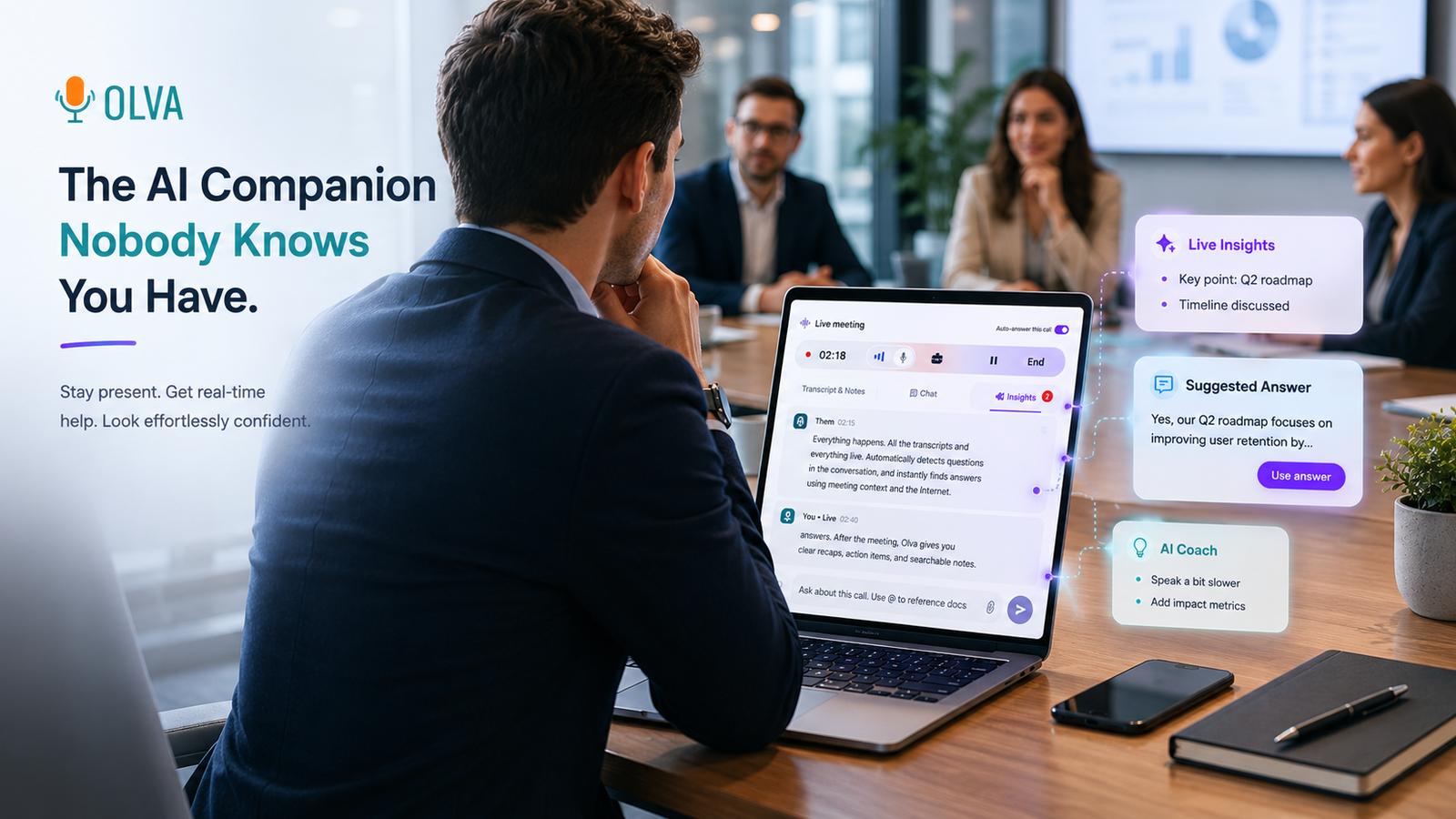
Key features of invisible AI that change the game:
- Live transcription that captures all voices so participants can stay focused.
- Automatic question detection that flags objections and technical queries the moment they arise.
- Instant answers informed by meeting context and uploaded documents (e.g., product spec, SOW, pricing sheet).
- Live insights like opportunity detection and suggested follow-ups.
- Private AI coaching that proposes phrasing, clarifications, or escalation paths in real time.
Olva embodies these capabilities as an invisible assistant that acts while the meeting is happening, which helps teams perform better instead of just remembering later.
Practical scenarios and examples
Below are concrete examples that illustrate how invisible AI improves hybrid and remote cross-functional meetings.
Scenario 1 — Technical deep-dive with a skeptical engineer
A customer asks a detailed question about API rate limits during a screen-shared demo. The sales engineer hesitates because they don’t recall exact thresholds.
How invisible AI helps:
- Automatic question detection flags the question and highlights it for the rep.
- Document-aware intelligence pulls the API spec uploaded before the call and surfaces the exact rate-limit numbers as an instant answer.
- AI coaching suggests a concise response that includes the numbers and a recommended follow-up: "Would it help if I showed how retries are handled in our SDK?"
Outcome: The rep answers confidently, demonstrates technical competence, and keeps the meeting on momentum.
Scenario 2 — Executive alignment with competing priorities
An executive from the prospect asks about ROI and integration timelines while the product manager and engineer discuss feasibility.
How invisible AI helps:
- Live insights detect purchasing intent in the executive’s phrasing and flags an opportunity.
- A suggested follow-up prompts the rep to clarify budget timing and decision criteria.
- Fact-checking cross-references uploaded case studies and presents a concise ROI snippet the rep can quote.
Outcome: The team shifts from debating feasibility to defining a timeline and decision owner, shortening the sales cycle.
Scenario 3 — Pricing negotiation with ambiguous terms
During a pricing discussion, the customer asks about discount eligibility and contractual SLA terms.
How invisible AI helps:
- Automatic question detection recognizes pricing and legal queries and surfaces the relevant contract clause from the uploaded enterprise agreement.
- Instant answers provide the correct eligibility criteria, and AI coaching suggests phrasing that preserves leverage while remaining collaborative.
Outcome: The sales team responds accurately without pausing the conversation to search for documents.
Practical playbook for running better hybrid cross-functional meetings
- Prepare shared artifacts ahead of time
- Upload key documents (product specs, pricing grid, standard contract) to your meeting assistant. Document-aware intelligence will use them during the call.
- Define roles and an agenda
- Decide who owns demo, technical answers, and next steps. Even with AI support, clarity reduces interruptions.
- Use live transcription to maintain focus
- Let transcription capture details so participants can stay present and rely on searchable text later.
- Let automatic question detection surface what matters
- When the assistant marks a detected objection or technical question, address it immediately or assign an owner to answer within a time-box.
- Leverage instant answers and AI coaching tactically
- Use suggested responses to maintain pace and accuracy. If the AI pulls an answer from a spec or previous call, read it succinctly and confirm with the customer.
- Act on live insights
- If the assistant detects buying signals or an escalation risk, prioritize follow-ups and explicitly capture next steps before the meeting closes.
- Post-meeting: use memory wisely
- After the call, exports should reflect decisions, action owners, and any AI-detected open questions. Keep memory searchable so future meetings build on what happened.
Privacy and etiquette in remote selling
Invisible AI should be private by design. For cross-functional meetings involving customers or sensitive technical details, the assistant must operate without appearing as a bot participant or broadcasting that an AI is listening to everyone. Best practices:
- Keep AI private to meeting participants who have explicitly enabled it.
- Allow transcript and data deletion to respect security policies.
- Transparently document what the assistant does in your internal playbook so team members understand scope and limits.
Olva follows these principles by working without bot participants and letting users control their transcripts and data.
Measuring success: KPIs that improve when meetings perform better
Track metrics that reflect in-meeting performance rather than post-meeting recall:
- Time to close after first cross-functional call.
- Percentage of meetings that reach a defined next step (e.g., technical POC, procurement review).
- Rate of resolved technical objections within the initial call.
- Reduction in multi-meeting clarification cycles.
Improvements in these KPIs are better predictors of revenue velocity than raw transcript volume or recording counts.
Where invisible AI complements existing tools
Recording and analytics platforms remain valuable for coaching and pipeline analysis. Invisible AI is not a replacement; it’s complementary:
- Use recording tools to capture sessions for organizational memory.
- Use invisible AI during the meeting to help participants respond in real time and to reduce the need for follow-ups.
For teams that already rely on post-call insights, adding live assistance closes the gap between knowing and doing.
Final checklist: run a seamless hybrid cross-functional meeting
- Upload relevant documents to your meeting assistant.
- Confirm roles and agenda with internal participants.
- Turn on live transcription and invisible AI support before the customer joins.
- Monitor automatic question detection and act on flagged objections.
- Use instant answers from documents to respond accurately.
- Capture suggested follow-ups and ownership in the meeting notes.
- Review post-meeting memory to prepare the next touchpoint.
Conclusion
Hybrid and remote selling requires more than better recordings and cleaner transcripts. It requires live performance: the ability to answer questions precisely, detect buying signals, and guide cross-functional participants to aligned decisions in real time. Invisible AI — intelligent, private, and document-aware — augments human teams during the meeting itself, turning fragmented hybrid interactions into decisive, forward-moving conversations.
When remote sales reps, product managers, and engineers are supported by live transcription, automatic question detection, instant answers, and AI coaching, meetings become engines for momentum rather than repositories for memory. Tools like Olva (https://olva.ai) demonstrate how meeting intelligence can be both invisible and indispensable, helping teams not just remember what was said, but win what matters next.