From Classroom to Conference Room: AI Coaching for Autistic Junior Employees and Students
Transitioning from school to work is challenging for any junior professional — but for autistic students and early-career employees, the shift often brings additional social, communication, and sensory hurdles. Organizations that want to build inclusive teams must go beyond generic training and provide practical, real-time support that helps autistic people perform their best in live interactions: classroom presentations, team stand-ups, client calls, interviews, and cross-functional meetings.
This article explains how AI coaching—designed for in-the-moment assistance—can reduce anxiety, improve communication, and accelerate career readiness for autistic junior employees and students. It presents practical examples for educators, managers, recruiters, and product or technical teams, compares common meeting tools fairly, and highlights how an invisible, real-time assistant (like Olva) fills critical gaps that post-meeting tools miss.
Why real-time support matters
Many accessibility accommodations focus on adjustments outside meetings: written instructions, extra time on tests, or flexible schedules. Those are essential. But social communication and quick back-and-forth in live conversations are where autistic people often need immediate cues and structure:
- Understanding when to interject or defer in a fast-paced discussion
- Translating vague questions into specific tasks
- Handling unexpected objections during a presentation
- Managing sensory overload from rapid speaker changes or noisy calls
Support that arrives only after a meeting—summaries or transcripts—can help with reflection and follow-up. But it doesn’t help the person in the moment when they need to choose words, ask clarifying questions, or interpret social signals. That’s why live AI coaching is so valuable: it offers private, contextual guidance while the interaction is happening.
What effective AI coaching looks like for autistic junior employees
Accessible AI coaching for meetings should include several core capabilities:
- Invisible assistance that won’t call attention to the user or create awkward bot participants
- Live transcription so users can track the conversation visually while listening
- Automatic question detection to highlight points that require a response or clarification
- Instant, context-aware suggested responses and follow-up questions
- Document-aware answers that use uploaded job aids, product docs, or class materials
- Post-meeting memory for later reflection and targeted coaching
When combined, these features help a junior employee or student bridge the gap between understanding content and participating confidently.
Practical scenarios and examples
- Classroom presentation practice
Scenario: A student with social anxiety and autism must present a short project. They often struggle with pacing and responding to audience questions.
How AI helps:
- Live transcription provides a visual cue of how long their sentences are and reveals audience interruptions.
- The assistant suggests real-time pacing tips (e.g., “Slow down; you’re speaking quickly”) and auto-detects audience questions, offering short, rehearsed answers from the student’s uploaded notes.
- After the practice, the student receives specific action items (e.g., “Pause after each slide, invite one question, rehearse the two flagged Q&A points”).
- First client call in a junior sales role
Scenario: A newly hired junior account exec with autism wants to contribute in a customer call but worries about interrupting or missing buying signals.
How AI helps:
- Invisible assistance listens and highlights potential buying signals and objections in real time.
- Automatic question detection notifies the user when the customer asks a pricing or scope question and offers short, on-brand phrasing to respond.
- If the user needs extra context, Live Q&A can fetch a summary of the last five minutes or pull answers from uploaded product docs.
- Team stand-up in a noisy open office
Scenario: A junior developer with auditory processing differences struggles to follow rapid updates in a daily stand-up.
How AI helps:
- Live transcription gives a scrollable record the developer can glance at while listening.
- The assistant surfaces suggested clarifying questions (e.g., “Do you need help with the API change?”) and flags any requests assigned to the developer for quick confirmation.
- Post-meeting memory creates a searchable history so nothing is lost and follow-up is straightforward.
Manager and educator best practices for deploying AI coaching
- Ask first, personalize second: Always discuss tools and accommodations with the individual. Some users will welcome live AI support; others may prefer different options.
- Integrate training into onboarding and classroom activities: Allow practice sessions where junior employees or students can learn how to use live prompts, adjust reply styles, and control privacy settings.
- Combine human coaching with AI: Pair AI prompts with mentorship check-ins. Coaches can review AI-suggested improvements and adapt them to the person’s communication style.
- Make documents available: Uploading pitch decks, syllabi, job aids, or code docs turns AI into a document-aware assistant able to answer specific, accurate questions during conversation.
Fair comparison with other meeting tools
Many established tools—Otter.ai, Rev, Gong, Fireflies—offer excellent capabilities for transcription, recording, and post-meeting summaries. Those features are invaluable for accessibility and review. They help users revisit content, prepare for follow-ups, and document decisions.
Where typical tools fall short for autistic junior professionals:
- Most focus on after-the-fact intelligence rather than in-the-moment coaching.
- They often appear as meeting participants or produce visible recordings that can increase anxiety for some users.
- They may highlight what was said but don’t actively guide what to say next or how to react socially.
How real-time AI coaching fills the gap
An assistant designed for live support builds on those strengths and adds:
- Invisible AI Assistant: private support without a visible bot joining the meeting, reducing social stigma and distractions.
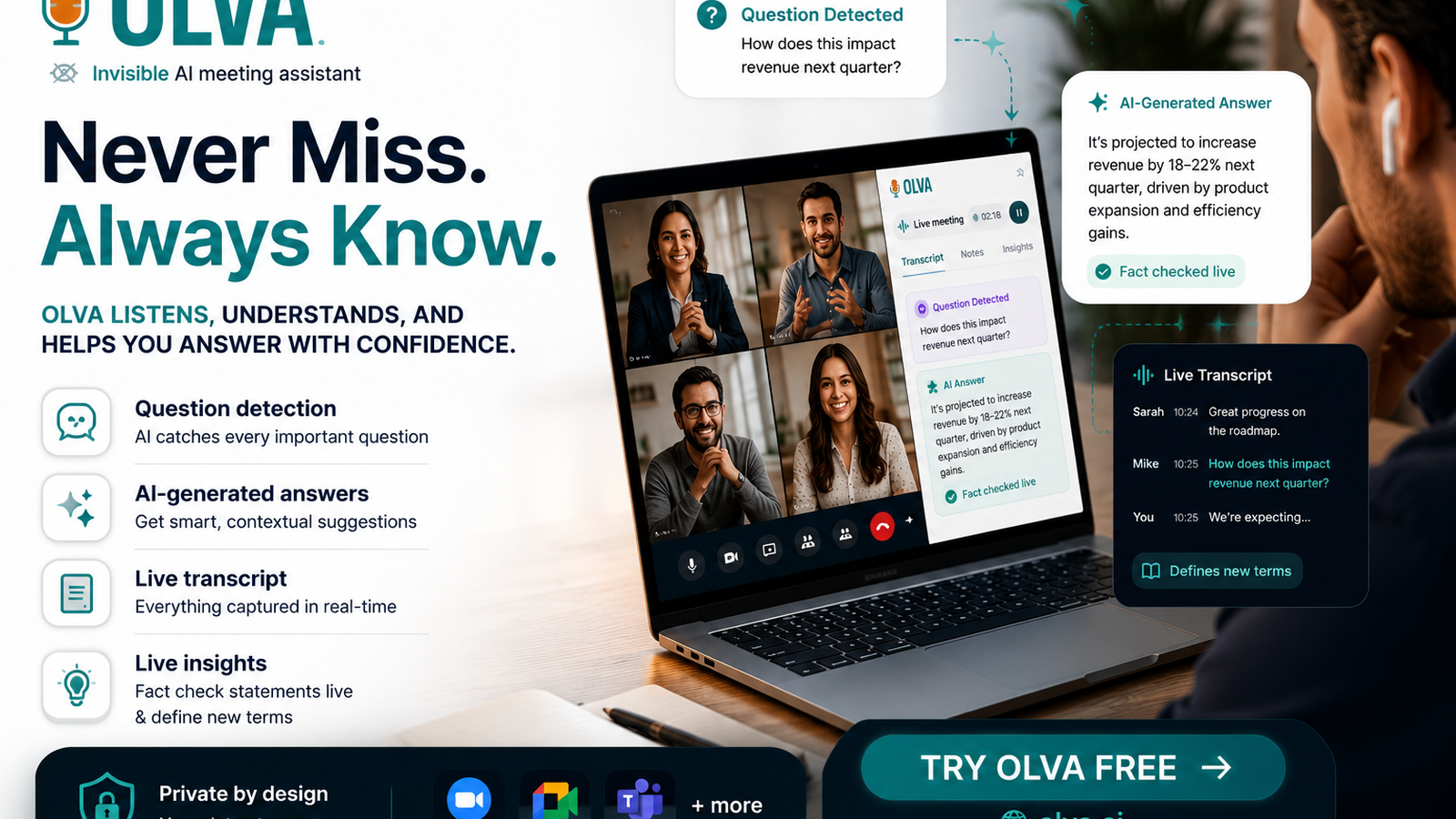
- Automatic Question Detection + Instant Answers: when a question is detected, the assistant proposes accurate, context-aware responses that reference uploaded documents or prior meetings.
- Live Insights & Opportunity Detection: beyond transcription, the assistant identifies emerging risks, potential follow-ups, or buying signals—helpful for junior employees who are still learning to read conversational cues.
- AI Coaching: on-the-fly suggestions for phrasing, asking clarifying questions, and handling objections in a way that respects the user’s communication preferences.
These differences make real-time AI coaching especially powerful for autistic junior staff who need subtle, private, and immediate support.
Privacy and dignity: why invisibility matters
For many autistic individuals, being singled out during a meeting can increase stress. Tools that join meetings as visible participants, flash notifications, or automatically record every interaction may feel intrusive.
An invisible assistant that provides private, local-facing guidance protects dignity while still delivering value. Important privacy considerations include:
- No visible bot participants or awkward notifications in meetings
- User-only access to transcripts with easy deletion options
- Clear controls for when the assistant listens and when it’s offline
These guardrails let users choose when and how to receive support without drawing attention to themselves.
Implementation checklist for teams and educators
- Assess needs: Survey students and junior employees about communication challenges and preferred accommodations.
- Pilot with volunteers: Start small with a pilot group to collect feedback on usability, phrasing suggestions, and privacy preferences.
- Prepare content: Upload common documents (syllabi, onboarding guides, product sheets) so the assistant’s answers are accurate and context-aware.
- Train mentors: Show managers and educators how to interpret AI-driven insights and incorporate them into human coaching.
- Measure outcomes: Track confidence, participation rates in meetings, and early career retention for participants using live AI coaching.
Real-world benefits (evidence-informed expectations)
- Increased participation: Visual and textual cues lower the barrier to speaking up in meetings.
- Faster ramp time: Instant, contextual prompts reduce uncertainty and accelerate role learning.
- Fewer misunderstandings: Live clarification suggestions and fact checking reduce mistakes from misheard requests.
- Better confidence: Private coaching builds communication skills without public correction.
A final note on design and ethics
When deploying AI coaching for autistic users, prioritize consent, transparency, and customization. Ensure the assistant is configurable: users should control verbosity, phrasing tone (concise vs. elaborative), and privacy levels. Regularly review the system’s suggested language for neurodiversity-affirming phrasing and avoid recommendations that pressure users to conform to a narrow communication norm.
Conclusion
Moving from the classroom to the conference room is not just a change of venue—it’s a change in expectations, pace, and social norms. Autistic junior employees and students can thrive with supports that work when they need them: during the conversation.
Real-time, invisible AI coaching provides private, contextual help—live transcription for clarity, automatic question detection to spot critical moments, instant answers using uploaded documents, and strategic, on-the-fly coaching to suggest phrasing or follow-ups. These features reduce anxiety, improve participation, and accelerate professional growth while preserving privacy and dignity.
For teams and educators building inclusive environments, pairing human mentorship with live AI coaching is a practical, scalable way to level the playing field. Tools that only summarize meetings afterward are valuable, but the next generation of meeting assistants helps people perform better in the moment.
Explore how live meeting intelligence can support neurodiverse talent at https://olva.ai — and consider trials that center consent, customization, and human oversight as you design accommodations and training programs.